



Executive Roll Top
An executive roll top offers serious workspace and clever storage, hiding paperwork behind a smooth wooden curve.
Executive Roll Top
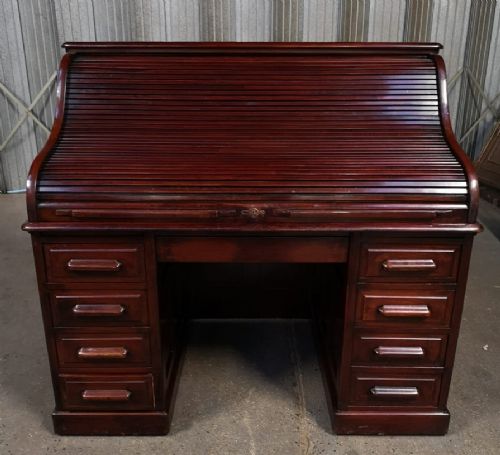
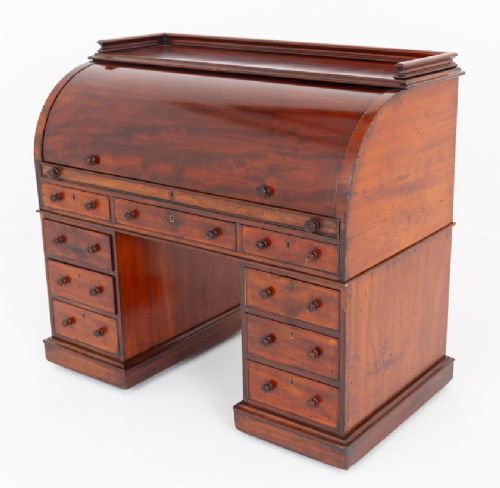
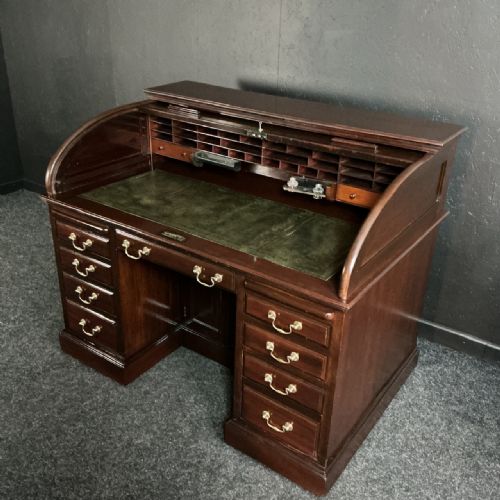
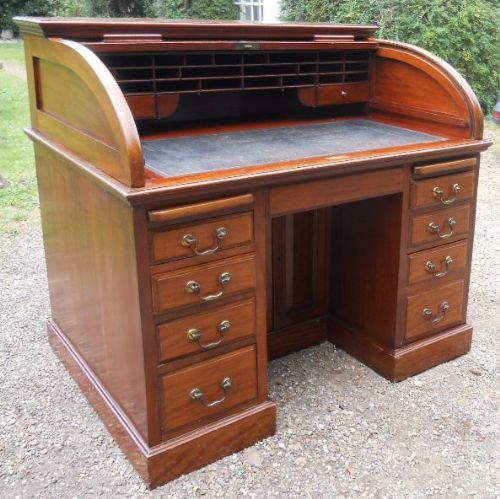
When you search for an executive roll top, you are looking at substantial desks designed to organise large amounts of correspondence and paperwork. The main feature is a tambour shutter or solid cylinder that pulls down to conceal the working surface and pigeonholes.
The pieces on this page span the Victorian and Edwardian eras, alongside William IV examples. You will most frequently meet mahogany and walnut constructions, often configured as large kneehole desks.
Origins range from British workshops to American makers such as the Boston Chair Company. These desks served demanding professional environments where privacy and secure storage mattered as much as a grand appearance.
How they were made
Cabinet makers built these desks using solid timbers like mahogany and walnut, frequently selecting burr walnut veneers for visual depth. Drawer linings often utilised secondary woods, while internal fittings included satinwood drawers and letter compartments.
The rolling mechanism relies on tambour slats glued to canvas backing, allowing the flexible curtain to travel smoothly along concealed grooves. Brass hardware, including locks and drop handles, completed the construction.
Executive Roll Top Retail Price Guide 2026
Typical asking prices for executive roll top among the pieces listed under this phrase on Sellingantiques today, from the lower quarter to the upper quarter. They describe what is for sale here now, not the wider market.
Listings feature Victorian and Edwardian periods alongside William IV, constructed primarily in mahogany and walnut with brass and leather details.
What varies in quality
The distinction between ordinary and exceptional examples rests on the quality of the timber selection and the precision of the tambour mechanism. Superior desks exhibit tightly matched veneers and smooth, effortless action in the rolling shutter.
Internal complexity also sets pieces apart, with better desks featuring intricate pigeonhole layouts and subsidiary drawers executed in contrasting woods. The integrity of the original locking mechanisms and fitted leather writing surfaces further define the upper tier.
Boston Chair Company
The Executive Roll Top Glossary
- Tambour
- A flexible shutter made of narrow wooden slats attached to canvas, allowing it to curve around a track and conceal the desk interior. This technique requires precise joinery to ensure smooth operation over decades of use.
- Kneehole desk
- A freestanding desk with a central recess for the user's legs, flanked by pedestals of drawers on both sides. This form provides substantial storage while maintaining a formal presence in a room.
- Cylinder desk
- A desk featuring a solid, quarter-circle wooden cylinder that rolls back to reveal the writing surface, differing from the slat-based tambour. It represents a more formal mechanism found in fine nineteenth-century examples.
- Pigeonhole
- A small compartment within the desk superstructure used for sorting letters and documents. In executive desks, these are often arranged in tiered banks with miniature drawers.
Executive Roll Top: Frequently Asked Questions
What is an executive roll top desk?
An executive roll top is a large nineteenth or early twentieth-century desk featuring a slatted or solid wooden cover that pulls down to lock away papers. They were built for offices and studies to keep work organised and private.
These desks typically include numerous internal drawers and pigeonholes behind the main roll. They combine heavy timber construction with complex joinery to house paperwork securely.
How do I operate the roll top mechanism?
The rolling shutter, known as a tambour, runs along curved tracks cut into the sides of the desk. Pulling the handle downward guides the slats smoothly over the desk interior.
Regular use benefits from clean tracks and occasional light maintenance. The mechanism relies on the flexibility of the canvas backing behind the wooden slats.
How do I date these desks?
Dating relies on timber choices, construction methods, and stylistic cues from periods like the Victorian and Edwardian eras. Earlier pieces often feature solid mahogany and hand-cut dovetails.
Later Edwardian examples may show different secondary woods and lighter internal fittings. Maker marks and brass hardware styles also help narrow down the decade of manufacture.
Where should I place it in a room?
Because many executive desks are finished on all sides or feature panelled backs, they can stand proudly in the centre of a room rather than flat against a wall. Ensure you measure the floor space to accommodate the chair and allow the drawers to open fully.
Keep the desk away from direct heat sources and strong sunlight to protect the polish and prevent the timber from drying out.