
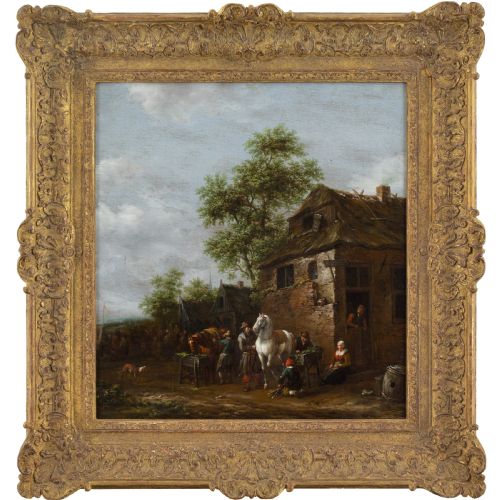
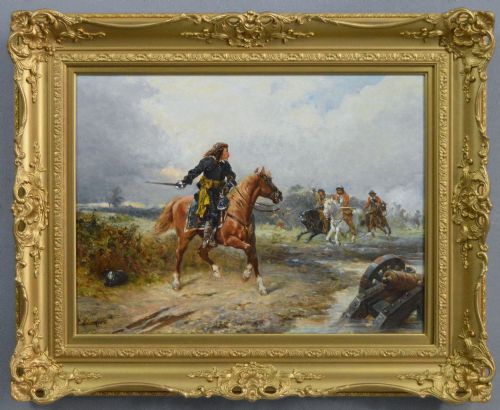


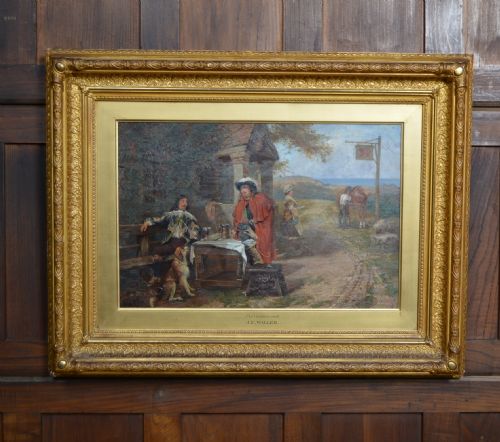

Equestrian Genre Oil Painting
An equestrian genre oil painting brings the movement, labour and atmosphere of horses, riders and rural life directly onto the wall.
Equestrian Genre Oil Painting
When you search for an equestrian genre oil painting, you encounter nineteenth and early twentieth-century canvases depicting horses working, resting or moving through rural landscapes and village scenes. These works capture everyday interactions between people, animals and horses in settings such as blacksmiths, farmyards and country lanes.
You are most likely to meet Victorian and Edwardian examples rendered in oil on canvas, frequently housed within period giltwood frames. The subjects range from heavy working horses and cart teams to hunting parties and Andalucian riders.
The compositions blend animal portraiture with human narrative, placing horses alongside ploughmen, blacksmiths, tavern patrons and country folk. They reflect nineteenth-century realism and pastoral traditions originating from English, French and Spanish studios.
How They Were Made
These works rely on oil paint applied to stretched canvas, utilising the slow-drying properties of the medium to build depth through layered glazes and opaque brushwork. Painters achieved texture in coats of horses, straw and wooden carts by varying brush pressure and paint thickness.
Frames play a structural and aesthetic role, most commonly constructed from wood and finished in giltwood to catch and reflect light across the canvas surface. The combination of durable canvas supports and oil pigments has ensured the survival of these rural and historical scenes through the nineteenth century and beyond.
Several canvases manage to squeeze pigs, goats, poultry and cattle alongside the requisite horses, proving that rural nineteenth-century farmyards were delightfully crowded places.
What Varies in Quality
Quality reveals itself in the anatomical accuracy of the horses and the natural integration of figures within the landscape or interior setting. Master painters command perspective and light, rendering the strain of heavy horses or the quiet atmosphere of a barnyard with anatomical precision.
The handling of secondary details - such as farm implements, dogs, foliage and architectural elements - separates accomplished canvases from routine workshop production. Furthermore, the originality of the period frame contributes significantly to the integrity and visual weight of the piece.
John Arthur Lomax·John Sanderson Wells·Léon Joseph Voirin·Arthur Longley Vernon·Edward Brice Stanley Montefiore·Gilbert Scott Wright·Vernon Stokes·Heywood Hardy·John Frederick Herring Jnr·Thomas Blinks·George Cole
The Equestrian Genre Oil Painting Glossary
- Genre painting
- A style of art depicting scenes from ordinary life, including figures working, socialising or resting in domestic and rural environments.
- Giltwood
- Wood, typically carved timber, coated with gold leaf or metallic gilding to form decorative picture frames during the nineteenth century.
- Impasto
- Paint applied thickly to a canvas, standing out from the surface so that the brush or palette knife marks remain visible.
- Provenance
- The documented history of ownership of a painting, tracing its journey from the artist's studio to the present marketplace.
- Pastoral
- A genre of art depicting rural life and landscapes, often celebrating the perceived peace and simplicity of agricultural existence.
Equestrian Genre Oil Painting: Frequently Asked Questions
What subjects appear in these paintings?
These canvases depict horses engaged in heavy labour, ploughing fields, visiting blacksmiths or resting near barns alongside figures and farm animals.
Scenes also extend to hunting parties, tavern gatherings and pastoral landscapes featuring riders in various nineteenth-century settings.
How do I date an equestrian oil painting?
Dating relies on stylistic evidence, costume details of the human figures, artist signatures and the construction methods of the underlying canvas and frame.
Nineteenth-century works often bear specific stylistic hallmarks of Victorian realism, pastoralism or academic painting traditions.
Where were these paintings produced?
The works originate primarily from British, French and Spanish studios active during the Victorian and Edwardian eras.
Artists drew inspiration from rural landscapes, agricultural hubs, country estates and regional traditions across Europe.
How should I hang an oil painting?
Oil paintings require secure wall fixings suited to the combined weight of the stretched canvas and heavy giltwood frame.
Position the work away from direct sunlight, heating vents and damp environments to protect the canvas and oil pigments over time.