


Engraved Silver Fish Knife
An engraved silver fish knife is a specialist Victorian dining utensil designed to separate delicate fish courses, combining bright blade decoration with sturdy handles.
Engraved Silver Fish Knife
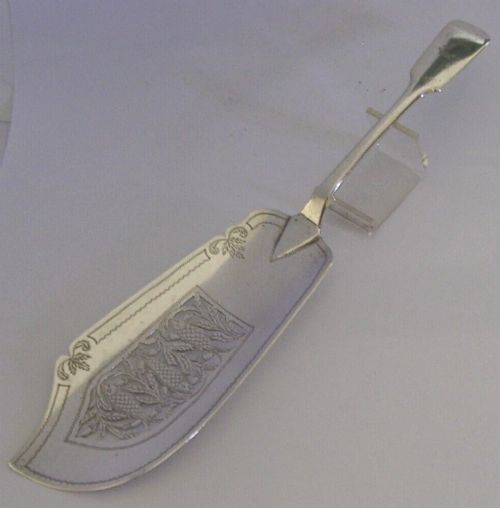
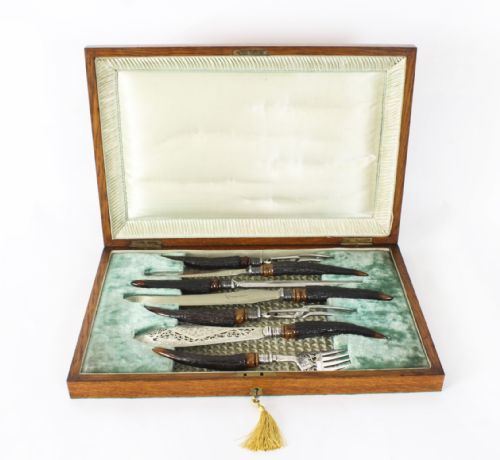
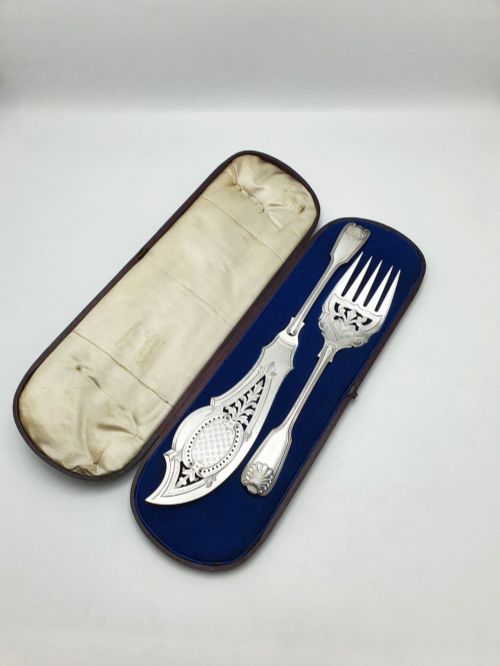
An engraved silver fish knife forms part of a specialised flatware tradition designed for formal dining tables during the nineteenth century. These pieces appear on this page as individual serving utensils, paired forks, and larger cased sets spanning the Victorian period and earlier reigns.
The primary forms include single fish slices, serving sets with matched forks, and boxed sets intended for specific courses. The Victorian era dominates the selection, alongside earlier George IV and French Restoration examples that demonstrate similar craftsmanship.
How they were made
Silversmiths utilised sterling silver and silver plate for the blades and slices, often applying intricate hand engraving alongside pierced work to depict natural motifs. Blades were shaped to glide easily beneath fish flesh without tearing the delicate texture.
Handles required contrasting materials to balance the metal weight, incorporating mother-of-pearl, wood, velvet, stag antler, and horn into the construction. These natural elements were shaped to fit the hand securely during formal dining.
The available items span the Victorian period, with occasional examples extending back to the George IV and French Restoration eras.
What varies in quality
Quality rests upon the depth and crispness of the hand engraving across the blade and the structural integrity of the joint between blade and handle. Sharper, more detailed piercing and botanical or hunting motifs indicate superior workshop output.
The choice of handle material and its preservation also distinguish pieces, with matched sets maintaining uniform colour and grain in natural horn or mother-of-pearl. Complete fitted cases add context regarding the original tier of the commission.
Charles Boyton·Henin and Cie
The Engraved Silver Fish Knife Glossary
- Sterling Silver
- An alloy consisting of pure silver and other metals to ensure durability in functional tableware. This material provides the bright reflective surface seen on nineteenth-century servers.
- Silver Plate
- A thin layer of silver fused to a base metal core through manufacturing processes common in the Victorian period. This technique offered an accessible alternative to solid silver.
- Fish Slice
- A broad, flat serving utensil with a shaped blade designed to lift portions of fish. These items often feature pierced decoration and hand engraving.
- Fiddle Pattern
- A traditional nineteenth-century flatware handle design featuring shoulders above a widening stem. This profile appears frequently on silver servers from the period.
Engraved Silver Fish Knife: Frequently Asked Questions
What is a fish knife used for?
A fish knife is a flatware piece designed specifically to lift and separate fish flesh during formal meals. The broad blade avoids the need for a sharp cutting edge, as fish requires gentle handling.
Historical examples often feature elaborate engravings of hunting scenes or natural motifs, reflecting the formal dining customs of the nineteenth century.
How do I identify a Victorian fish knife?
Victorian fish knives often feature hallmarks indicating the assay office and date letter alongside maker marks. The stylistic cues include detailed hand engraving and natural handles such as antler, horn, or mother-of-pearl.
Most pieces on the market date from the mid to late nineteenth century, aligning with the expansion of specialised dining flatware.
Are these knives made of solid silver?
These utensils are constructed from either sterling silver or silver plate over a base metal core. Hallmarks help determine whether a piece is solid silver or plated.
Both solid silver and plated versions incorporate decorative engraving and natural handles, meaning material choice does not restrict the intricacy of the design.
How should I store cased fish servers?
Cased fish servers benefit from being kept in their original fitted boxes away from direct sunlight and excessive humidity. The velvet or silk linings inside the cases help protect the metal and handle materials.
Handling the silver with clean cloths prevents tarnishing agents from transferring to the engraved surfaces.