

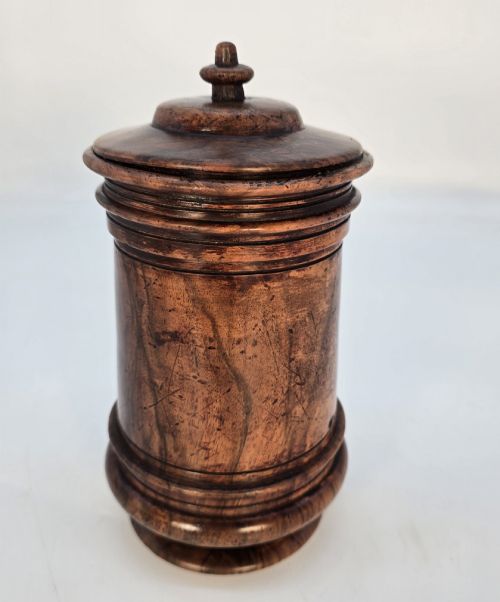


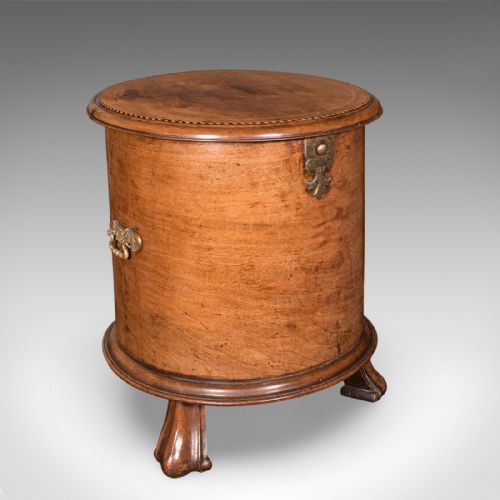

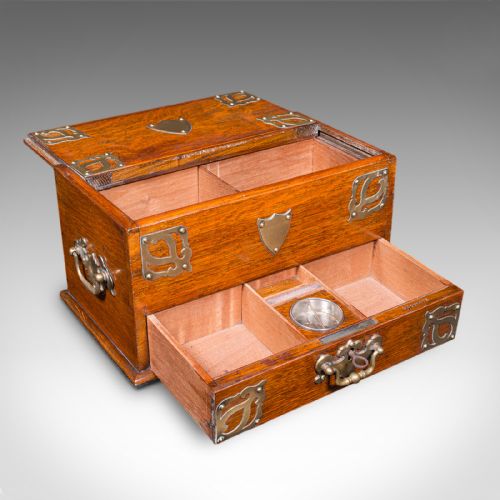


English Wooden Caddy
An English wooden caddy stores fine dry leaves safely in timber boxes shaped by Georgian and Victorian joiners.
English Wooden Caddy
An English wooden caddy sits primarily as a tea storage box, alongside related tabletop containers like biscuit barrels and work boxes shaped in walnut, mahogany, and rosewood. These containers emerge frequently from Regency and Victorian workshops, displaying rectangular, sarcophagus, or dome-topped silhouettes.
Tea caddies form the core of this selection, split between double compartments and loose leaf designs. Buyers also encounter occasional George II and Georgian iterations alongside later Edwardian smoking and stationery boxes.
Distinctions in Execution
Quality rests in the precision of the timber matching and the intricacy of the inlay work, where tight geometric tessellation or crisp brass brass-inlay distinguishes finer boxes from plain production pieces. The stability of the carcase and the original condition of internal components dictate the grade of survival.
Makers who utilised high-figure burr walnut or figured rosewood achieved superior visual depth, whereas utilitarian boxes relied on simpler oak or fruitwood construction with minimal ornamentation.
English Wooden Caddy Retail Price Guide 2026
Typical asking prices for english wooden caddy among the pieces listed under this phrase on Sellingantiques today, from the lower quarter to the upper quarter. They describe what is for sale here now, not the wider market.
A few cunning boxes double as miniature chests of drawers, proving that even Victorian tea leaves deserved proper architectural dignity.
Mappin & Webb·Henry Hollamby·John Grinsell & Sons·Gillows
The English Wooden Caddy Glossary
- Tea Caddy
- A box designed to store loose tea leaves securely under lock and key. These containers often featured internal divisions to keep green and black tea separate.
- Sarcophagus
- A box shape featuring a domed or sloping hinged lid atop a rounded body, resting on bun or bracket feet. This classical revival silhouette appeared frequently during the Regency period.
- Tunbridge Ware
- Woodworking decorated with microscopic mosaic tesserae assembled from various natural coloured timbers to form pictorial panels. Makers applied these veneers to rosewood carcases.
- Teapoy
- A pedestal table fitted with a tea caddy box mounted upon a central column and platform base. Regency examples frequently incorporate storage compartments beneath the hinged top.
- Escutcheon
- A small protective plate surrounding the keyhole of a box, usually cast in brass. It prevents the wood from splintering around the lock mechanism.
English Wooden Caddy: Frequently Asked Questions
What is an English wooden caddy?
An English wooden caddy is a lidded box built to preserve and portion dry leaves in domestic drawing rooms.
Craftsmen shaped these containers from hardwoods like mahogany and rosewood, incorporating internal compartments and locks to safeguard valuable provisions.
How were tea caddies used?
Householders stored loose tea blends inside dual or single compartments within the box, keeping the contents dry and secure.
The lady of the house typically kept the key to control access to the valuable leaves.
How do I date a wooden caddy?
Dating relies on observing the silhouette, timber choices, and decorative techniques characteristic of periods like the Regency or Victorian eras.
Sarcophagus shapes and brass inlay point to early nineteenth-century work, while Tunbridge mosaics indicate mid-to-late Victorian production.
How do I care for antique wood?
Antique timber boxes require stable indoor humidity away from direct sunlight and heat sources to prevent the veneers from lifting.
Applying a light coat of appropriate wax maintains the lustre of the polished walnut or mahogany surfaces.