






English Weather Station
An english weather station brings together brass, glass and carved oak to measure pressure and time in any traditional hallway.
English Weather Station
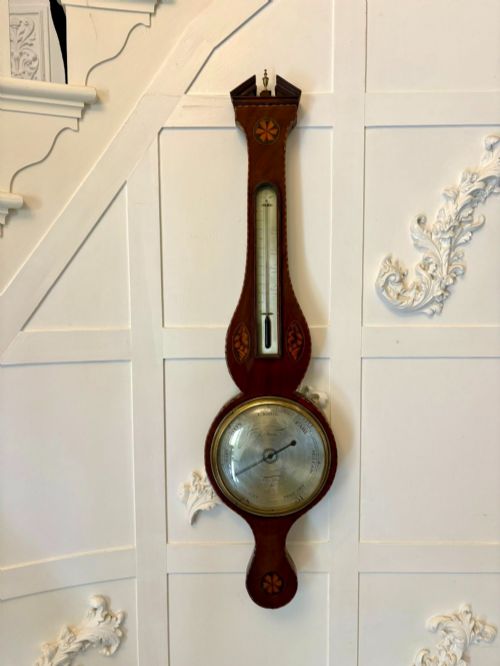
When you search for an english weather station, you are looking at barometers, stick barometers, banjo barometers and desk clocks housed in mahogany, oak or onyx. These instruments recorded atmospheric pressure and temperature for domestic forecasting long before digital screens existed.
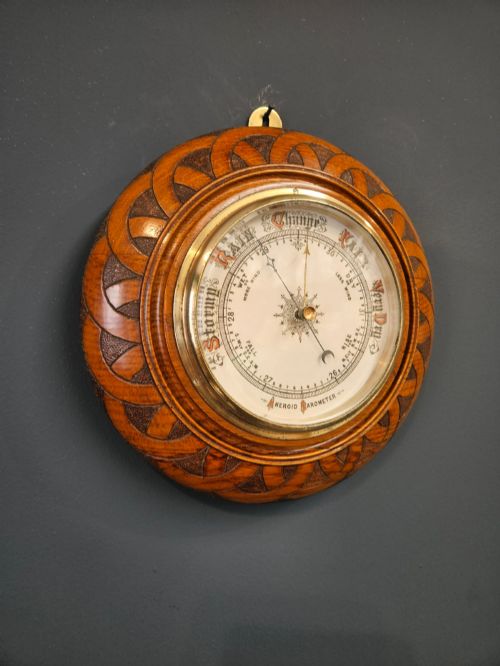
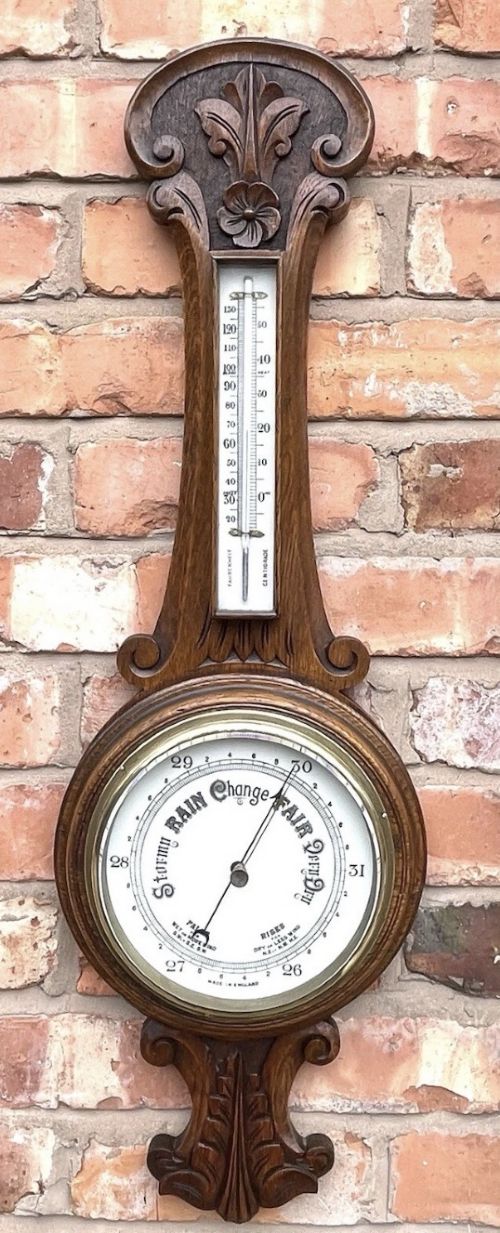
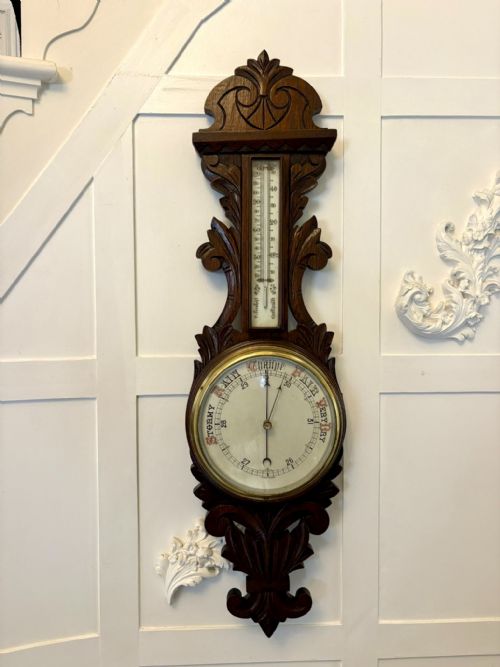
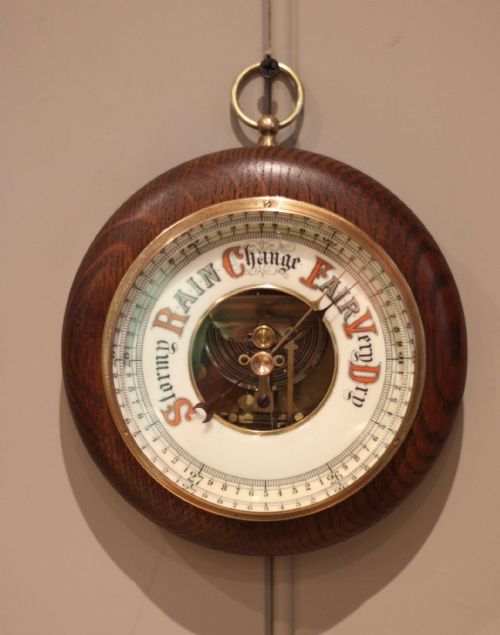
The versions you are most likely to meet on this page span the Victorian and Edwardian periods, alongside Georgian and Art Deco examples. They take the form of wall-mounted banjo instruments, heavy carved oak aneroid cases and occasional desk combinations.
Makers such as W Watson & Sons, J Hughes London, Short & Mason Limited, Blake & Son, Negretti & Zambra and Gilbert London signed these pieces. Their work reflects the domestic scientific interests of nineteenth and early twentieth century households.
Materials and construction
Cases were predominantly constructed from seasoned oak and mahogany, occasionally inlaid with shell motifs or finished in satinwood. These timbers were selected for stability to protect the delicate internal mechanisms from humidity changes.
Brass dials, bezels and mercury tubes or aneroid capsules form the operational heart of each instrument. Glass faces protect the inscribed paper or metal dial plates while allowing clear observation of the mercury or pointer needle.
Makers represented include Short & Mason Limited, Negretti & Zambra, and J Hughes London.
Assessing quality
The distinction between standard domestic instruments and finer examples lies in the crispness of the wood carving and the quality of the timber grain. Finer oak and mahogany cases exhibit precise turning and careful joinery that has survived decades of wall mounting.
Signed dials by established makers such as Negretti & Zambra or Short & Mason elevate an instrument above anonymous workshop output. The legibility of the engraved or printed graduations on the brass and ceramic plates also indicates the original workshop tier.
W Watson & Sons·J Hughes London·Short & Mason Limited·Blake And Son·Negretti And Zambra·Gilbert London·L Malacrida
The English Weather Station Glossary
- Aneroid barometer
- An instrument that measures atmospheric pressure using a flexible metal box without liquid. Changes in pressure cause the metal to expand or contract, moving the dial pointer.
- Stick barometer
- A tall, narrow instrument containing a vertical glass tube filled with mercury. It provides a direct reading of atmospheric height.
- Banjo barometer
- A household barometer featuring a rounded top and an extended lower stem resembling a banjo. It frequently incorporates a thermometer and hygrometer alongside the main dial.
- Barograph
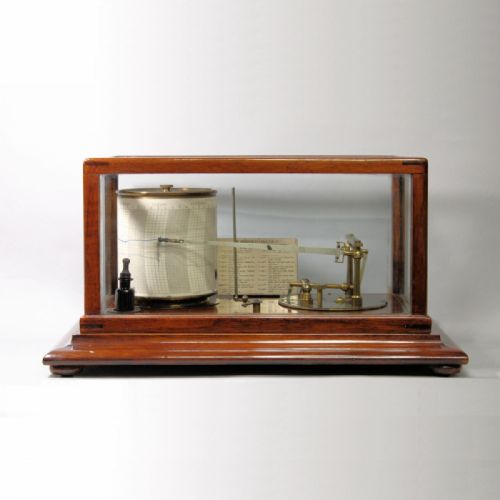
- A recording barometer that draws a continuous line of atmospheric pressure onto a revolving paper drum. These are typically housed in mahogany cases with glass panels.
- Bezel
- The metal ring that holds the glass cover in place over the dial face. It is often hinged to allow access for setting the pointer.
English Weather Station: Frequently Asked Questions
How do I read an aneroid barometer?
Read the main pointer to find the current atmospheric pressure reading in inches or millibars. Use the manual setting hand to mark the position so you can see if pressure rises or falls over the day.
Falling pressure often indicates approaching unsettled weather, while rising pressure suggests fair conditions ahead. Comparing successive readings gives the most reliable domestic forecast.
Where should I hang a wall barometer?
Hang your barometer on an interior wall away from direct sunlight, radiators and draughts. Rapid temperature fluctuations can distort the internal metal components and affect the accuracy of the reading.
A stable hallway or study provides the ideal environment where the wood case remains protected from extreme humidity shifts.
How do I date an oak barometer?
Examine the style of the wood carving, the construction of the case back and the typography on the dial face. Victorian oak instruments often feature deep relief carving and turned bezels.
Georgian and Edwardian examples show distinct stylistic shifts in cabinetmaking and dial design, helping narrow the decade of manufacture.
Did all barometers include thermometers?
Many banjo and aneroid barometers incorporated a secondary alcohol or mercury thermometer on the upper stem. This allowed households to monitor temperature alongside atmospheric pressure.
Some desk models also combined clocks and barometers into a single piece of furniture for the study.