
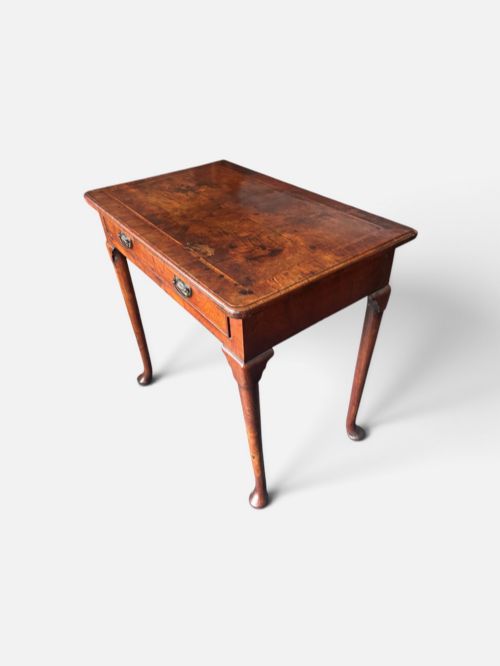
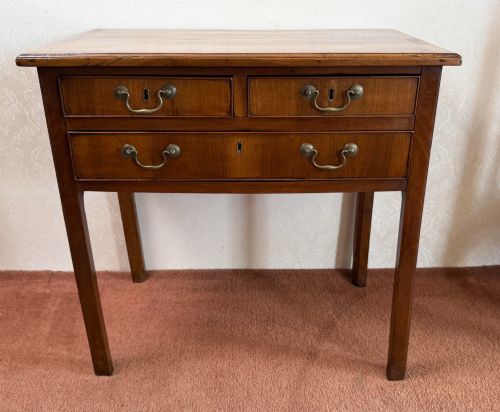


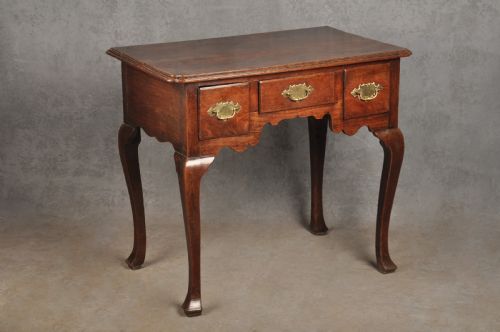

English Walnut Lowboy
An English walnut lowboy is a small serving and dressing table offering deep drawers and rich timber figure, prized for timeless utility and understated elegance.
English Walnut Lowboy
When you search for an English walnut lowboy, you are looking at small tables designed for dressing or correspondence that sit low to the ground and typically feature multiple drawers.
The pieces on this page span the 17th century through the Georgian era alongside later revivals from the Edwardian period and the 1930s.
You are most likely to meet authentic 18th century examples alongside Georgian revival interpretations made in the early 20th century.
Materials and construction
Cabinet makers utilised solid walnut and burr walnut veneer laid over secondary timbers such as oak, creating highly figured surfaces across the drawer fronts and tops.
Brass hardware including drop handles and escutcheons completes the construction of these tables, secured to drawer frames built for daily use.
Many of these small tables spent centuries holding heavy pewter washbasins before retiring to polite parlour duty.
Judging quality in walnut furniture
Quality rests in the richness of the timber figure, where striking burr walnut veneer displays depth and warmth that plain grain lacks.
Refinement of proportion and the crispness of joinery distinguish period pieces from later revivals, marking the difference between straightforward utility and master cabinet making.
The English Walnut Lowboy Glossary
- Lowboy
- A small side table or dressing table fitted with drawers, standing on relatively tall legs. This form gained popularity in the late 17th and 18th centuries.
- Burr Walnut
- Timber taken from a walnut tree growth or burl, yielding swirling, highly decorative grain patterns. Cabinet makers prized this wood for veneering prominent surfaces.
- Georgian Revival
- A style popular in the Edwardian era and the early 20th century that emulates the proportions and decorative vocabulary of 18th century British furniture.
- Escutcheon
- A protective plate surrounding a keyhole, usually fashioned from brass on period lowboys to complement the drawer pulls.
English Walnut Lowboy: Frequently Asked Questions
What is a lowboy used for?
These small tables served primarily as dressing tables for personal grooming or as writing and correspondence desks in bedchambers and parlours.
Today, their compact footprint makes them versatile side tables or hall tables that provide discreet drawer storage without dominating a room.
How do I tell an 18th century lowboy from a revival piece?
Original pieces show the natural wear, timber shrinkage, and hand-cut joinery consistent with eighteenth-century workshop practices.
Revival pieces made in the Edwardian era or the 1930s often display standardised machine construction methods and cleaner interior secondary woods.
Does burr walnut differ from plain walnut?
Burr walnut comes from knotted growths on the tree, producing intricate, swirling patterns that decorators valued for primary surfaces like table tops.
Plain walnut has a straighter, more uniform grain and was frequently used for structural framing and legs.
Where should I place a lowboy at home?
A lowboy fits neatly into entrance halls as a surface for post and keys, utilising the drawers to keep surfaces clear.
They also function well in living rooms or bedrooms against a blank wall beneath a mirror or small painting.