
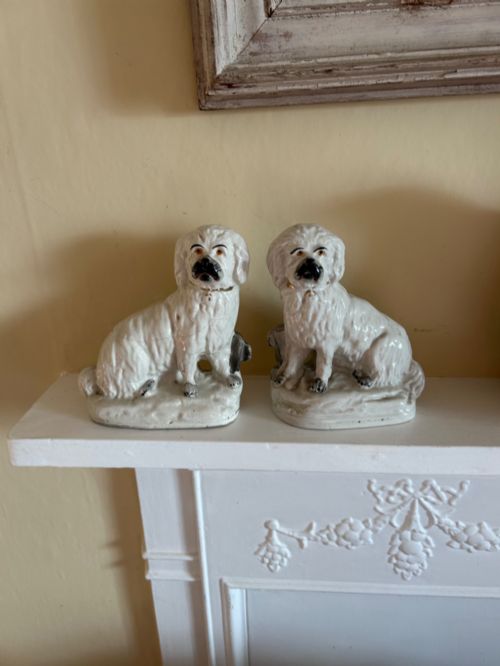


English Pottery Spaniels
These English pottery spaniels are traditional chimney ornaments that bring quiet character and historic charm to any mantelpiece.
English Pottery Spaniels
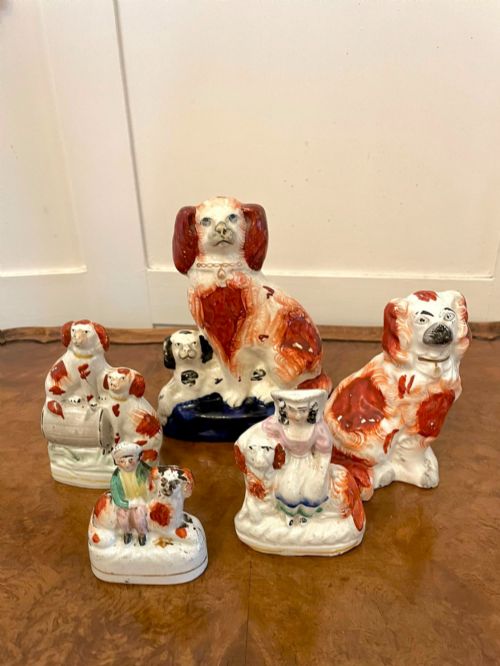
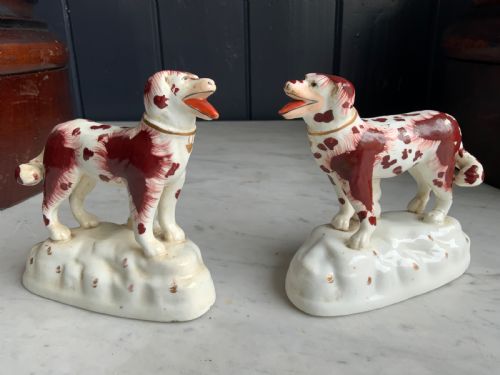
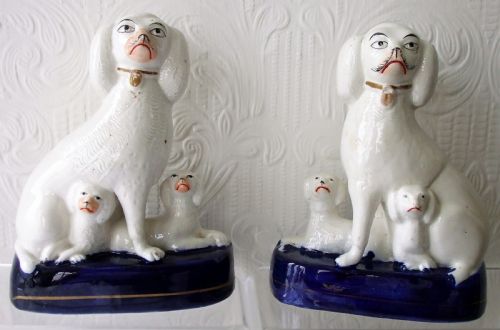
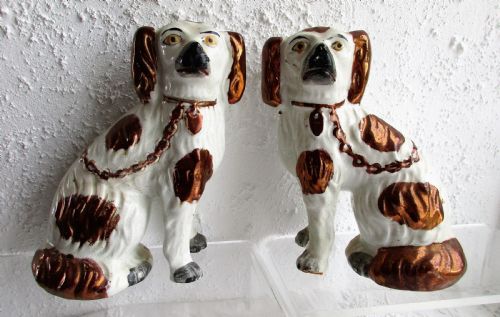
English pottery spaniels take the form of decorative figurines and figures modelled as loyal hearth dogs, frequently referred to as comforter spaniels. These pieces emerge predominantly from nineteenth-century Victorian production, carrying the distinct aesthetic of the era into modern interiors.
The selection here includes pairs and collections modelled not only as classic spaniels, but occasionally featuring poodles, Maltese terriers, and pugs with pups or children. Buyers most commonly meet these dogs as matching pairs designed to sit facing one another on either side of a fireplace.
Dates span across the nineteenth century, with specific examples originating from the Regency period through to eighteen ninety, capturing the evolving tastes of Victorian potters. The forms range from small mantel ornaments to large figures detailed with glass eyes and gilt highlights.
Distinctions in quality
Quality rests heavily on the crispness of the modelling and the sensitivity of the hand-painted details upon the ceramic surface. Superior pairs display finely brushed coats and carefully rendered eyes that bring character to the animal rather than appearing flat or hastily applied.
Periods represented span from the Regency era through to eighteen ninety, with a strong Victorian presence.
The English Pottery Spaniels Glossary
- Comforter spaniels
- Staffordshire ceramic figures traditionally placed on mantelpieces to guard the hearth and comfort the household. These dogs usually face inwards toward each other.
- Earthenware
- A porous clay body fired at lower temperatures, commonly used for nineteenth-century decorative figures before being glazed. It forms the foundation of most Staffordshire spaniels.
- Stoneware
- A dense, impermeable ceramic fired at higher temperatures than earthenware. It provides a heavier and more robust body for specific nineteenth-century figures.
- Gilt
- A thin layer of gold applied to ceramic surfaces for decoration. It frames collars and lockets on select Victorian spaniels.
English Pottery Spaniels: Frequently Asked Questions
How do I style spaniels on a mantelpiece?
Place the pair of spaniels facing inward toward the centre of the mantelpiece, mirroring how they sat on nineteenth-century hearths.
Keep them at eye level where the hand-painted enamel details and gilt highlights can catch the room's light.
What periods do these spaniels come from?
The pieces span the nineteenth century, with strong representation from the Victorian era alongside Regency and specific decades like eighteen sixty and eighteen eighty.
Dates are determined by the potting style, glaze characteristics, and modelling conventions of the period.
Are these dogs always found in pairs?
Many examples are modelled and sold as matching pairs designed to sit symmetrically on either side of a fireplace.
Collections also include single figures, groups with puppies, or larger sets of four.
What materials make up these figures?
Makers utilised earthenware, ceramic, and stoneware as the primary body materials for shaping the dogs.
Surfaces were then finished with glazes, hand-painted enamel colours, copper lustre, and occasional glass eyes.