
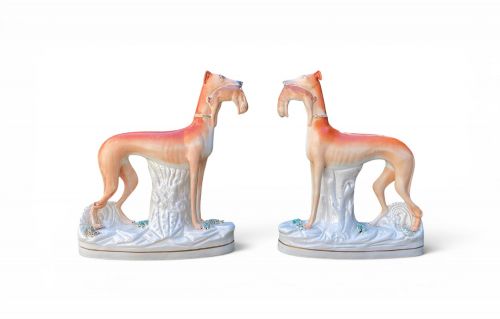
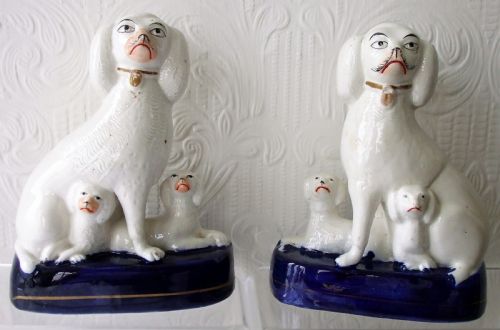
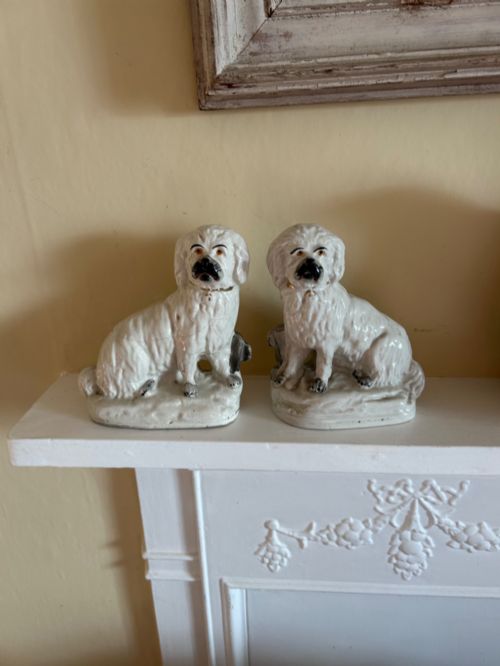


English Glazed Pottery Dogs
English glazed pottery dogs bring character to a room, offering the charm of Victorian and Georgian mantelpiece ornaments.
English Glazed Pottery Dogs
English glazed pottery dogs are decorative figures and mantelpiece ornaments modeled as popular breeds including spaniels, poodles, greyhounds, pugs, and Maltese terriers.
The pieces appearing here include pairs and single figures, with some taking functional forms such as quill holders or desk accessories.
Makers produced these ceramics predominantly during the Victorian era and the Georgian period, utilising earthenware and stoneware.
Materials and construction
Potters shaped these earthenware and stoneware figures using ceramic moulds before applying a surface glaze.
Workers finished the ceramic bodies with hand painting, enamel colours, and occasional details in gold leaf.
Some greyhounds doubled as quill holders, ready to assist with correspondence after a hard day of sitting on the mantelpiece.
Assessing the work
Pairs matching in size and posture command greater attention than mismatched single figures.
The English Glazed Pottery Dogs Glossary
- Earthenware
- Porous pottery fired at lower temperatures, commonly used for traditional figures. It requires a protective glaze to hold liquid and colour.
- Staffordshire
- A generic regional term for pottery produced in the English county of Staffordshire. Many 19th-century animal figures originated from these kilns.
- Stoneware
- A dense, durable ceramic fired at higher temperatures than earthenware. It resists moisture naturally even before glazing.
- Enamel
- Vitreous paint applied over the fired ceramic glaze to add surface colour. It provides the characteristic spots and markings on the spaniels.
English Glazed Pottery Dogs: Frequently Asked Questions
What are English glazed pottery dogs?
These pieces are ceramic figures shaped like various dog breeds, produced primarily in the 19th century as decorative mantelpiece ornaments.
Potters created pairs and single dogs from earthenware and stoneware, decorating them with hand-painted enamels and glaze.
How were these pottery dogs displayed?
Victorian and Georgian households placed pairs of spaniels, greyhounds, or poodles symmetrically on mantelpieces and shelves.
Some specialised pieces, such as greyhound quill holders, served a functional purpose on a desk.
How do I date a Staffordshire dog?
Dating relies on stylistic clues, materials such as stoneware or earthenware, and the complexity of the enamel painting.
Pieces span from the Georgian period through the height of Victorian production in the mid to late 19th century.
Are these dogs always found in pairs?
Makers frequently produced these ceramic animals as matched pairs designed to sit facing one another on either end of a shelf.
Individual figures and small collections of four also appear within the available material.