

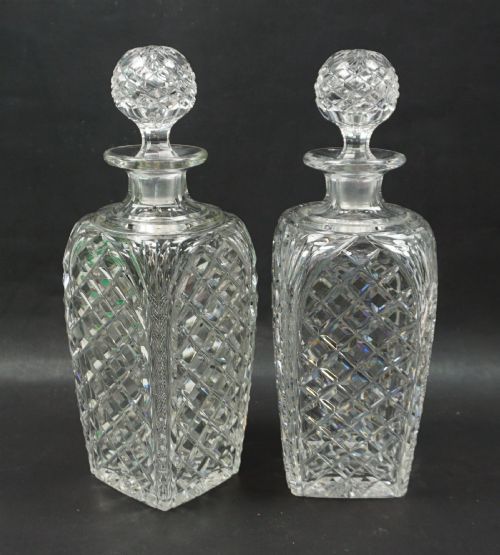


English Cut Glass Decanter
An English cut glass decanter brings weight and brilliant light to a sideboard, shaped by decades of pouring wine and spirits.
English Cut Glass Decanter
An English cut glass decanter is a vessel designed to hold and serve wine, sherry, port, or whisky, encountered frequently across Georgian, Victorian, and Edwardian periods. Collectors search for these pieces to find functional vessels that demonstrate period craftsmanship through heavy glass bodies and faceted stoppers.
The selections span distinct forms including ovoid shapes, square section tapered bodies, and ship's decanters built with wide bases for stability at sea. Alongside traditional decanters, related forms like claret jugs, carafes, scent bottles, and tantalus sets appear throughout the eras.
Examples cross multiple styles from Regency symmetry through Victorian elaboration and Edwardian refinement, occasionally reaching into Art Deco and Mid-Century Modern designs. Most pieces combine clear cut glass or lead crystal with sterling silver or silver plate collars, mounts, and stoppers.
Materials and production methods
The primary material is heavy lead crystal or clear glass, often shaped through blowing into moulds or free-blowing before undergoing deep geometric or pillar cutting on a wheel. Makers achieved deep refraction and sharp facets by pressing the glass against rotating wheels fed with abrasive grit and water.
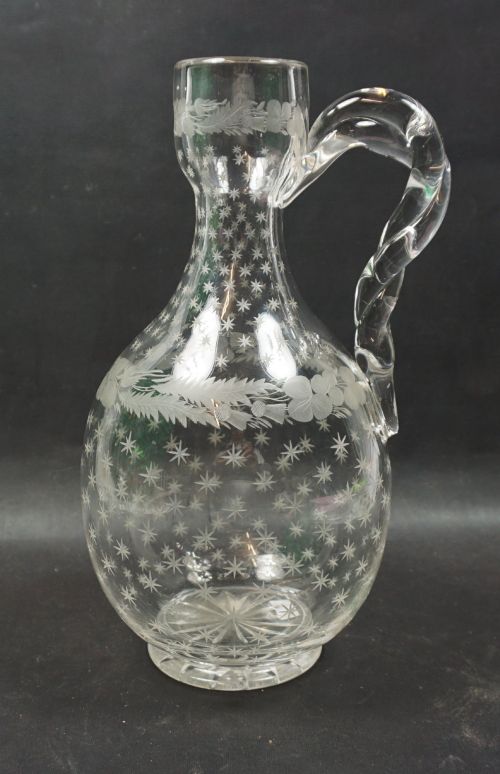
Metal components such as collars, handles, and stoppers utilise sterling silver or silver plate, frequently bearing hallmarks that record assay offices and years of production. Engraved details on the glass bodies, including crests, flowers of the union, birds among vines, and dolphins, were added by hand using small copper wheel cutters.
English Cut Glass Decanter Retail Price Guide 2026
Typical asking prices for english cut glass decanter among the pieces listed under this phrase on Sellingantiques today, from the lower quarter to the upper quarter. They describe what is for sale here now, not the wider market.
Object types include spirit bottles, claret jugs, scent bottles, and locking tantalus sets alongside standard decanters.
Distinctions in quality
Quality rests upon the depth, crispness, and symmetry of the wheel-cut facets, where sharp edges and clean geometric alignment separate superior cutting from softer, shallower work. The clarity of the metal and the absence of clouding or excessive bubbles within the glass substance dictate visual brilliance.
The weight and balance of the vessel, combined with the snug fit of an original matching stopper, determine the integrity of the piece. Finer examples integrate hallmarked silver mounts or detailed hand engraving that remains sharp and intentional across the surface.
Richardsons·Barnsley and Co·Mappin and Webb·Hukin and Heath
The English Cut Glass Decanter Glossary
- Ship's decanter
- A form featuring a broad, flat base and a conical body designed to prevent tipping during marine travel. This practical shape kept contents secure on rolling tables.
- Lead crystal
- A high-clarity glass containing lead oxide that increases refractive index and weight. This material allows deeper, sharper facet cutting.
- Pillar cut
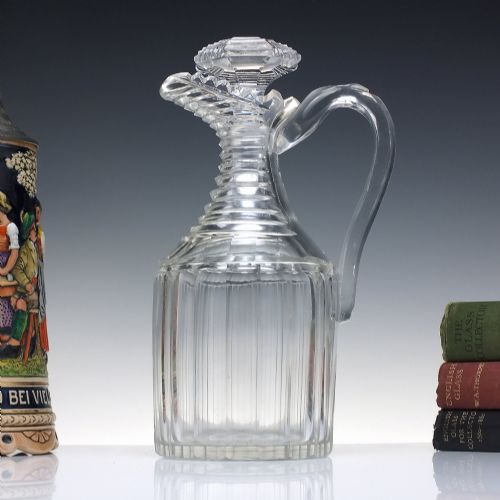
- A decorative pattern of wide, vertical flutes carved into the body of the glass. It creates strong linear reflections along the vessel.
- Silver collar
- A metal band fitted around the neck of the bottle to strengthen the rim and secure a stopper or locking mechanism. Many carry English silver hallmarks.
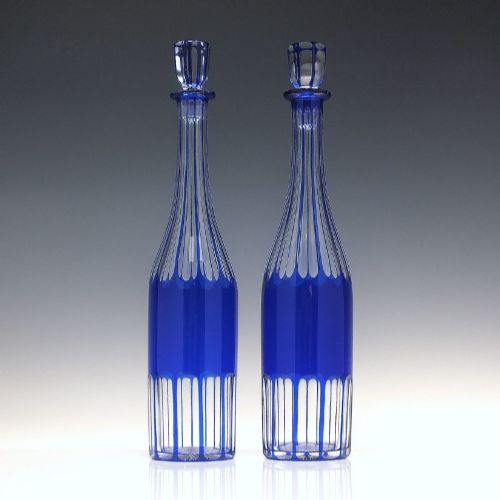
- Cranberry overlay
- A layer of red glass fused over a clear glass core before cutting through the outer layer to reveal the clear glass beneath. This technique produces strong colour contrast.
English Cut Glass Decanter: Frequently Asked Questions
How do I date an old decanter?
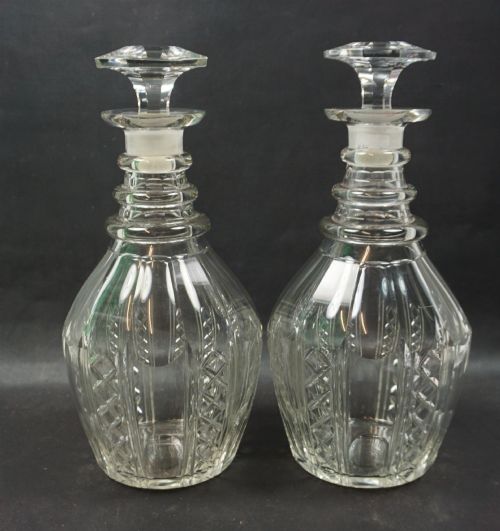
Dating relies on shape, cutting style, and any accompanying silver hallmarks. Georgian and Regency pieces often feature three or more neck rings and ovoid or ship's profiles.
Victorian and Edwardian examples introduce heavier pillar cutting, cranberry overlays, and silver plate or hallmarked silver mounts that tie directly to assay office date letters.
Are stoppers usually original?
Stoppers were individually ground to fit each neck during manufacture, meaning replacements often sit unevenly or show mismatched cutting patterns. Examining the base of the stopper and the interior of the neck for corresponding number marks helps confirm originality.
Matching wear patterns between the stopper peg and the neck interior also indicate they have aged together.
What is a ship's decanter?
A ship's decanter is a specific bottle shape with a wide, low centre of gravity and a steeply flared base. This wide footprint prevented the vessel from sliding or overturning on board rolling ships.
Their robust proportions made them popular on land as well as at sea throughout the Georgian and Regency periods.
How should I clean cloudy glass?
Cloudiness inside old decanters is typically mineral scaling from long-term storage of liquids. Gentle cleaning with warm water, mild soap, and specialised cleaning beads without harsh abrasives preserves the interior surface.
Avoiding sudden temperature changes prevents thermal shock and cracking in heavy lead crystal.