



English Chaise Longue
An English chaise longue brings nineteenth-century drawing-room elegance and afternoon repose to a modern interior.
English Chaise Longue
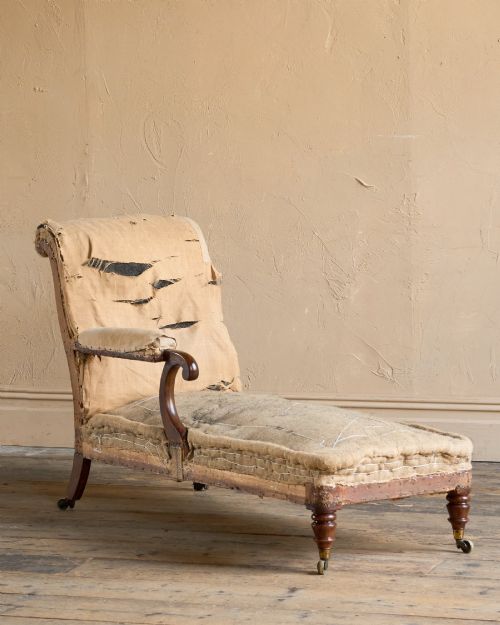
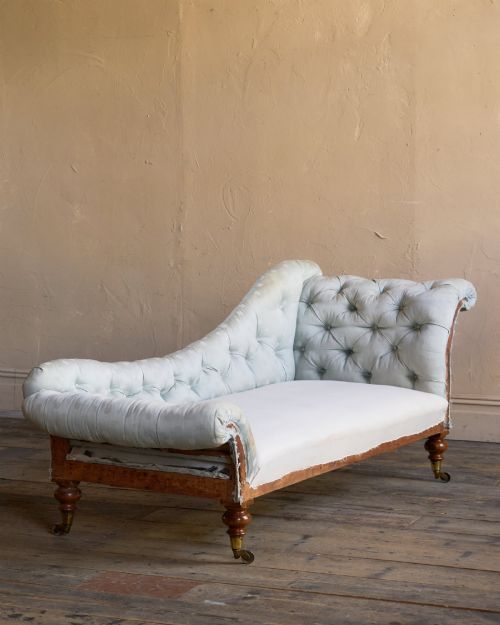
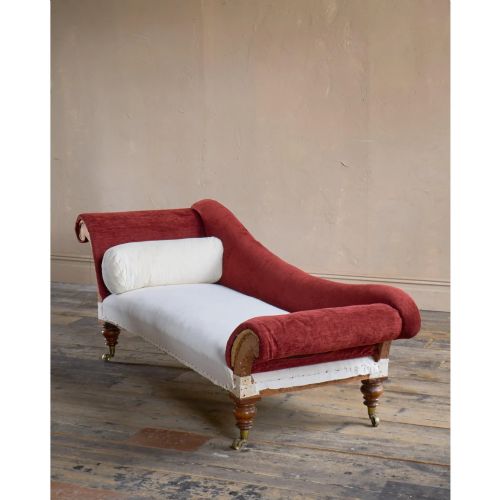
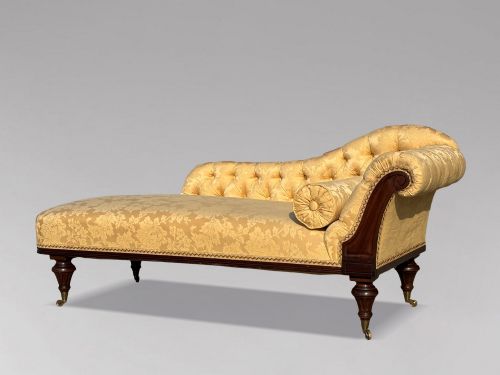
An English chaise longue is a form of daybed, settee, or couch designed for reclining, appearing across nineteenth-century styles from Regency to Late Victorian. The pieces seen here span the 1800s, including early nineteenth-century Regency examples and mid-to-late Victorian variations.
Buyers most frequently encounter mahogany and rosewood frames paired with upholstered surfaces in velvet, calico, or various fabric coverings. Forms range from classical scroll ends to double spoon backs and box ottomans.
Originating as fashionable seating for country houses and town mansions, these daybeds combine structural timber frames with sprung or padded lounging surfaces. They function equally well as standalone statement furniture or practical resting places.
Judging quality in daybeds
Quality rests upon the crispness of the timber carving, the integrity of the underlying frame joinery, and the proportion of the scrolled backrest. Pieces associated with notable cabinetmakers display superior wood selection and refined turning on the legs.
English Chaise Longue Retail Price Guide 2026
Typical asking prices for english chaise longue among the pieces listed under this phrase on Sellingantiques today, from the lower quarter to the upper quarter. They describe what is for sale here now, not the wider market.
A nineteenth-century box ottoman daybed lets you store your secrets right beneath your afternoon nap.
Holland and sons·Howard & Sons·H. Goodall & Sons·Jas Shoolbred·Miles & Edwards
The English Chaise Longue Glossary
- Regency
- A style spanning the early nineteenth century defined by classical restraint and inspiration from ancient Greece and Rome. This period produced clean architectural lines in furniture design.
- Mahogany
- A durable, reddish-brown tropical hardwood favoured by nineteenth-century cabinetmakers for its stability and fine grain. It takes a high polish.
- Castor
- A small wheel mounted on a swivel attached to the foot of a piece of furniture for easy movement. Original brass examples add authenticity to nineteenth-century seating.
- Calico
- A plain-woven cotton fabric frequently utilised as an under-upholstery layer or a simple primary covering on period seating. It provides a neutral, durable base.
- Ottoman
- A piece of upholstered furniture without a back or arms, sometimes incorporating internal storage space. Reversible box versions allow for adaptable lounging.
English Chaise Longue: Frequently Asked Questions
How do I style a chaise longue?
Position the piece in a generous drawing room, bedroom, or library where it can float away from the wall to showcase its profile. Allow sufficient floor space around the scroll end so the silhouette remains the visual focus of the room.
Complement the upholstery with a simple throw or leave the period fabric uncovered to display the design clearly. Pair it with low-slung seating rather than tall cabinets to maintain balanced proportions in the interior.
Can I use an antique daybed daily?
Nineteenth-century frames built from solid mahogany or rosewood offer robust daily support when the internal joinery is sound. They function well for reading and resting just as they did in period country houses.
Consider the condition of the internal webbing and padding before heavy daily use. Professional conservation of the upholstery ensures the structure handles modern lounging comfortably.
How do I tell Regency from Victorian pieces?
Regency daybeds, dating from the early nineteenth century, typically feature clean architectural lines, classical scroll ends, and restrained mahogany or rosewood surfaces. They reflect a direct influence of ancient classical design. Ninteenth-century Victorian pieces often introduce more exuberant carving, turned legs, buttoned velvet upholstery, and varied forms like double spoon backs or box ottomans. The decorative vocabulary shifts from austere classical curves to richer, heavier ornamentation.