







English Canterbury Furniture
English canterbury furniture provides elegant multi-tier storage for sheets, folios, and periodicals, bringing period refinement to any sitting room.
English Canterbury Furniture
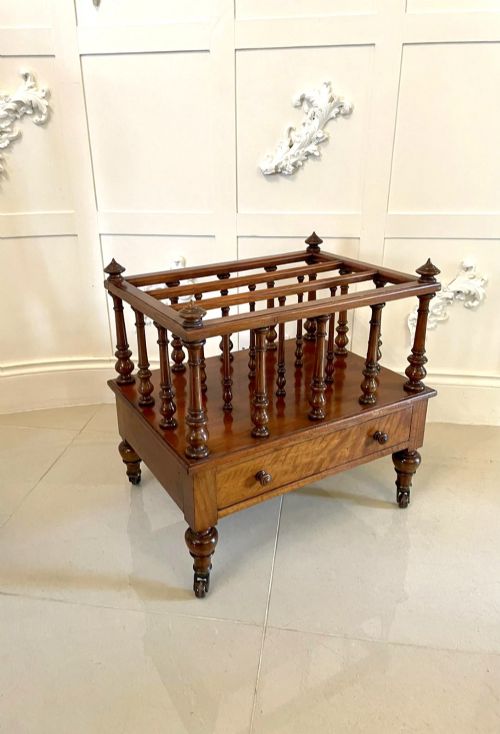
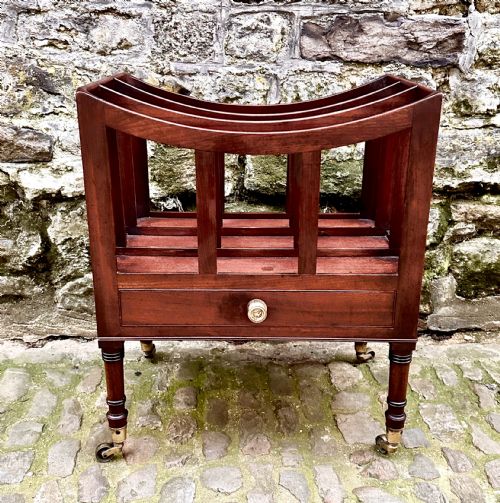
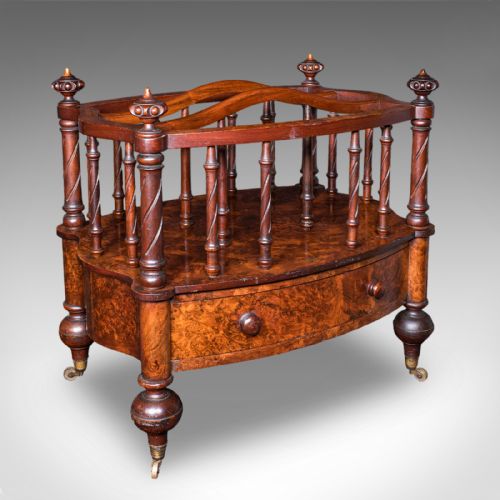
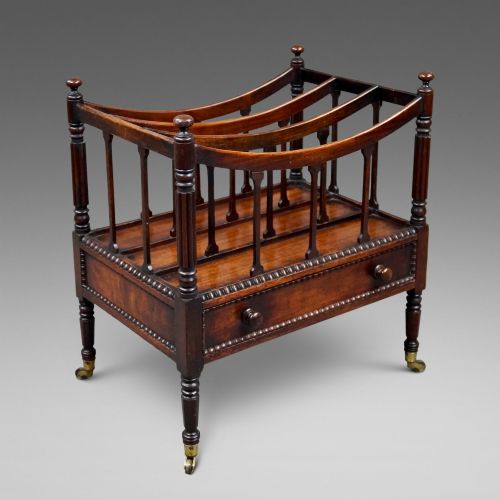
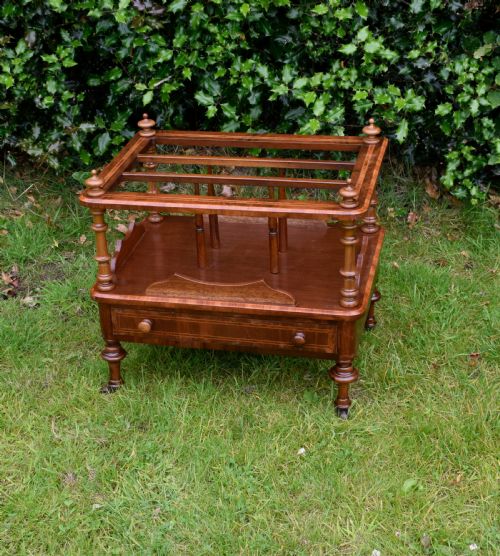
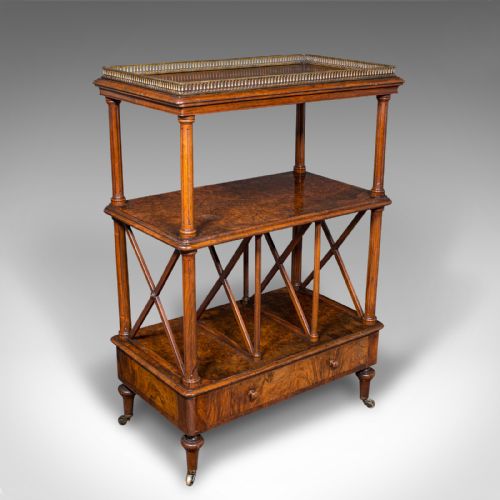
When you search for English canterbury furniture, you encounter low stands featuring slatted or divided partitions designed to hold newspapers, magazines, folios, and sheet music. These pieces frequently incorporate a low drawer beneath the partitions and rest upon short turned legs fitted with castors for mobility.
The selections span distinct historical eras, most notably the Georgian, Regency, William IV, and Victorian periods. You will encounter standard magazine racks alongside larger folio stands, combined whatnot and etagere designs, and fall-front music cabinets.
Mahogany and rosewood dominate the earlier Regency and Georgian examples, whilst walnut, burr walnut, and oak appear frequently in mid-to-late 19th-century and Edwardian pieces. Boxwood inlay and fine turned spindles frequently enrich the structural woodwork.
How they were made
Cabinet makers utilised dense timbers such as mahogany and rosewood for structural stability, shaping slender partitions and vertical supports by hand. Figured walnut and burr walnut veneers were carefully applied to primary display surfaces to create striking grain patterns.
Makers integrated brass castors into the feet to allow these movable stands to shift easily across carpets. Joinery methods included precise dowelling and dovetailing, particularly visible in the construction of the small base drawers often incorporated beneath the rack compartments.
English Canterbury Furniture Retail Price Guide 2026
Typical asking prices for english canterbury furniture among the pieces listed under this phrase on Sellingantiques today, from the lower quarter to the upper quarter. They describe what is for sale here now, not the wider market.
Listings feature canterburys spanning the Georgian, Regency, William IV, Victorian, and Edwardian periods, constructed in mahogany, rosewood, walnut, and oak.
What varies in quality
The distinction between standard production and exceptional work lies in timber selection and decorative restraint. Pieces utilising finely figured veneers, crisp boxwood stringing, and well-turned columns demonstrate a higher level of workshop execution.
Proportion and structural integrity define the superior examples. The way vertical divisions are joined to the base platform and the delicacy of the turned spindle work separate utilitarian stands from refined drawing room pieces.
Gillows of Lancaster·J C Loudon·Liberty
The English Canterbury Furniture Glossary
- Canterbury
- A low stand with divisions for holding loose papers, sheet music, or periodicals. Named after the Archbishop of Canterbury, who is said to have commissioned the first such piece.
- Folio stand
- A larger piece designed to hold oversized prints, drawings, or bound sheets. These often feature adjustable folding frames rather than fixed vertical partitions.
- Whatnot
- An open set of shelves used for displaying decorative items, frequently combined with a canterbury base. It provides tiered storage without heavy doors.
- Etagere
- A French term for a piece of furniture with several shelves placed one above the other. English makers adopted the form to create display stands with integrated storage.
- Boxwood inlay
- Narrow strips of contrasting pale wood inserted into recesses within darker timbers to form geometric borders. This decorative technique highlights the edges of tops and drawer fronts.
English Canterbury Furniture: Frequently Asked Questions
What is an English canterbury used for?
These pieces were originally designed to hold sheet music, newspapers, and unbound literary folios near a seating area. They kept reading materials tidy and accessible in the drawing room or parlour.
Today, they serve a similar function for modern magazines, journals, and art books. Their compact footprint makes them practical for storing periodicals beside a sofa or armchair.
How do I date a canterbury?
Dating relies on timber choice, construction methods, and prevailing decorative styles. Regency and Georgian examples tend to feature solid mahogany or rosewood with restrained classical lines, whilst Victorian pieces often display figured walnut and heavier turning.
Secondary indicators include the presence of boxwood inlay, the profile of the legs, and the design of the castors. Cabinet makers shifted from hand-cut dovetails to machine-finished joints as the nineteenth century progressed.
Can these stands hold heavy books?
Canterburys are constructed primarily for loose papers, periodicals, and sheet music rather than heavy folio volumes. Their slatted partitions and slender uprights are engineered for lighter items.
While sturdy enough for daily newspapers and current magazines, placing dense hardback books across the divisions can strain the joinery. Folio stands are better suited to heavier art and reference books.
Where should I place a canterbury in my home?
These versatile stands suit sitting rooms, studies, and hallways where reading materials accumulate. Their low profile allows them to sit beside desks or beneath windows without obstructing views.
Because they are finished on all sides in better examples, they function well freestanding rather than pushed strictly against a wall. The incorporation of castors means they can be repositioned easily as needed.