

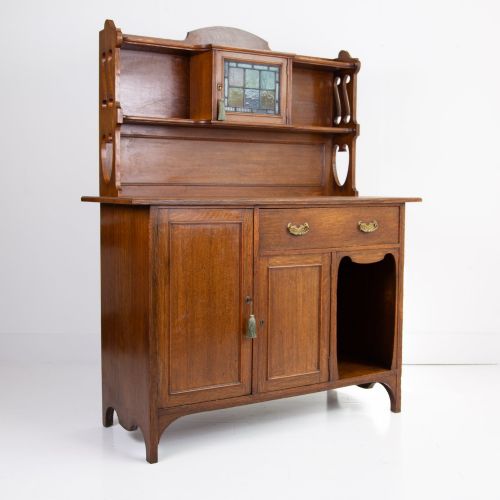
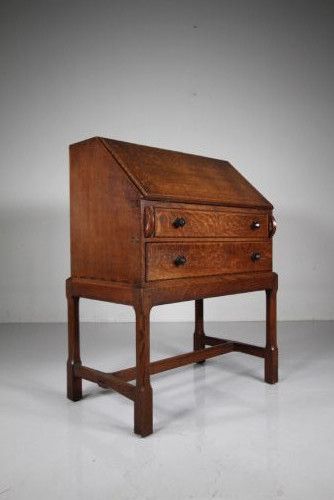


English Arts and Crafts Cabinet
An english arts and crafts cabinet brings honest timber and utility into a room, offering sturdy storage rooted in early twentieth century ideals.
English Arts and Crafts Cabinet
When you search for an english arts and crafts cabinet, you are looking at practical furniture forms spanning the Victorian era through the nineteen forties. The pieces on this page range from compact desktop stationery boxes and music cabinets to substantial oak dressers, sideboards, and writing bureaux.
You are most likely to meet oak examples featuring vernacular styles such as the Cotswold School or influences linked to Edward Barnsley, Stanley Webb Davies, and Robert Mouseman Thompson. These domestic items emphasise utility and straightforward joinery over excessive ornamentation.
The origins stretch across English workshops from eighteen eighty to nineteen forty, capturing a shift towards handcrafted integrity. Buyers encounter both utilitarian cupboards and decorative glazed door formats designed for everyday use.
Materials and construction
Makers relied heavily on native timbers, predominantly English oak and golden oak, alongside occasional pale walnut. These woods provided the structural backbone for heavy sideboards, washstands, and bookcases.
Functional hardware played a central role in the aesthetic, utilising exposed brass hinges and iron fittings alongside leaded glass panels. Joinery was kept visible and robust, reflecting the philosophy of the movement.
English Arts and Crafts Cabinet Retail Price Guide 2026
Typical asking prices for english arts and crafts cabinet among the pieces listed under this phrase on Sellingantiques today, from the lower quarter to the upper quarter. They describe what is for sale here now, not the wider market.
The listings on this page span several decades, moving from Victorian and Edwardian oak furniture into nineteen thirties and forties workshop production.
Distinctions in quality
The finest examples display maker marks, stamps, or direct workshop provenance, separating unsigned vernacular pieces from documented studio furniture. Superior quality manifests in the selection of figured golden oak and careful hand-planed surfaces rather than mechanical uniformity.
Hardware integrity and the retention of original fittings dictate the grade of a piece. Well-preserved leaded glass doors and unaltered brass handles elevate a cabinet above standard utility items.
Edward Barnsley·Stanley Webb Davies·Robert Mouseman Thompson
The English Arts and Crafts Cabinet Glossary
- Cotswold School
- A regional design movement centred on traditional hand woodworking techniques. It prioritises simple lines and exposed construction methods.
- Fall Front
- A hinged writing flap that drops down to form a desk surface. It conceals interior pigeonholes and small drawers.
- Leaded Glass
- Small panes of glass held together within cames of lead. This technique frequently decorates cabinet doors of the period.
- Dresser Base
- A low sideboard form featuring drawers and cupboards beneath a flat top. It represents a staple of English country dining furniture.
English Arts and Crafts Cabinet: Frequently Asked Questions
What defines an arts and crafts cabinet?
These cabinets are defined by their honest construction, sturdy timber frames, and a focus on utility rather than applied historical ornament. They reflect a rejection of mass production in favour of traditional craftsmanship.
You will find that most examples use solid oak and feature hand-wrought brass or iron hardware that is deliberately made visible.
How do I care for solid oak furniture?
Solid oak requires stable indoor humidity levels to prevent timber movement or splitting over time. Regular dusting with a dry cloth keeps the surface clean without stripping the natural finish.
Avoid placing these pieces near direct heat sources or in strong sunlight, which can dry out and fade the wood over the years.
Where were these cabinets originally used?
These pieces served practical storage roles throughout the domestic home, from hallways and studies to dining rooms and bedrooms. Washstands and music cabinets fulfilled specific daily household needs.
Their robust construction meant they were built to withstand heavy daily use by families across generations.
How can I tell the period of a piece?
Dating relies on examining the construction methods, timber selection, and stylistic cues such as whether a piece leans towards Victorian revival or later Cotswold simplicity. Hardware styles and maker stamps provide definitive clues.
Earlier Victorian examples often incorporate heavier mouldings, whereas nineteen thirties pieces tend to show cleaner, pared-back lines.