



English Coasters
English antique coasters hold the bottles and decanters that civilized dining tables, protecting polished timber from rings while adding metal or wood polish to the room.
English Coasters
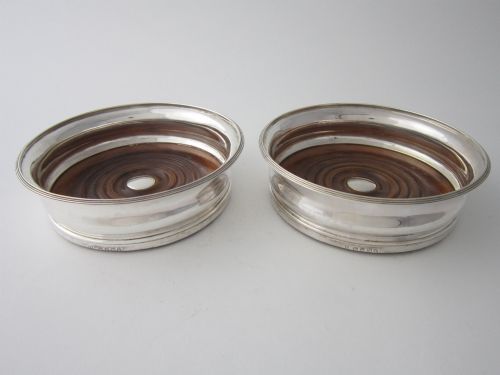
When you search for English antique coasters, you encounter table accessories designed to hold wine bottles, decanters, and cheese dishes safely upon the dining surface. The pieces on this page span from the Georgian and Regency periods through to the Victorian era and the early twentieth century.
The form is most frequently circular, intended to cradle a single wine bottle or decanter base. You will also meet larger double and triple bottle holders, alongside related serving pieces like cheese trucks and rotating trays.
Materials range from rich mahogany and turned treen to gleaming sterling silver, Old Sheffield plate, and silver plate. Styles follow the prevailing tastes of their respective centuries, moving from restrained George III elegance to ornate Victorian detailing and Edwardian practicality.
Materials and construction
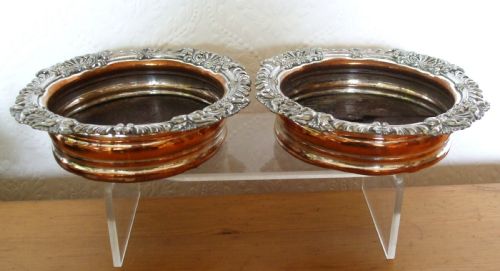
Silversmiths utilised sterling silver and silver plate, often shaping the metal into pierced galleries or beaded rims to secure the glass vessels. Old Sheffield plate appears in early examples, showing the distinctive fusion of silver onto a copper base.
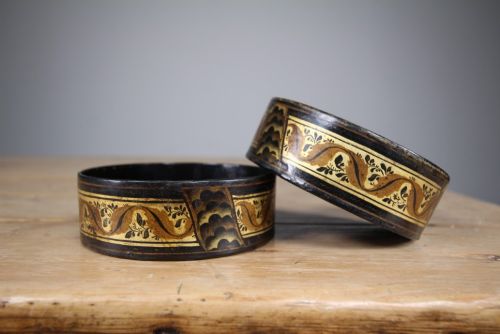
Wooden coasters were turned from dense timbers such as mahogany, sometimes incorporating carved details or fitted inserts. Artisans also worked with papier-mâché and lacquer, occasionally applying surface gilding or Victorian chinoiserie decoration.
English Coasters Retail Price Guide 2026
Typical asking prices for english coasters among the pieces listed under this phrase on Sellingantiques today, from the lower quarter to the upper quarter. They describe what is for sale here now, not the wider market.
Listings feature items spanning the Georgian, Regency, Victorian, and Edwardian periods, utilising both silver and mahogany.
Distinctions in quality
Quality rests in the crispness of the casting or the precision of the woodturning. Early silver coasters exhibit sharp, hand-punched piercing and crisp hallmarks, whereas mass-produced later items show softer detail.
In wooden pieces, the integrity of the timber and the quality of the base insert dictate the grade. A well-balanced weight and robust construction separate superior examples from standard utilitarian vessels.
Rupert Favell & Co.
The English Coasters Glossary
- Old Sheffield Plate
- An early method of fusing a thin sheet of silver to a thicker copper core. This technique predates modern electroplating and leaves a subtle copper seam along exposed edges.
- Treen
- Small handmade wooden household objects. These pieces display the skill of the turner using native hardwoods.
- George III
- The period from seventeen sixty to eighteen twenty. Pieces from this era often display classical restraint and fine silver piercing.
- Sheffield Plate
- A term sometimes applied broadly to nineteenth-century electroplated wares. It denotes a silver coating applied over a base metal foundation.
- Chinoiserie
- European decorative style reflecting Chinese artistic motifs. Victorian versions employ painted or lacquered oriental scenes upon papier-mâché.
English Coasters: Frequently Asked Questions
What were antique coasters used for?
These pieces served to protect polished dining tables from moisture rings and spills left by wine bottles. Diners passed them along the mahogany surface during the port and claret course after the meal.
They also kept bottles steady during dinner service when ships at sea or lively conversation caused the table to vibrate. The raised rims prevented decanters from sliding off.
How do I date a silver coaster?
Hallmarks stamped into the metal provide the most reliable guide to a silver piece's age. These marks indicate the assay office, the maker, and the exact year of manufacture.
Style also helps place an item when marks are absent or rubbed. George III pieces favour neat, pierced galleries, while Victorian examples tend to be heavier and more ornate.
Are wooden and silver coasters cleaned differently?
Silver requires periodic polishing with a non-abrasive cream to maintain its reflective finish without wearing away the underlying plate or hallmark details. Treen and mahogany need only a gentle wipe with a dry cloth.
Moisture is the primary hazard for wooden items. Prolonged dampness from wine bottles can warp the timber or ruin the baize lining on the base.
Can I still use antique coasters today?
Modern decanters and wine bottles fit comfortably into most standard nineteenth-century coasters. They function just as well on a modern dining table as they did in a Georgian parlour.
Their sturdy construction suits daily use, though modern users often insert a small felt pad to protect the historic interior wood or metal from fresh moisture.