





Empire Style Shelving
Empire style shelving brings architectural gravity and rich timbers into a room, offering commanding proportions and classic mounts.
Empire Style Shelving
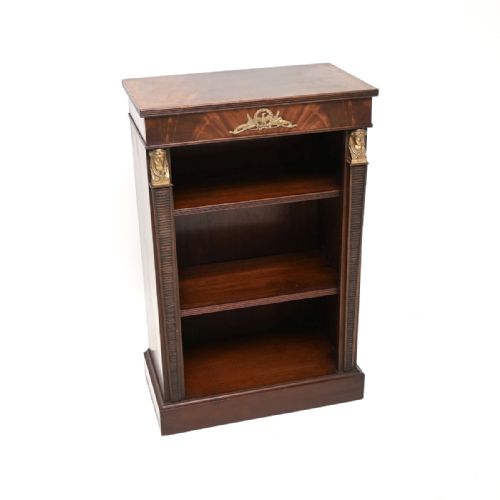
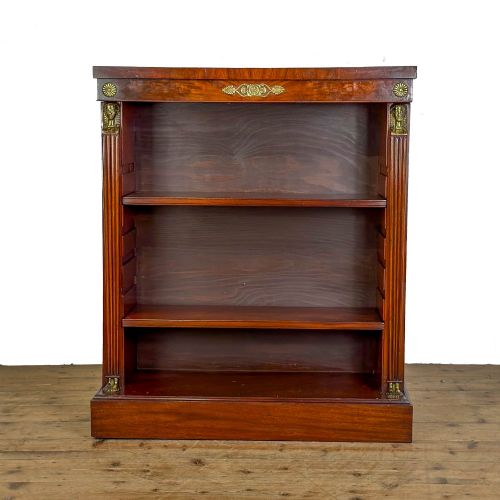
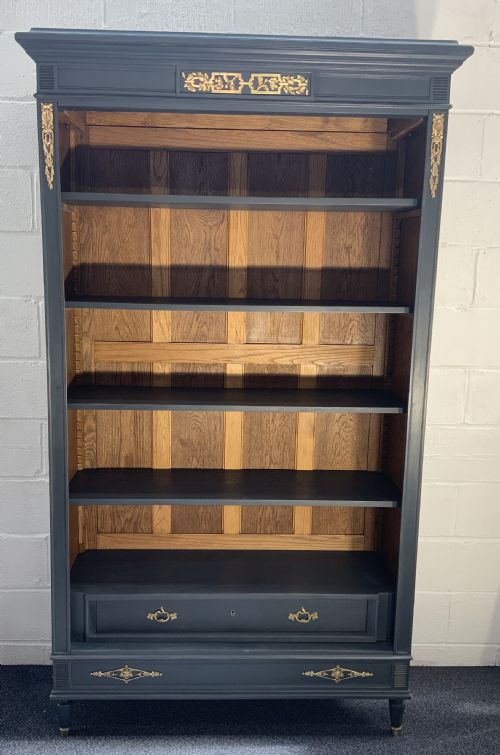
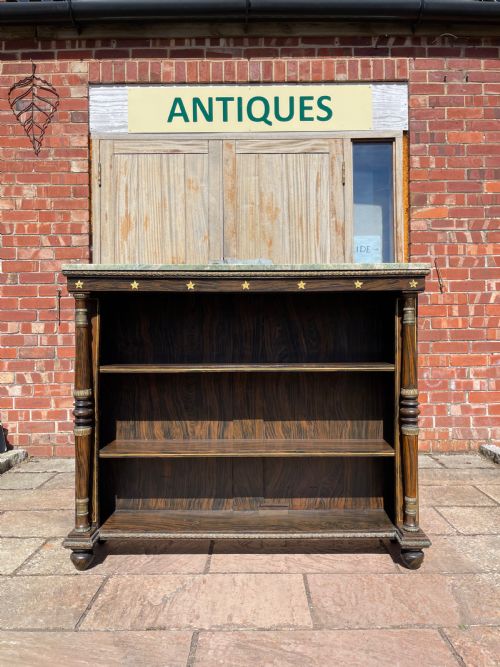
Empire style shelving primarily comprises open bookcases and bookcases with cabinets, manifesting in forms designed with classical architectural severity. When buyers search for empire style shelving, they encounter pieces originating across the nineteenth and early twentieth centuries, spanning periods from the Regency era to 1930.
The prevailing versions met on this page include mahogany open bookcases and rosewood variants, alongside French Empire and Empire Revival interpretations. Makers and manufacturers utilised dark tropical hardwoods and occasional lighter timbers such as birch veneer and satin birch to build these substantial library and display pieces.
How they were made
These bookcases rely on dense foundational timbers like mahogany and rosewood, often paired with birch or simulated paint finishes to achieve their distinctive surface presence. Cabinetmakers constructed these carcases with solid framing and veneered panels.
Cast brass and ormolu mounts provide the characteristic classical embellishments, bolted directly to the timber elements. Gilding and painted details further accent the architectural mouldings and pilasters.
Empire Style Shelving Retail Price Guide 2026
Typical asking prices for empire style shelving among the pieces listed under this phrase on Sellingantiques today, from the lower quarter to the upper quarter. They describe what is for sale here now, not the wider market.
Materials documented across the current selection include brass, ormolu, mahogany, rosewood, marble, satin birch, and birch veneer.
What varies in quality
The refinement of the cast ormolu and brass mounts separates standard execution from finer examples, as does the crispness of applied architectural detail. Heavier, more detailed metalwork indicates a higher grade of production.
Timber selection and veneer matching dictate the visual depth of the bookcase, with rich grain patterns in rosewood and mahogany elevating the piece. The structural integrity of the open shelving and the precision of the classical proportions determine overall merit.
The Empire Style Shelving Glossary
- Ormolu
- Gilded bronze mounts applied to furniture. This technique provides metallic contrast against dark woods like mahogany.
- Empire Style
- A neoclassical design movement drawing on ancient Roman and Egyptian motifs. It emphasises symmetry, columns, and classical mounts.
- Open Bookcase
- A shelving unit without doors. This form displays book bindings directly.
- Regency
- A British design period associated with the early nineteenth century. It shares classical influences with contemporaneous continental styles.
Empire Style Shelving: Frequently Asked Questions
What is empire style shelving?
Empire style shelving consists of bookcases and open shelving units influenced by classical Roman, Greek, and Egyptian design. These pieces utilise architectural forms, columns, and metal mounts.
They appear primarily in rich timbers like mahogany and rosewood, dating from the nineteenth and early twentieth centuries.
Where should I place an open bookcase?
An open bookcase functions well in studies, libraries, or living rooms where books and decorative objects require prominent display. Their architectural presence anchors a wall.
Ensure placement avoids direct sunlight to protect sensitive rosewood or mahogany veneers from fading.
What is the difference between French Empire and Regency?
French Empire furniture derives directly from Napoleonic France, featuring bold neoclassical geometry and heavy cast ormolu mounts. Regency style is the British equivalent from a similar era.
Both styles share classical vocabulary, but British Regency pieces often display distinct local cabinetmaking traditions and lighter proportions.