

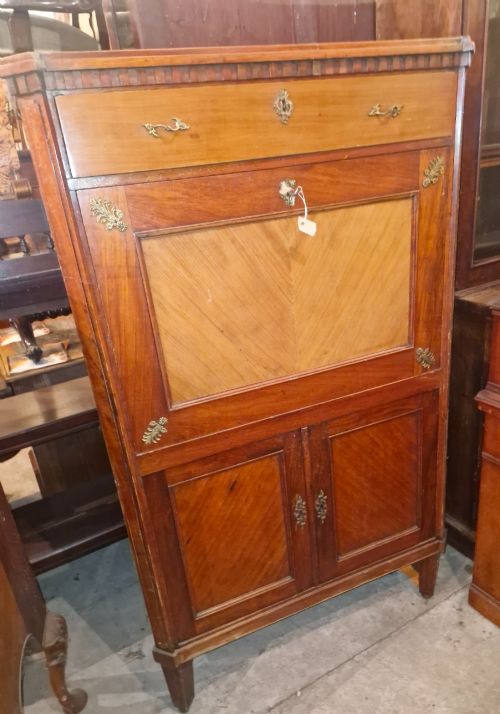
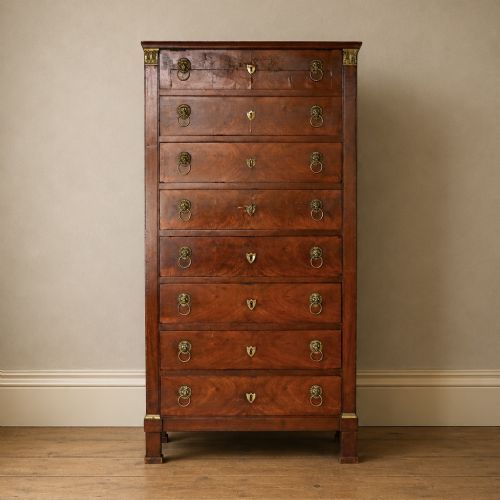
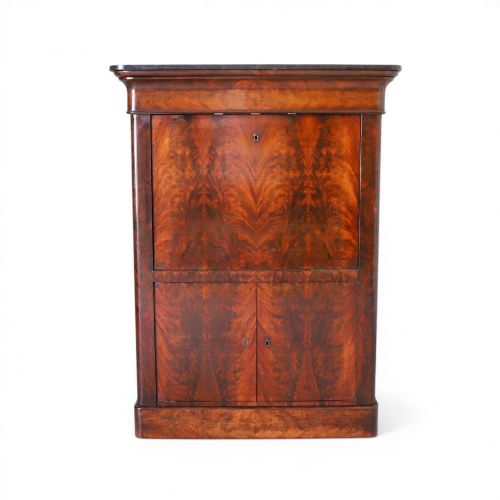


Empire Style Secretaire Desk
These empire style secretaire desk examples combine grand architectural presence with practical fitted writing surfaces for domestic use.
Empire Style Secretaire Desk
An empire style secretaire desk brings architectural dignity to a room, functioning primarily as a writing cabinet with a drop-down flap or cylinder front. Buyers searching for an empire style secretaire desk encounter nineteenth-century Continental forms, particularly French Empire and Biedermeier expressions.
The material vocabulary relies heavily on mahogany, flame mahogany, and walnut, often elevated by contrasting ebonised birch or marble tops. These pieces frequently incorporate secret drawers concealed behind architectural facades, alongside fitted pigeonholes and small compartments for correspondence.
How empire style secretaire desk furniture was constructed
Cabinetmakers utilised dense timbers such as mahogany and walnut as foundational bases, frequently applying figured flame mahogany veneers to large flat surfaces to create striking visual patterns. Structural integrity relied on robust carcase construction in secondary woods like oak, supporting heavy marble slabs where specified.
Decorative enrichment depended on cast and chased ormolu mounts, brass accents, and ebonised detailing that defined the neoclassical aesthetic. Drawer linings and interior fittings demonstrate traditional joinery techniques, accommodating complex mechanical drops and secret locking mechanisms.
Empire Style Secretaire Desk Retail Price Guide 2026
Typical asking prices for empire style secretaire desk among the pieces listed under this phrase on Sellingantiques today, from the lower quarter to the upper quarter. They describe what is for sale here now, not the wider market.
Many cabinets conceal secret compartments behind false drawer fronts to hide private correspondence.
What separates fine examples from standard items
Quality rests upon the selection and matching of wood veneers, where symmetrical flame patterns across a cylinder front or drop-down flap indicate superior craftsmanship. The precision of cabinet joinery around interior pigeonholes and hidden compartments further distinguishes finer workshop output.
The integration and chasing of metal mounts determine the refinement of the piece, as finely detailed ormolu hardware sits flush and harmonises with the timber grain. Integrity of original marble tops and the smooth operation of writing surfaces dictate the overall preservation state.
The Empire Style Secretaire Desk Glossary
- Secrétaire à abattant
- A tall upright cabinet featuring a hinged fall-front writing flap that conceals an interior of small drawers and pigeonholes. This form provides a compact workspace while concealing domestic paperwork behind formal architectural doors.
- Ormolu
- Gilded bronze mounts applied to furniture for decorative contrast and neoclassical ornamentation. The technique involves applying a mercury and gold amalgam to cast bronze before firing.
- Biedermeier
- A central European style spanning the nineteenth century that prioritised clean lines, domestic utility, and native timbers over heavy ornamentation. It offers a restrained interpretation of empire aesthetics.
- Escritoire
- A writing desk or cabinet designed specifically for correspondence and the storage of writing materials. The term encompasses various desk forms with enclosed writing surfaces.
Empire Style Secretaire Desk: Frequently Asked Questions
What is an empire style secretaire desk?
An empire style secretaire desk is a nineteenth-century storage and writing cabinet defined by neoclassical proportions, architectural details, and a drop-down or cylinder writing surface.
These pieces typically feature rich mahogany or walnut veneers, sometimes accented with brass or ormolu mounts and topped with marble.
How do I use the writing flap?
The drop-down flap, known as the abattant, pulls down to create a horizontal writing surface supported by internal stays or desk arms.
Once lowered, it reveals a fitted interior containing small drawers and pigeonholes designed for letters and stationery.
Where were these desks made?
The pieces seen in this tradition originate primarily from continental Europe, spanning French Empire workshops and German-speaking Biedermeier regions.
Craftsmen in these areas adapted classical architectural motifs for sophisticated domestic interiors.
How do I identify Biedermeier pieces?
Biedermeier furniture is recognised by its lighter birch or walnut timbers, minimalist geometry, and absence of heavy metal mounts.
It focuses on the natural grain of the wood rather than classical military ornamentation.