



Empire Period Lighting
Empire period lighting brings heavy classical grandeur into a room, pairing deep patinated bronze with glittering ormolu to catch the candlelight.
Empire Period Lighting
When you search for empire period lighting, you are looking at substantial metalwork shaped by the classical revival across the nineteenth century, including the Regency and Charles X eras. These pieces range from simple candlesticks to multi-light candelabra, wall lights, and ceiling lanterns.
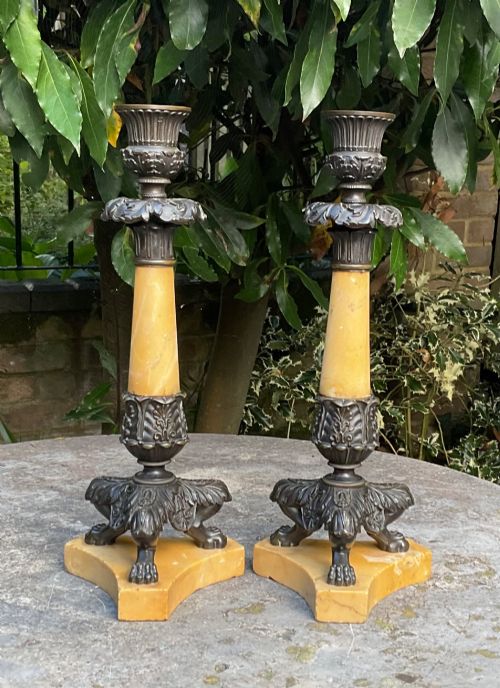
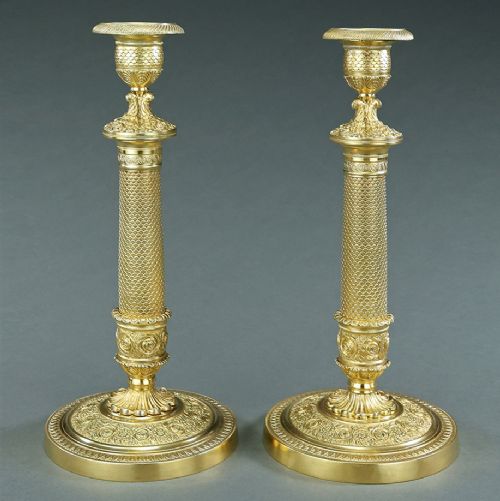
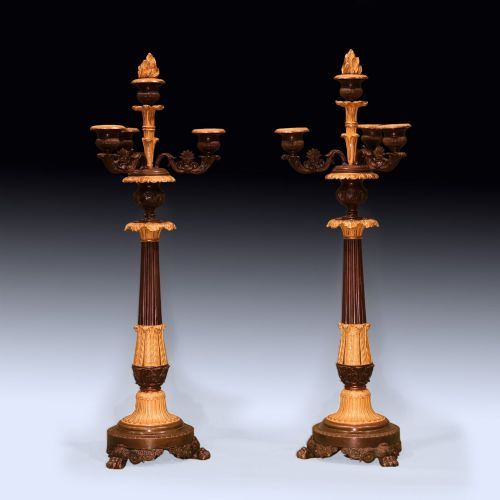
You are most likely to meet pairs of bronze and ormolu candlesticks or candelabra on this page, often mounted upon marble plinths. The forms draw directly on ancient Greek and Roman design, showing dolphins, griffins, and classical figures.
The objects span French Empire, Regency, and Neoclassical styles, reflecting a shared obsession with symmetry, military might, and mythological motifs. Makers adapted these grand continental designs for British interiors as well, creating the Regency equivalents seen here.
Materials and Construction
These pieces rely on a combination of cast bronze, patinated dark bronze, and fire-gilded ormolu, which creates a sharp visual contrast between dark metallic surfaces and bright gold highlights. Founders used lost-wax or sand-casting methods to achieve crisp detail, then chased the metal surfaces by hand.
Many designs incorporate natural materials like Sienna marble and slate for heavy plinths and bases, anchoring the soaring metallic branches above. Cut glass lustres occasionally dangle from the arms to refract the flickering light.
Empire Period Lighting Retail Price Guide 2026
Typical asking prices for empire period lighting among the pieces listed under this phrase on Sellingantiques today, from the lower quarter to the upper quarter. They describe what is for sale here now, not the wider market.
Several heavy bronze candlesticks take the form of arched dolphins, leaping to support the light above.
What Defines Quality
The standard of chasing and the sharpness of the casting separate average examples from the finest pieces. Superior ormolu shows deep, even gold colour and crisp leaf work that does not blur at the edges.
The weight of the bronze and the solidity of the marble plinths dictate the overall presence of the object. Signed works or those employing complex figural forms like dolphins and griffins sit firmly at the top of the range.
Rabiat
The Empire Period Lighting Glossary
- Ormolu
- A type of gilding that applies finely ground high-carat gold amalgam to a bronze object before the mercury is driven off by heat. This technique creates a durable, rich golden surface.
- Patinated Bronze
- Bronze treated with chemicals or heat to darken the surface, producing a rich brown or black tone. This dark finish provides contrast against bright ormolu mountings.
- Candelabra
- A branched candlestick designed to hold multiple candles at once. These often feature removable arms or central finials.
- Sienna Marble
- A highly decorative yellow marble with purple and grey veining, quarried in Italy. It frequently forms the heavy plinths beneath bronze lighting.
- Athenienne
- A classical tripod stand or burner adapted during the Neoclassical period to serve as a decorative support or incense burner.
Empire Period Lighting: Frequently Asked Questions
What is empire period lighting?
Empire period lighting consists of heavy bronze and ormolu candlesticks, candelabra, and wall lights made during the early nineteenth century. The style draws heavily on classical Greek, Roman, and Egyptian motifs popular during the Napoleonic era and the British Regency.
These pieces were designed to display wealth and a refined classical taste by illuminating grand rooms with polished metal and flickering candlelight.
How were these lights used?
Candlesticks and candelabra sat upon mantelpieces, sideboards, and dining tables to provide functional illumination before the advent of gas and electric lighting. Wall lights were mounted beside mirrors or windows to reflect and multiply the available light.
Multi-light candelabra often featured adjustable arms to direct the illumination where it was needed most during evening gatherings.
How do I tell French Empire from Regency lighting?
French Empire pieces often display bolder Napoleonic symbols, military trophies, and richer fire-gilding. Regency lighting translates these French forms into a British idiom, sometimes incorporating local motifs like dolphins or bamboo alongside classical elements.
Both styles share a foundation in Neoclassical design, but the handling of the bronze and the choice of marble often point to the side of the Channel where the piece was cast.