
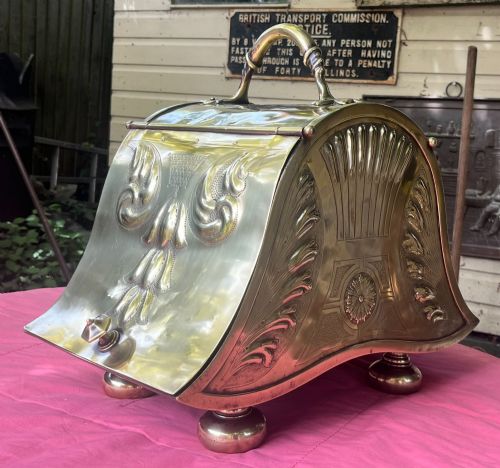


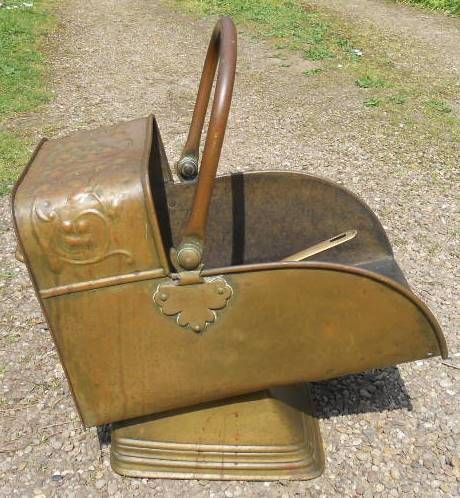
Embossed Brass Coal Helmet
An embossed brass coal helmet stands ready by the hearth, combining practical fuel storage with bright Victorian metalwork to warm the room.
Embossed Brass Coal Helmet
An embossed brass coal helmet is a fireside vessel designed to hold solid fuel close to the grate. These containers take the distinctive sloped shape of a medieval headpiece, featuring a wide mouth for shovelling and a raised rear handle.
The pieces on this page span the Victorian and Edwardian eras, alongside earlier Regency examples and later 19th Century work. Alongside the typical helmet profile, the selection includes coal buckets, double-lidded boxes, and country house bins.
Makers utilised sheet brass, cast brass, and copper, frequently combining the metal body with wooden handles in ebonised wood or ebony. The outer surfaces often display raised ornamentation achieved through hammering or pressing.
How they were made
Sheet brass and copper formed the main bodies of these helmets, shaped to create the characteristic curved hood and slanted opening. Artisans utilised cast brass for handles, feet, and hinges, ensuring the movable parts supported the daily weight of coal.
Surface ornamentation relied on embossing, where craftsmen pressed or hammered designs into the metal from behind to create raised patterns. Handles frequently incorporated turned ebony or ebonised wood to provide a secure grip insulated from the metal.
What varies in quality
Quality rests in the weight of the metal and the crispness of the raised decoration across the body. Thicker sheet brass and deep, well-defined embossing distinguish finer items from simpler production.
The integrity of the construction marks the difference between standard and superior pieces. Riveted joints, solid cast handles, and original wooden grips demonstrate attentive manufacturing.
Benham & Froud·Henry Loveridge
The Embossed Brass Coal Helmet Glossary
- Coal helmet
- A fireside vessel shaped with a high back and a sloped front resembling a headpiece. This form allowed easy scooping of fuel onto the fire.
- Embossing
- A technique where patterns are raised in relief on the surface of sheet metal by hammering from the reverse side. This adds texture and visual depth to the brass or copper body.
- Ebonised wood
- Timber treated to resemble ebony, frequently utilised for the grab handles on fireside buckets. The dark finish provides a contrast against polished brass.
- Fireside accessory
- A functional household object intended for placement near the hearth. These items combine utility with decorative metalwork suited to reception rooms.
Embossed Brass Coal Helmet: Frequently Asked Questions
What is a coal helmet?
A coal helmet is a traditional fireside container shaped with a flared mouth and a high back, designed specifically to hold and transport solid fuel. The profile resembles a historical headpiece, which made it both a functional tool and a decorative object.
These vessels sat beside the fireplace in Victorian and Edwardian parlours. Their form allowed servants or homeowners to scoop coal cleanly onto the grate.
How do I clean embossed brass?
Embossed brass requires gentle cleaning to preserve the dark patina in the recessed areas of the pattern. Use a soft cloth and mild metal polish, avoiding abrasive pads that flatten the raised details.
Many collectors prefer to leave a light aged tone on older metalwork. Excessive polishing removes the historical character accumulated over decades by the hearth.
Are these coal helmets still functional?
These pieces were built to hold heavy loads of solid fuel and remain sturdy enough for daily use today. Many owners continue to use them beside open fires or wood-burning stoves.
Alternatively, they function well as decorative containers for magazines or dried kindling. Their metallic surfaces bring warmth and reflection to modern living spaces.
How do I date a brass coal helmet?
Dating relies on stylistic clues, manufacturing methods, and the types of handles or fixings used on the body. Pieces from the Regency era tend to feature neoclassical lines, while Victorian and Edwardian examples often display rich embossing or Art Nouveau motifs. Nail types, hinge construction, and maker marks stamped into the metal also help establish the decade of production. Comparing the weight and decorative style provides a reliable guide to age.