
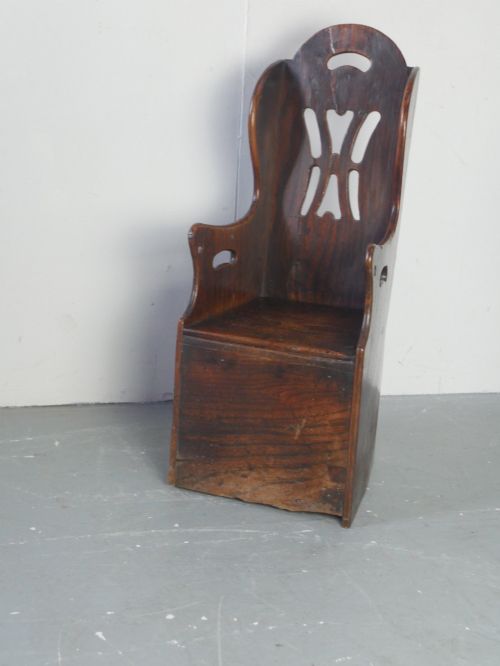
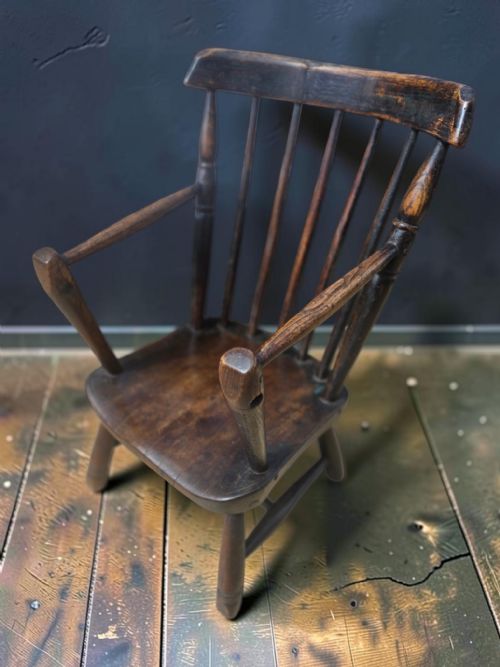
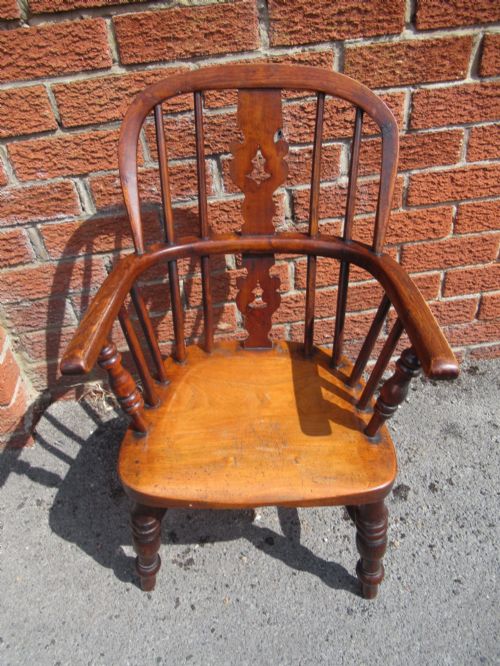


Elm Country Child Chair
An elm country child chair is a small vernacular seat built for domestic use, prized for its honest regional character and durable timbers.
Elm Country Child Chair
When you examine an elm country child chair, you find robust domestic seating scaled down for younger occupants. The pieces span periods from the eighteenth century through the Edwardian era and into the early twentieth century, showing rich vernacular traditions across English regions.
The versions most commonly met on this page are Windsor armchairs and stick-back designs, frequently constructed with elm seats combined with ash, beech, or yew for the framework. Makers applied vernacular styles ranging from Georgian and Victorian country models to simpler spindle-back and rocking formats.
How they were made
Craftsmen built these chairs using solid native timbers, pairing heavily grained elm for carved saddle seats with straight-grained ash, beech, or fruitwood for spindles and legs. Turners shaped components on pole lathes while joiners bored holes directly into the solid wooden seats to receive tenons.
Construction relied heavily on traditional Windsor techniques, securing spindles and legs with wedges to form rigid joints without complex metal hardware. Workshops often utilised bentwood methods for hooped backrests, steaming timbers to achieve curved continuous rails.
The inventory encompasses standard armchairs, rocking chairs, high chairs, potty chairs, and commode chairs.
What varies in quality
The distinction between ordinary and superior pieces rests on the selection of timber and the dexterity of the turning. Better examples exhibit richly figured elm seats with deep saddle depressions alongside slender, well-proportioned spindles.
Structural harmony also separates grades, with finer workshops achieving balanced proportions that mirror full-sized vernacular seating rather than clumsy miniatures. The integration of rarer secondary woods like yew or fruitwood further elevates the standing of an individual piece.
The Elm Country Child Chair Glossary
- Windsor chair
- A chair built with a solid wooden seat into which the legs and back spindles are separately inserted. This method created sturdy seating widely adopted by rural joiners.
- Crinoline stretcher
- A curved hoop stretcher linking the legs of a chair to provide rigidity. The design draws its name from the shape of mid-nineteenth-century hooped petticoats.
- Vernacular furniture
- Practical domestic objects made by regional craftsmen using local materials and traditional methods rather than strict academic pattern books.
- Saddle seat
- A wooden chair base sculpted with hollows and contours to mimic the shape of a saddle. Elm was frequently chosen for this due to its resistance to splitting.
- Spindle back
- A chair back constructed from a series of turned vertical wooden rods. These rods connected a solid seat to a top rail.
Elm Country Child Chair: Frequently Asked Questions
What is an elm country child chair?
These pieces are scaled-down versions of traditional adult vernacular seating, produced for domestic use in rural households.
They combine robust construction with local timbers, offering a tangible link to historical family life and regional woodworking traditions.
How were child windsors used?
Rural families relied on these small seats for everyday domestic life, placing them near hearths or dining tables for young children.
Some examples incorporated rocking rails or commode functions, adapting the basic Windsor form for nursery routines.
How do I date an elm child chair?
Dating relies on observing construction traits, timber choices, and overall stylistic vernacular details that shifted between the eighteenth and twentieth centuries.
Earlier eighteenth-century pieces often display heavier proportions and simpler turned members, while Victorian and Edwardian examples incorporate machine-tooled components and different wood combinations.
Why is elm used for the seats?
Elm possesses an interlocking grain structure that resists splitting when nails or wedged tenons are driven directly into the wood.
This characteristic made it the preferred material for carved saddle seats that needed to anchor sturdy leg and spindle assemblies.