

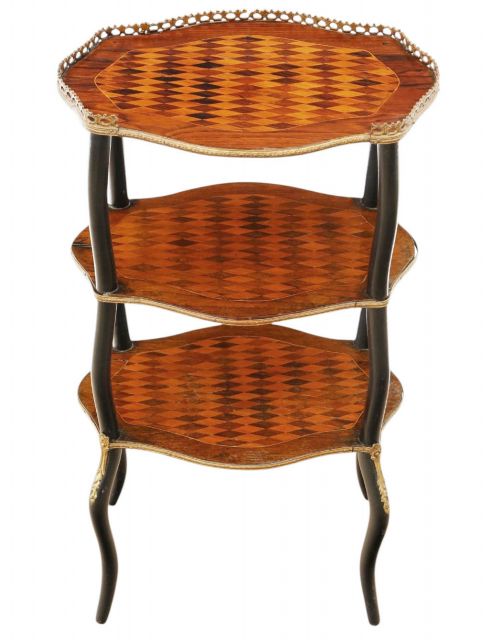


Edwardian Tiered Corner Table
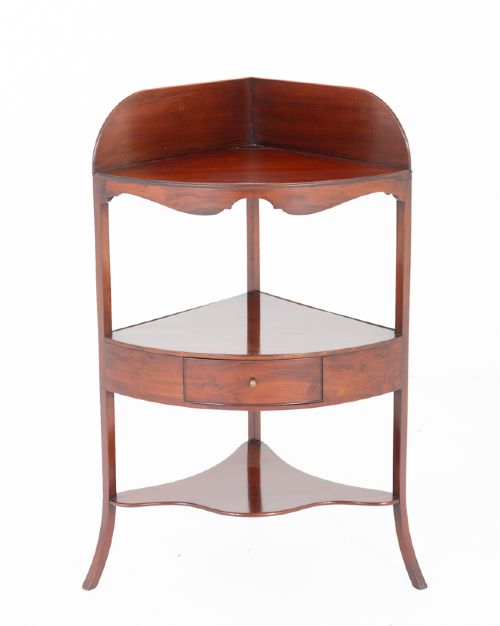
An Edwardian tiered corner table is a compact shelving piece designed to fit snug against a room junction, offering multiple surfaces for display and daily use.
Edwardian Tiered Corner Table
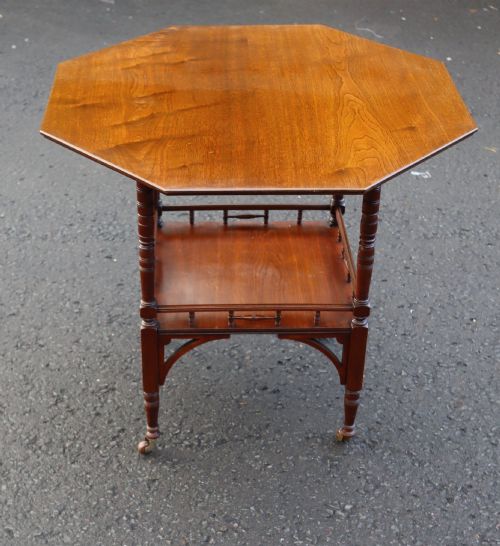
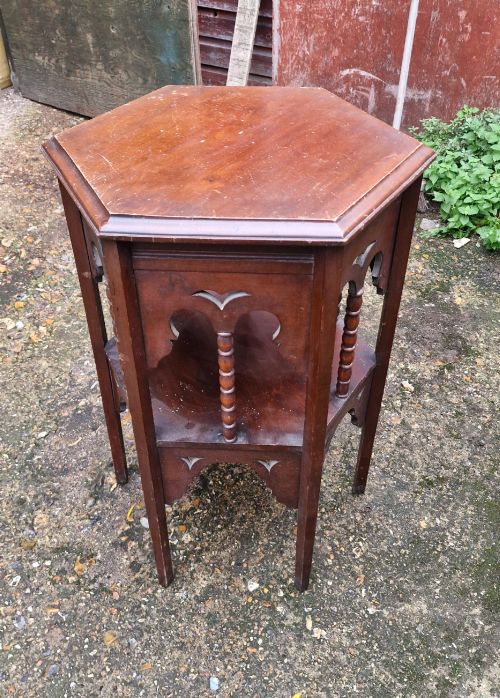
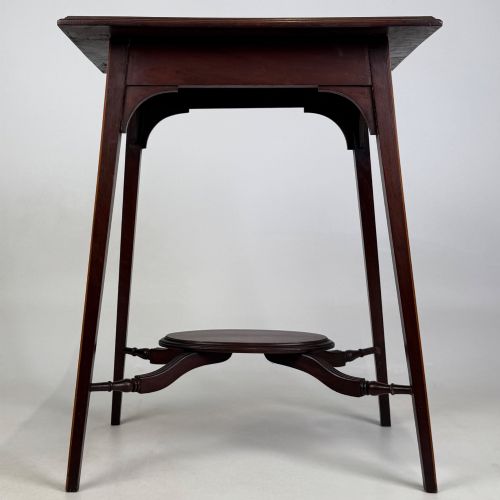
An edwardian tiered corner table appears in forms ranging from simple occasional tables and side tables to multi-shelf etageres, whatnot display shelves, and plant stands. These items originate predominantly from the Edwardian period, alongside examples spanning from the late Victorian era through the 1920s.
Makers utilised various timber types including mahogany, oak, walnut, beech, and ebonised wood, frequently enhanced with satinwood inlay, boxwood, and mixed timber parquetry. Most variants employ multi-tiered structures or shaped tops such as six-sided and octagonal formats to maximise display capacity in compact spaces.
How they were made
Carpenters constructed these tables using solid hardwoods and veneers, applying brass fittings on specific models for structural or decorative reinforcement. Inlaid decoration often involved contrasting timbers like satinwood and boxwood set directly into mahogany surfaces.
Finishing techniques included ebonising timber to imitate more costly materials, hand carving on structural supports, and applying delicate parquetry geometric patterns across table tops and display tiers.
Edwardian Tiered Corner Table Retail Price Guide 2026
Typical asking prices for edwardian tiered corner table among the pieces listed under this phrase on Sellingantiques today, from the lower quarter to the upper quarter. They describe what is for sale here now, not the wider market.
Several tables hedge their bets with six-sided tops, refusing to commit fully to either a square or a circle.
What varies in quality
Quality differences emerge through the complexity of the timber preparation and the precision of inlaid work, where intricate parquetry and fine satinwood stringing demand high levels of joinery skill. Simpler turned leg models in beech or oak sit at a different craftsmanship tier compared to heavily inlaid mahogany or walnut display pieces.
The integrity of the tier supports and the choice of primary timber dictate the longevity and overall finish of the structure. Finer examples integrate thoughtful proportions with harmonious wood grains across multiple levels rather than relying solely on applied surface decoration.
Liberty of London
The Edwardian Tiered Corner Table Glossary
- Etagere
- A piece of furniture consisting of a set of open shelves for displaying small objects or ornaments. These tiers graduate in size or maintain uniform platforms depending on the specific model.
- Parquetry
- Geometric mosaic woodwork used for decorative floors, table tops, or panels. Artisans arrange small blocks of contrasting timber to form intricate patterns.
- Satinwood
- A hard, durable timber with a characteristic golden-yellow sheen used extensively for cabinet making and fine stringing. It provides striking contrast when inlaid into darker woods like mahogany.
- Whatnot
- An open set of multi-tiered shelves designed for holding bric-a-brac, books, or ornaments. This form gained widespread popularity throughout the Victorian and Edwardian eras.
- Dumb Waiter
- A tiered movable serving table or stand used for holding dishes or decorative items. These tiered structures provide multiple surfaces without occupying excessive floor space.
Edwardian Tiered Corner Table: Frequently Asked Questions
Where should I place an edwardian tiered corner table?
These pieces fit naturally into unused room junctions where traditional rectangular furniture leaves awkward gaps. Their multi-tiered design provides vertical display space for plants, books, and ornaments without crowding the floor.
Position them in living rooms, hallways, or studies to draw the eye upward and utilise dead architectural angles effectively.
How do I identify an edwardian piece?
Edwardian furniture generally exhibits lighter proportions and brighter timber tones than its heavy Victorian predecessors. Look for restrained inlay work, slender turned legs, and functional multi-tiered shelving.
Design influences from the Sheraton Revival period frequently appear through symmetrical stringing, satinwood details, and refined classical motifs.
What is the difference between an etagere and a corner table?
An etagere specifically prioritises open display shelving across multiple tiers, often taking a freestanding or corner-fitting role to showcase decorative objects. A corner table may function primarily as a low surface with a single top, though many edwardian examples incorporate a secondary lower shelf.
Both forms serve similar spatial functions but etageres lean heavier into vertical display capacity.
Can these tables hold heavy items?
Most of these tables were built for decorative ornaments, small lamps, and plants rather than heavy loads. The upper tiers on multi-shelf models and etageres are typically supported by slender vertical posts.
Distribute weight evenly across the main surfaces and reserve delicate top tiers for lighter decorative pieces.