
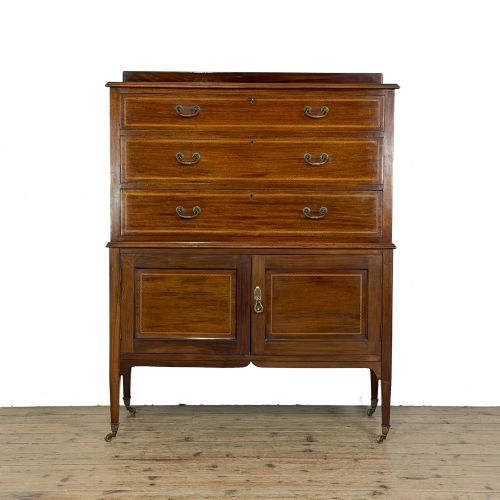
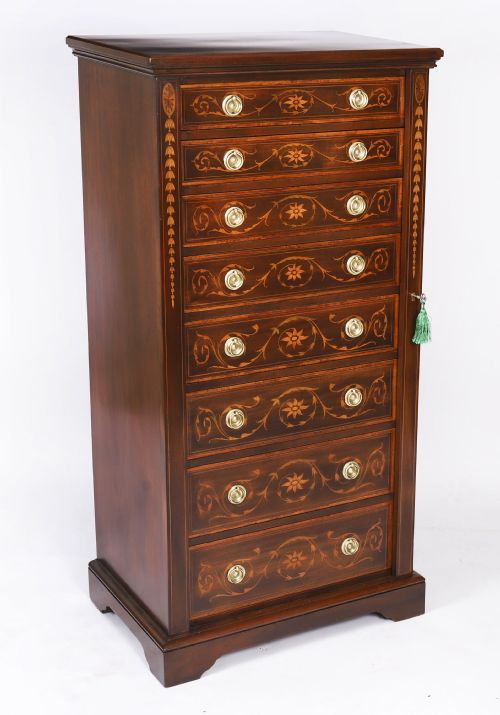


Edwardian Tall Drawer Unit
An edwardian tall drawer unit brings vertical storage and period character to any room, offering practical depth without crowding the floor.
Edwardian Tall Drawer Unit
An edwardian tall drawer unit covers a practical range of vertical storage forms, from slim bedroom chests to specialised music cabinets and towering banks of drawers. You will most frequently encounter mahogany and oak constructions designed to maximise capacity in rooms with limited floor space.
The selection on this page stretches from standard Edwardian and early twentieth-century workshop pieces to related variants like tall bookcases and multi-tier shelving units. These taller formats reflect a period focus on efficient domestic and commercial organisation.
How they were made
Cabinet makers relied on solid mahogany, oak, and walnut, frequently enhancing drawer fronts with delicate satinwood inlay and mounting the doors or drawers with brass hardware. Pine also served as a sturdy structural timber, particularly in utilitarian workshop furniture.
Construction techniques balanced domestic refinement with industrial demands, utilising dovetailed drawer joints and fitted internal compartments for music sheets, documents, or specimens.
Recorded forms span across filing cabinets, music cabinets, bookcases, and banks of twenty-four drawers.
What varies in quality
Quality rests upon the selection of timbers and the crispness of decorative detailing, such as fine satinwood inlay against rich mahogany grounds. Finer examples display meticulous joinery and balanced proportions that elevate utilitarian pieces into accomplished cabinet work.
Commercial and filing formats distinguish themselves through robust hardware and uncompromised structural integrity designed for heavy daily use, whereas domestic cabinets prioritize polished decorative surfaces.
J Shoolbred
The Edwardian Tall Drawer Unit Glossary
- Wellington chest
- A tall, narrow chest of drawers secured by a locking side flap that hinges down over the drawer edges. This specific form provides high-capacity storage within a compact footprint.
- Bank of drawers
- A large cabinet containing numerous shallow drawers arranged in multiple columns and rows. These units originated in commercial or institutional settings for cataloguing items.
- Satinwood
- A luminous, yellow-brown hardwood native to Ceylon and India, prized for its natural sheen. Makers used it predominantly for stringing and decorative inlay work on darker timbers.
- Whatnot
- An open set of tiered shelves supported by slender uprights, designed for displaying ornaments or holding books. These versatile pieces gained widespread popularity during the nineteenth and Edwardian periods.
Edwardian Tall Drawer Unit: Frequently Asked Questions
Where were tall drawer units used?
These tall formats suited bedrooms, studies, and music rooms where floor space was at a premium. Domestic versions held garments or sheet music, while commercial variants organised office paperwork.
Industrial workshop pieces provided heavy-duty storage for tools or specimens. Their vertical design allowed maximum capacity without obstructing room flow.
How do I identify Edwardian proportions?
Edwardian furniture generally favours lighter, more slender proportions than bulky Victorian predecessors. Pieces often feature straight lines and restrained decorative flourishes.
Makers balanced height with visual lightness, using tapered legs or subtle inlay to soften towering vertical panels.
Are these units suitable for modern rooms?
Their vertical orientation makes them exceptionally practical for modern flats and rooms with restricted floor space. They deliver generous storage capacity while occupying minimal square footage.
Rich timber tones and period hardware add warmth and character to contemporary interiors.
What is a music cabinet?
A music cabinet is a specialised low or tall piece designed specifically to store sheet music and scores. They typically feature a series of shallow drop-front drawers or internal vertical shelves.
Finely panelled doors often conceal the contents to maintain a neat appearance in the parlour or drawing room.