
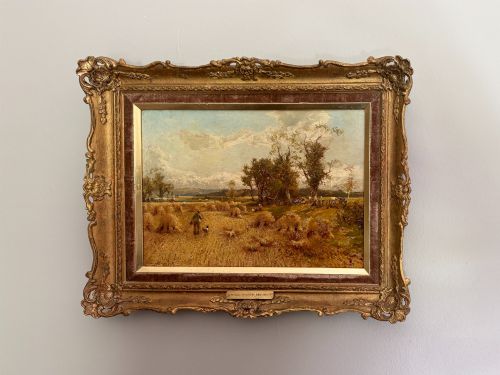
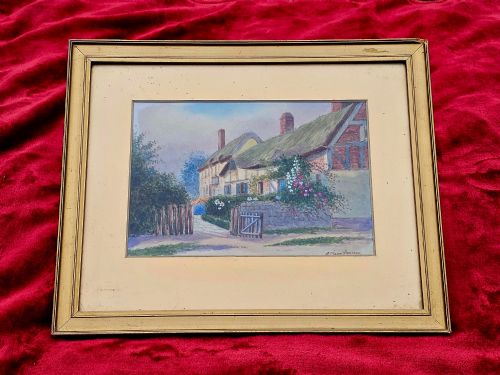
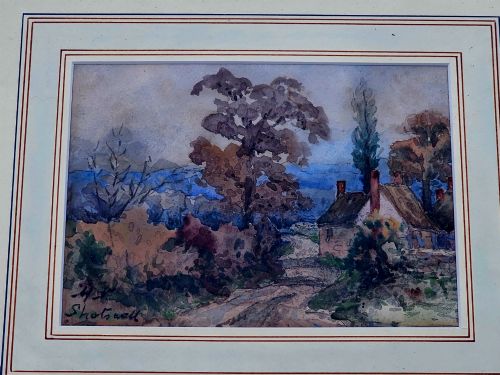
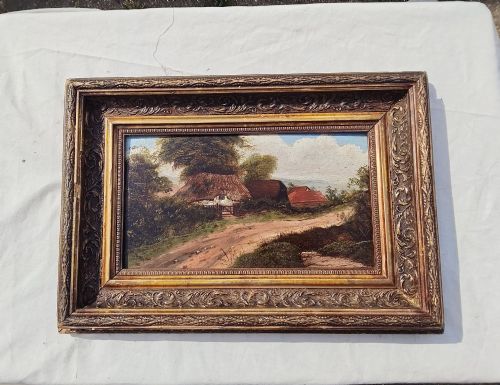


Edwardian Rural Landscape Picture
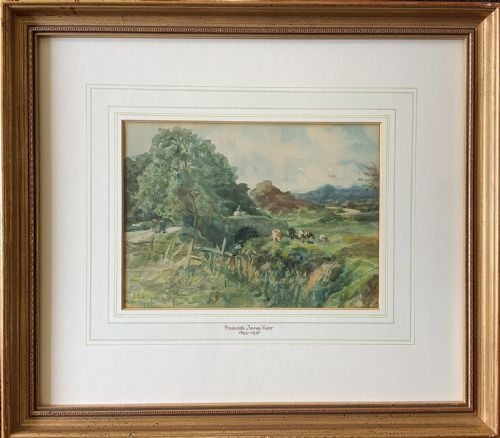
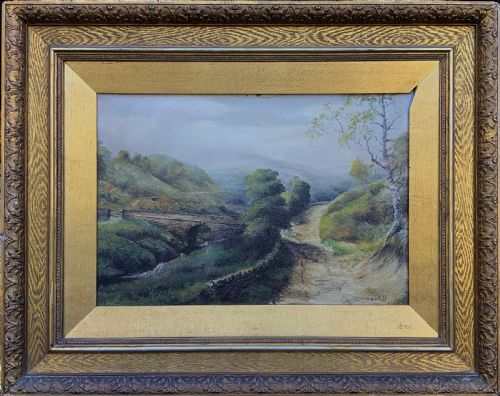
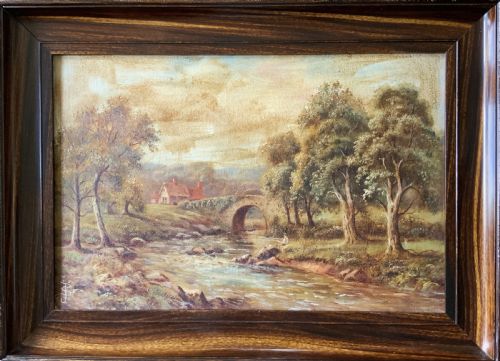
An edwardian rural landscape picture captures a quiet view of farmland, cottages and country life on paper or canvas.
Edwardian Rural Landscape Picture
An edwardian rural landscape picture brings the fields, rivers and villages of Britain into an interior through the medium of paint.
Most examples found here date from the late nineteenth century into the early decades of the twentieth century, reflecting a period of pastoral realism and impressionism.
Subjects range from farm labourers and heavy horses at work to quiet streams, thatched cottages and coastal villages.
Watercolour and Oil on Supports
Artists worked primarily in watercolour on paper or oil paint applied to canvas, card or board, often framing the finished work in gilt wood.
Watercolours rely on transparent washes and careful pencil underdrawing to capture light and atmosphere, whilst oils permit heavier impasto and richer texture.
Supports varied according to scale and artist preference, with smaller panels and cards used for swift plein-air studies and larger canvases reserved for finished compositions.
Several pictures record the exact moment chickens were fed or hay was cut in forgotten fields.
Brushwork and Composition
Quality rests upon the confidence of the brushwork and the artist's command of light, tone and natural movement within the scene.
Stronger pieces demonstrate careful observation of human and animal figures integrated naturally into the topography, avoiding stiff or formulaic placement.
Condition of the surface, preservation beneath glass and the retention of the original or period frame all contribute to the integrity of the surviving work.
A. Marie Parsons·Frederick James Kerr·Sydney Yates Johnson·Henry Charles Fox·Cuthbert Crossley·Henry John Yeend King·M. C. Hider·John Atkinson·James William Booth·George Soper·William Langley·George Kilburne·Vernon Stokes·B. Kaufmann·Joseph Kirkpatrick·Fred Stead·Kershaw Schofield·Arthur Claude Strachan·John Abernethy Lynas-Gray·Samuel Towers·William Manners·Walter Duncan·George Hamilton Constantine·Thomas Nicholson Tyndale·William Greaves
The Edwardian Rural Landscape Picture Glossary
- Watercolour
- A painting method using pigment suspended in a water-based solution applied to paper. It relies on the white of the paper shining through translucent washes.
- Impressionism
- A style focusing on the accurate depiction of light in its changing qualities, often using visible brushstrokes. British practitioners adapted these continental methods to local scenery.
- Gilt wood
- Timber frames coated in a thin layer of gold leaf or metallic gilt. These mouldings protect the artwork and complement the tonal palette of the painting.
- Plein-air
- Painting outdoors to capture direct observations of natural light and weather. This practice became widespread among landscape artists in the nineteenth century.
- Provenance
- The documented history of ownership of an artwork. A clear lineage helps verify the attribution and age of a landscape picture.
Edwardian Rural Landscape Picture: Frequently Asked Questions
How do I date a rural landscape picture?
Dating relies on costume details in any figures, the style of the frame, and known working dates of the artist recorded in signatures or inscriptions.
Paper stock, canvas types and written notes on the reverse often provide additional clues to the exact decade of creation.
Were these watercolours always framed?
Most watercolours on paper were framed behind glass shortly after completion to protect the delicate medium from moisture and dust.
Original period frames often show appropriate wear that matches the age of the painting within.
What is the difference between oil and watercolour here?
Watercolours utilise thin, translucent washes on paper to create light, airy effects, whereas oils offer thicker pigment layers on canvas or board.
Oils generally present a heavier texture and richer surface depth than works executed on paper supports.
How should I care for an antique landscape?
Keep works on paper away from direct sunlight to prevent the watercolour pigments from fading over time.
Maintain stable room temperatures and avoid hanging pieces in damp environments such as kitchens or unheated rooms.