




Edwardian Pearl Bangle
An Edwardian pearl bangle captures the delicate grace of early twentieth-century design through luminous pearls set in rich gold and platinum.
Edwardian Pearl Bangle
An edwardian pearl bangle is a rigid wrist ornament typically defined by fine gemstones and pearls created during the early 1900s. These pieces often feature hinged structures designed to sit securely on the wrist, reflecting the refined tastes of the period.
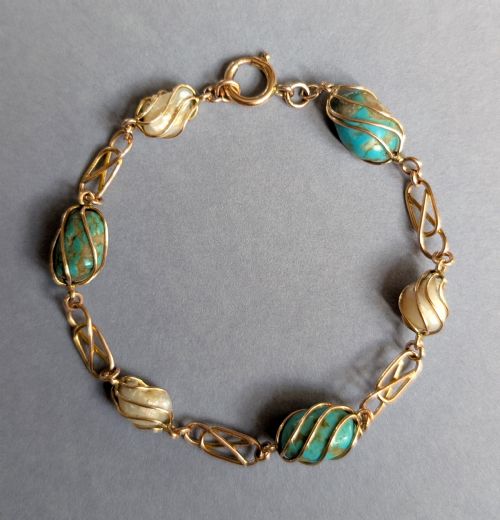
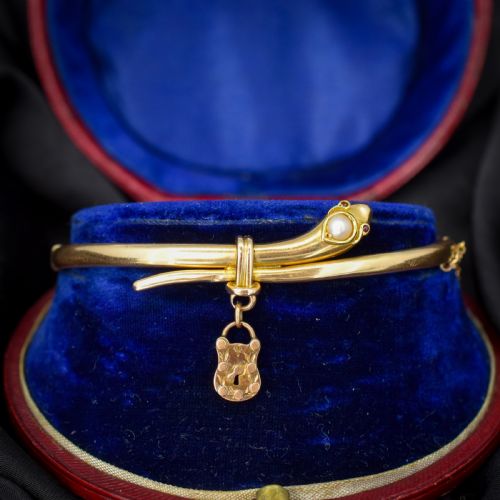
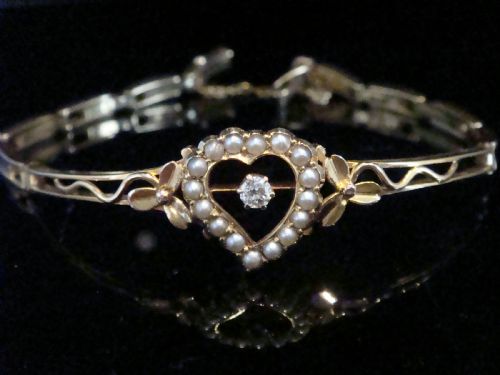
Most examples found here date from the Edwardian era and surrounding decades, frequently incorporating seed pearls alongside materials like turquoise, diamond and sapphire. The forms range from simple floral motifs to intricate double heart and snake configurations.
Makers of the period utilised both traditional yellow gold and emerging platinum settings to showcase natural saltwater and seed pearls. These bracelets bridge the aesthetic transition from late Victorian sentimentality to the crisp geometry of Art Deco.
How They Were Made
Jews and goldsmiths constructed these bangles using 9ct gold, 15ct yellow or rose gold, 18ct gold and platinum. Metalwork techniques included casting, wire twisting and hollow forming to create substantial yet wearable weights.
Pearls and seed pearls were meticulously set alongside diamonds, turquoise and aquamarine. Many designs employed delicate claw settings or bezel mounts to secure small stones whilst maximising light exposure.
Several bangles incorporate glass shaker compartments, allowing tiny seed pearls to rattle about delightfully behind a crystal face.
What Varies in Quality
The distinction between tiers rests upon the choice of precious metal and the precision of the stone setting. Higher grade examples employ 15ct or 18ct gold alongside platinum, paired with natural saltwater pearls and well-matched diamonds rather than seed pearls alone.
Construction intricacy also dictates worth, separating standard production bangles from complex serpent, double heart or twin bangle configurations. Original fitted boxes and documented provenance further elevate specific pieces.
The Edwardian Pearl Bangle Glossary
- Edwardian
- A stylistic period spanning from roughly 1901 to 1910 characterised by light, garland-style jewellery and extensive use of platinum. This era followed the Victorian period and preceded Art Deco.
- Seed pearl
- A very small, naturally formed pearl often used in clusters or floral motifs. They appear frequently in Edwardian and late Victorian jewellery.
- Saltwater pearl
- A pearl cultivated or naturally grown in marine molluscs. These command attention for their distinct lustre compared to freshwater varieties.
- Bangle
- A rigid bracelet that slips over the hand or opens via a hinged clasp. They range in profile from slender wire bands to wide hollow forms.
- Belle Epoque
- A period of optimism and artistic refinement running concurrently with the Edwardian era. Jewellery from this time relies heavily on platinum wirework and diamond accents.
Edwardian Pearl Bangle: Frequently Asked Questions
How do I wear an edwardian pearl bangle?
These rigid bracelets are designed to slide onto the wrist, often securing with a tongue clasp and safety chain for added security. They suit standalone wear or pairing with complementary gold and diamond rings from the same era.
Care should be taken to protect the pearls from harsh chemicals, perfumes and cosmetics, as organic gems are sensitive to acids and moisture. Storing the bangle in a lined box prevents surface scratching against other items.
What periods do these bangles come from?
The pieces span the late 19th century through to the 1930s, with a heavy concentration originating in the Edwardian era and the Belle Epoque. You will also encounter transitional Victorian pieces and later Art Deco designs.
Datings are derived from hallmark evidence, stylistic markers and the specific combination of metals like 15ct gold and platinum used during manufacturing.
Are pearls in these bangles natural?
Many listings feature natural saltwater pearls or delicate seed pearls gathered before the widespread cultivation of modern cultured pearls. Natural origin is a hallmark of the fine jewellery trade during the early twentieth century.
Microscopic examination of the drill holes and lustre helps specialists identify natural formation compared to later cultured alternatives.
What metals were used?
Jewellery from this timeframe utilises a variety of gold purities, predominantly 9ct, 15ct yellow or rose gold, and 18ct gold. Platinum also appears frequently, particularly in Edwardian and Belle Epoque pieces to create strong, thin settings for diamonds.
Rolled gold and silver also feature in specific regional or alternative grade pieces recorded in the listings.