


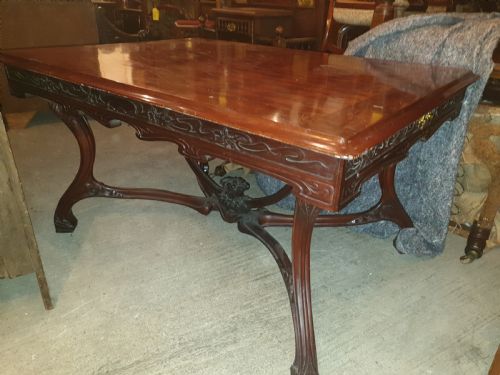
Edwardian Parlor Desk
These Edwardian parlor desk alternatives offer compact seating, with mahogany frames and inlay suited for period rooms.
Edwardian Parlor Desk
An edwardian parlor desk search brings up seating designed for domestic reception rooms rather than writing furniture, encompassing salon armchairs, side chairs, and musician seats in mahogany and rosewood. These pieces come primarily from the Edwardian period and the late Victorian era, reflecting the refined tastes of their original domestic settings.
The versions most commonly met on this page are salon armchairs and side chairs constructed from mahogany, often enhanced with satinwood inlay or marquetry. While designated as parlor seating rather than desks, they share the same delicate proportions and decorative timberwork valued in period interiors.
Materials and construction
Makers relied heavily on mahogany as the primary timber, occasionally utilising rosewood for specific Victorian examples. Wood inlay and satinwood inlay provided surface ornamentation to the timber frames.
Upholstery utilised fabric and velvet for the seats, supported by brass details where appropriate. Frames featured carved elements alongside inlaid marquetry.
Edwardian Parlor Desk Retail Price Guide 2026
Typical asking prices for edwardian parlor desk among the pieces listed under this phrase on Sellingantiques today, from the lower quarter to the upper quarter. They describe what is for sale here now, not the wider market.
Listings span periods from 1860 to 1910, encompassing Victorian, Late Victorian, and Edwardian styles.
Distinctions in quality
The refinement of the woodwork separates standard examples from finer pieces. Elaborate satinwood inlay and marquetry indicate greater craftsmanship than plain timber frames.
The integration of supportive upholstery with sturdy mahogany structure defines the upper tier of these parlor seats.
Jenks & Wood
The Edwardian Parlor Desk Glossary
- Mahogany
- A durable tropical hardwood favoured for its rich reddish-brown tone and stability in cabinetmaking. It forms the primary structural material for most pieces seen here.
- Marquetry
- The art of applying decorative pieces of veneer to a structure to form intricate designs. This technique appears on Edwardian salon chairs.
- Satinwood
- A light-yellow timber utilised for contrasting inlay work on darker woods. It provides bright detail against mahogany frames.
- Parlor
- A domestic reception room used for entertaining guests during the Victorian and Edwardian periods. Furniture made for this space prioritised elegance.
Edwardian Parlor Desk: Frequently Asked Questions
What are edwardian parlor desk alternatives used for?
These seating pieces served as decorative chairs in formal reception rooms for entertaining guests.
They provided comfortable auxiliary seating during social gatherings in Victorian and Edwardian homes.
How do I live with these chairs?
Place them in reception spaces or bedrooms where their delicate mahogany frames can be appreciated.
Protect the fabric or velvet upholstery from direct sunlight to preserve the textile materials.
How do I tell periods apart?
Victorian examples often display heavier rosewood construction or distinct musician chair configurations dating back to the mid-nineteenth century.
Edwardian pieces tend to feature lighter satinwood inlay and marquetry on mahogany frames.
What materials should I expect?
The primary material is mahogany, frequently decorated with satinwood inlay or marquetry.
Seats feature fabric or velvet upholstery, sometimes complemented by brass elements.