



Edwardian Mahogany Parlour Suite
Edwardian mahogany parlour suites bring refined seating and sophisticated entertaining spaces into the home with rich timber frames and elegant upholstery.
Edwardian Mahogany Parlour Suite
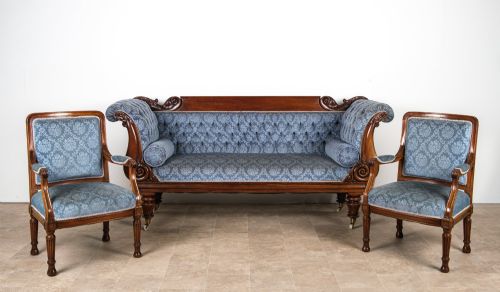
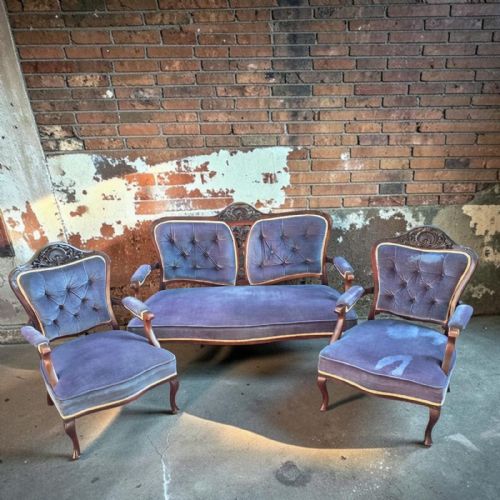
An edwardian mahogany parlour suite comprises matching or paired seating arrangements designed for formal reception rooms and sitting rooms. Buyers searching for an edwardian mahogany parlour suite will encounter matching sets consisting of settees, armchairs, and salon chairs intended to coordinate the decor of a room.
The selections span late Victorian and Edwardian periods, typically dating between eighteen ninety and nineteen ten. These suites manifest as three-piece, five-piece, or six-piece configurations combining settees with tub-shaped or open armchairs.
Forms vary from straightforward timber frames to elaborate suites designed for boudoir or salon use. Some examples arrive ready for re-upholstery while others retain their period fabric coverings.
How they were made
Cabinetmakers constructed these frames using solid mahogany, often highlighting the natural grain of the timber alongside delicate marquetry inlay and contrasting boxwood stringing. Frames frequently incorporated carved wooden details alongside structural brass fittings.
Upholstered elements relied upon traditional fabric coverings including damask and velvet to provide padded comfort on settees and matching chairs. Many pieces combined exposed inlaid woodwork with fully upholstered seats and backs.
Edwardian Mahogany Parlour Suite Retail Price Guide 2026
Typical asking prices for edwardian mahogany parlour suite among the pieces listed under this phrase on Sellingantiques today, from the lower quarter to the upper quarter. They describe what is for sale here now, not the wider market.
Tub-shaped settees offer a welcoming curve designed for corner placement in nineteenth-century drawing rooms.
What varies in quality
Quality differences emerge in the precision of the marquetry inlay and the complexity of the boxwood stringing across the mahogany surfaces. Finer examples display meticulous botanical or geometric patterns embedded directly into the timber framework.
The execution of carved wooden details and the overall cohesion of the matching suite dictate the tier of craftsmanship. Complete sets maintaining uniform styling across settees and armchairs demonstrate superior original design.
The Edwardian Mahogany Parlour Suite Glossary
- Parlour suite
- A coordinated set of seating furniture designed specifically for a formal reception room or parlour. These suites typically include a settee paired with matching armchairs.
- Marquetry inlay
- Decorative patterns formed by fitting contrasting pieces of wood veneer into the primary mahogany surface. This technique adds ornamental detail to the backs and crest rails of salon seating.
- Boxwood inlay
- Narrow strips of pale boxwood embedded into darker mahogany to create geometric borders and decorative lines. It defines the edges of panels on Edwardian furniture frames.
- Tub shaped settee
- A sofa featuring a continuous curved back and arms that wrap around the seated user. This comfortable form appears frequently in matching salon suites.
- Damask
- A reversible figured fabric traditionally utilised for upholstery on period seating. Its woven patterns provide a textured finish to parlour suite cushions.
Edwardian Mahogany Parlour Suite: Frequently Asked Questions
What pieces make up a parlour suite?
A parlour suite typically combines a two-seater settee or sofa with a matching pair of armchairs or occasional chairs.
Larger configurations occasionally expand to include five or six matching seating pieces designed for a uniform room layout.
How do I care for mahogany frames?
Maintain mahogany woodwork by dusting regularly with a soft dry cloth and avoiding direct exposure to strong sunlight.
Protect the polished timber surfaces from moisture and excessive heat fluctuations to preserve the finish.
Can these suites be re-upholstered?
Many period suites are suitable for re-upholstery to replace worn fabric while retaining the original wooden frame.
Some examples specifically require new fabric to match modern interior schemes while preserving the antique structure.
How do I distinguish Edwardian from Victorian styles?
Late Victorian pieces often feature heavier carved timber details and darker finishes compared to lighter Edwardian designs.
Edwardian suites lean towards brighter mahogany tones paired with delicate boxwood and marquetry inlay.