

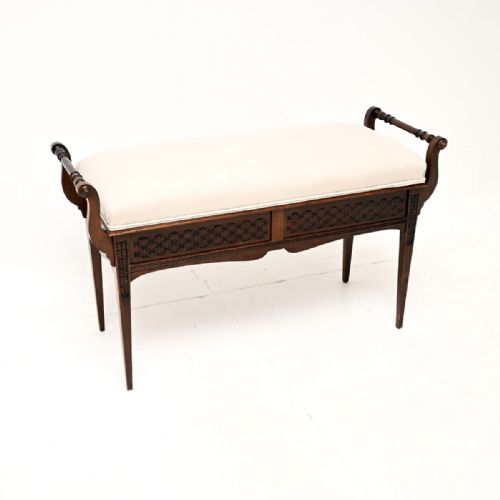


Edwardian Mahogany Duet Stool
An edwardian mahogany duet stool provides a wide seat for two players, combining practical music-making with refined domestic cabinet-making.
Edwardian Mahogany Duet Stool
An edwardian mahogany duet stool is a seating form designed specifically for two people sharing a piano or keyboard, appearing most frequently from the Edwardian period alongside examples dating from the late nineteenth century and the year nineteen hundred. These pieces function primarily as piano stools, piano stools and benches, or general stools and benches within domestic music rooms.
The objects seen here span several closely related styles, including Edwardian, Queen Anne revival, and Victorian designs. Makers constructed these seats to accommodate side-by-side performance while matching the prevailing polished wood aesthetics of contemporary parlours and drawing rooms.
How they were made
The primary material used for these pieces is mahogany, often enhanced with delicate decorative details such as boxwood inlay or satinwood inlay to create contrasting borders and motifs. Structural and decorative elements incorporate various metals, including brass, adding functional strength and visual accent to the frames.
Upholstery forms a crucial part of the construction, utilising fabric or leather surfaces to provide a comfortable seat for the dual occupants. Cabinet-makers combined these materials using traditional joinery and inlay techniques suited to late nineteenth and early twentieth-century furniture production.
Edwardian Mahogany Duet Stool Retail Price Guide 2026
Typical asking prices for edwardian mahogany duet stool among the pieces listed under this phrase on Sellingantiques today, from the lower quarter to the upper quarter. They describe what is for sale here now, not the wider market.
Listings for an edwardian mahogany duet stool frequently incorporate boxwood inlay and satinwood inlay across solid mahogany frames.
What varies in quality
Quality differences in an edwardian mahogany duet stool often rest on the precision and complexity of the woodwork, particularly the execution of boxwood or satinwood inlay across the mahogany surfaces. Finer examples display crisp botanical or geometric lines that require considerable skill from the woodworker.
The choice of upholstery materials and the robustness of the underlying frame construction also distinguish standard pieces from superior examples. Better workmanship ensures both aesthetic longevity and structural stability under the dual weight of two seated musicians.
James Shoolbred
The Edwardian Mahogany Duet Stool Glossary
- Duet stool
- A long seat built to accommodate two people playing a musical instrument together. These forms typically offer greater length than standard single piano seats.
- Boxwood inlay
- A decorative technique where pale wood is fitted into recesses in a darker ground like mahogany. This method creates sharp linear contrasts on the timber surface.
- Satinwood inlay
- The insertion of yellowish, highly figured timber into contrasting wood veneers. It provides a bright, golden accent to darker furniture frames.
- Queen Anne revival
- A design movement drawing inspiration from early eighteenth-century forms. Pieces in this style often feature characteristic cabriole legs and curved structural lines.
- Mahogany
- A dense, reddish-brown tropical hardwood valued for its stability and rich grain. It served as the primary timber for quality domestic furniture throughout the period.
Edwardian Mahogany Duet Stool: Frequently Asked Questions
What is an edwardian mahogany duet stool used for?
An edwardian mahogany duet stool provides wide, shared seating for two individuals playing a piano or keyboard simultaneously.
Beyond musical use, these sturdy benches also function as decorative occasional seating in living rooms and hallways.
Are these stools comfortable for daily use?
Yes, original and restored examples generally feature padded tops upholstered in durable fabric or leather to ensure comfortable seating during long practice sessions.
The generous length allows two adults to sit side-by-side without crowding.
How do I care for the mahogany and inlay?
Keep the wood polished with traditional beeswax and avoid placing the stool in direct sunlight or near heat sources to prevent the timber from drying out.
Gentle dusting protects the delicate boxwood or satinwood inlay work from accumulating grime.