



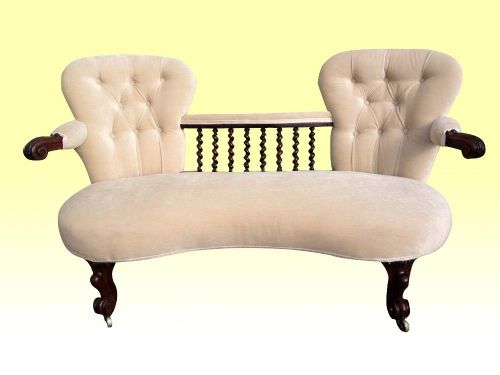


Edwardian Curved Sofa
An edwardian curved sofa brings flowing lines and timber frames into a room, offering both seating and elegance.
Edwardian Curved Sofa
An edwardian curved sofa brings together domestic seating forms from the Edwardian period alongside pieces from the Victorian era, the nineteenth century, and the early twentieth century. Buyers searching for an edwardian curved sofa will encounter varied settees, benches, salon suites, and occasional tables.
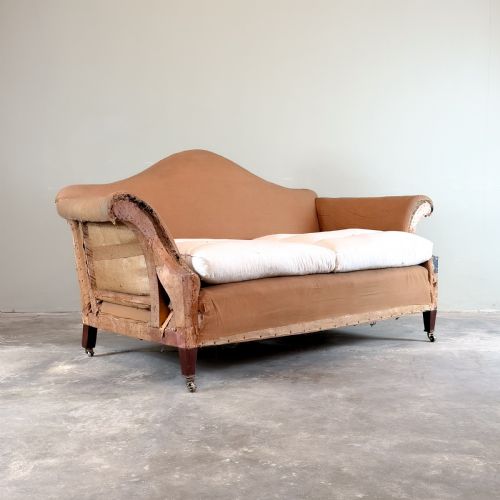
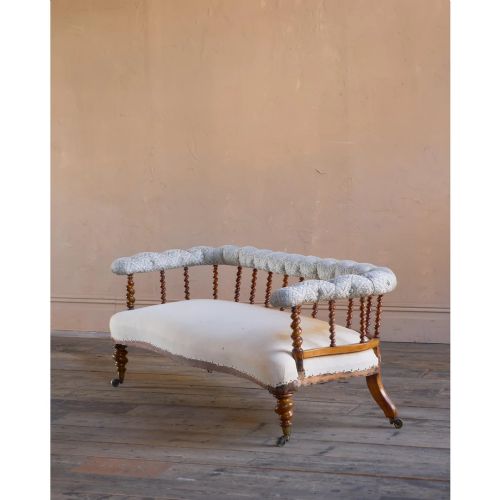
The pieces appearing on this page span several decades, including items dated around nineteen hundred, nineteen ten, nineteen twenty, and eighteen eighty. Alongside standard sofas, listings encompass camel back sofas, tub shaped settees, spindle back salon sofas, and painted couches.
Makers and workshops represented in the records include Thonet and C. Hindley & Sons, showing the range of domestic furniture design from this span of years. Materials vary from mahogany and satinwood to rosewood, beech, brass, fabric, velvet, and jute.
Materials and construction
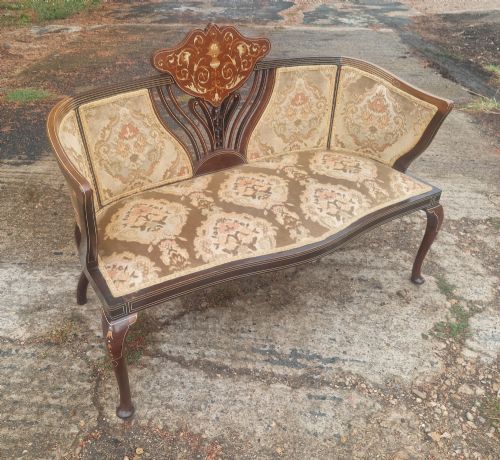
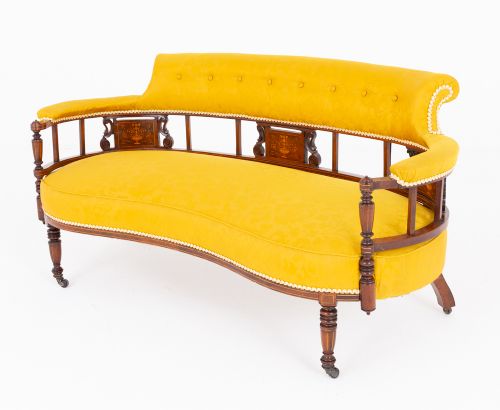
Cabinet makers utilised dense hardwoods such as mahogany, rosewood, satinwood, and beech to build structural frames and display decorative grain. Timber elements frequently featured inlaid details, contrasting woods, or painted finishes.
Curved forms and bentwood techniques allowed makers like Thonet to shape structural elements smoothly without traditional joinery. Upholstered sections employed traditional materials including velvet, fabric, and jute webbing.
Edwardian Curved Sofa Retail Price Guide 2026
Typical asking prices for edwardian curved sofa among the pieces listed under this phrase on Sellingantiques today, from the lower quarter to the upper quarter. They describe what is for sale here now, not the wider market.
The available furniture spans several distinct stylistic movements, including Art Nouveau and Viennese Bentwood alongside standard Edwardian designs.
Assessing quality
The distinction between ordinary and superior pieces rests on the precision of timber inlay, the choice of fine hardwoods like rosewood and satinwood, and the integrity of the curved framework. Maker attribution, such as work by Thonet or C. Hindley & Sons, elevates a piece through documented provenance.
Upholstery finish and the preservation of original fabric or deep buttoning demonstrate the care taken during production and subsequent upkeep.
C. Hindley & Sons·Thonet
The Edwardian Curved Sofa Glossary
- Edwardian
- Pertaining to the reign of King Edward VII, spanning nineteen hundred to nineteen ten, characterised by lighter furniture forms and neoclassical revival styles.
- Bentwood
- A technique of steaming wood to make it pliable, allowing manufacturers to create curved structural frames.
- Inlay
- A decorative technique where contrasting pieces of wood or other materials are inserted into depressions in the base wood.
- Settee
- A long upholstered seat with a back and arms, designed for more than one person.
- Camel back
- A sofa style featuring a graceful, undulating arched backrest resembling a camel's hump.
Edwardian Curved Sofa: Frequently Asked Questions
What periods do these curved sofas date from?
The listings span the late nineteenth century through to the early twentieth century, encompassing Victorian and Edwardian eras. Pieces are dated from eighteen eighty up to nineteen twenty.
Most items align closely with the Edwardian period or the year nineteen hundred, reflecting the prevailing domestic styles of those decades.
How were these curved settees used?
These pieces served as principal seating in formal drawing rooms, parlours, and salons. They provided comfortable seating for conversation and social gatherings.
Smaller formats functioned as end of bed seating or occasional furniture in private chambers and dressing rooms.
What timber types appear most often?
Makers relied on durable and decorative hardwoods including mahogany, rosewood, satinwood, and beech. These timbers provided the strength required for curved frameworks and delicate inlay work.
Contrasting woods were frequently chosen to highlight decorative motifs on the sofa frames.
How do bentwood pieces differ from standard frames?
Bentwood furniture relies on steam to soften timber, enabling makers to bend the wood into sweeping curves without complex joinery. This technique was mastered by firms such as Thonet.
Standard frames utilise traditional carpentry joints to achieve curved or shaped silhouettes.