



Edwardian Bookshelf on Castors
An Edwardian bookshelf on castors is a practical piece of portable library furniture designed to keep favourite volumes within easy reach.
Edwardian Bookshelf on Castors
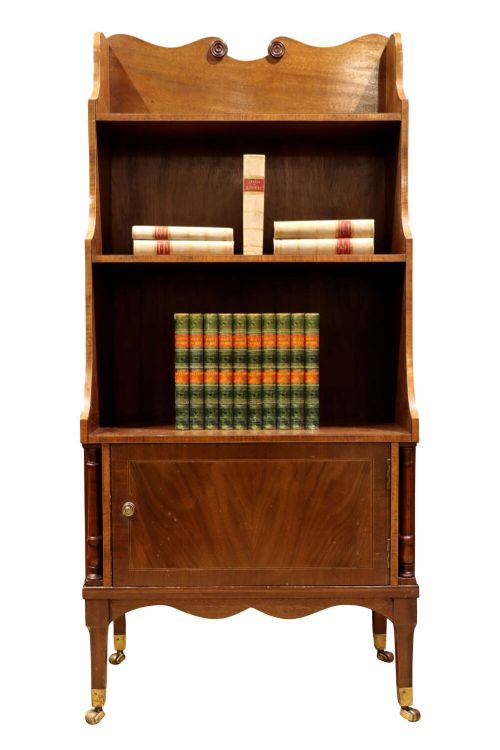
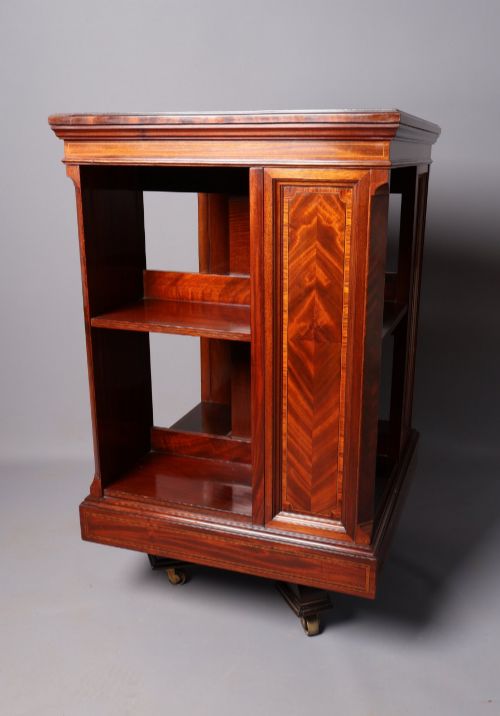
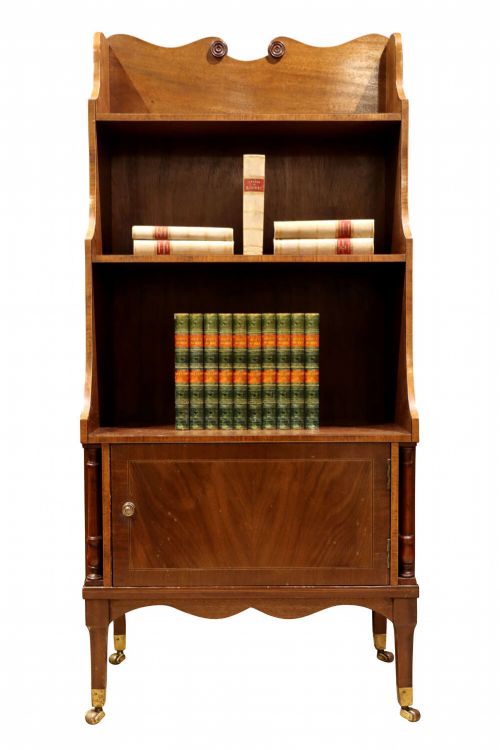
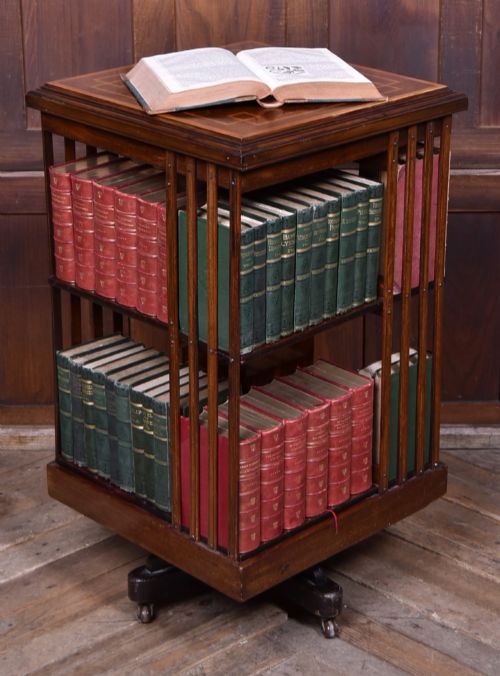
An Edwardian bookshelf on castors is a practical item of library furniture designed for easy mobility across timber floors or carpets. The pieces appearing under this search phrase span the Victorian and Edwardian eras, encompassing revolving bookcases, waterfall bookcase cabinets, small bookstands, and whatnots.
Mahogany forms the primary timber across the selection, often enriched with satinwood inlay or constructed from burr walnut and oak. These items provide functional book storage while offering the flexibility of repositioning thanks to their fitted castors.
Revolving bookcases represent the most common form meeting this search phrase, operating on a central spindle that allows users to access volumes from all sides. Other variations include tiered waterfall cabinets and compact stands suitable for a study or drawing room.
How they were made
Cabinet makers utilised solid mahogany and walnut, frequently applying decorative satinwood inlay to borders and panels to catch the light. Timber selection focused on grain pattern and stability, ensuring the structure remained sound during daily rotation or movement.
Castors made of brass or iron were fitted to the base of each piece, allowing heavy wooden carcases to glide smoothly. Joinery relied on traditional methods suited to weight-bearing furniture, combining stability with accessibility.
Edwardian Bookshelf on Castors Retail Price Guide 2026
Typical asking prices for edwardian bookshelf on castors among the pieces listed under this phrase on Sellingantiques today, from the lower quarter to the upper quarter. They describe what is for sale here now, not the wider market.
Revolving bookcases dominate the forms, accompanied by waterfall cabinets and whatnots.
What varies in quality
Quality reveals itself in the crispness of the satinwood inlay and the selection of figured mahogany or burr walnut veneers. Superior examples display careful attention to timber matching across panels and shelves.
The smoothness of the internal rotating mechanism on revolving models separates standard production from finer workshop output. Robust brass castors and solid secondary timbers indicate higher craftsmanship.
Maple and Co
The Edwardian Bookshelf on Castors Glossary
- Castor
- A small wheel mounted on a swivel assembly attached to the base of furniture for easy rolling. Brass versions are typical on finer pieces.
- Revolving bookcase
- A freestanding tiered bookstand designed to turn on a central pivot base. This allows access to multiple directions of shelving from a stationary seat.
- Waterfall bookcase
- A set of open shelves arranged in a stepped, descending profile resembling a waterfall. Cabinets often incorporate doors beneath the graduated tiers.
- Whatnot
- A multi-tiered movable stand used for displaying or storing books and ornaments. The form gained popularity during the Victorian and Edwardian periods.
- Satinwood inlay
- A decorative technique using contrasting light-coloured exotic wood set flush into the primary mahogany surface. It creates geometric or floral borders.
Edwardian Bookshelf on Castors: Frequently Asked Questions
How do revolving bookcases work?
These bookcases sit upon a concealed central pivot mechanism housed within a cruciform base. This allows the entire wooden superstructure to spin smoothly by hand.
Users can access volumes stored on all four sides without needing to walk around the furniture piece.
Were these made for home libraries?
Makers designed these movable bookcases for drawing rooms, studies, and parlours where space and convenience mattered. Their mobility let owners shift the library collection closer to a fireside chair.
Smaller revolving models sat comfortably beside desks or armchairs for ready access to dictionaries and novels.
What woods are most common?
Mahogany dominates the material selection, frequently enhanced by contrasting satinwood stringing or floral inlay. Burr walnut and oak also appear among the listed items.
These dense hardwoods provided the structural strength required to support heavy rows of bound books.
How do I distinguish Edwardian from Victorian?
Edwardian pieces tend to feature lighter, more restrained ornamentation with delicate satinwood inlay on mahogany carcases. Victorian examples often display darker timber tones and heavier proportions, including burr walnut finishes.
Construction details and registration dates help confirm the manufacturing period when style overlaps.