

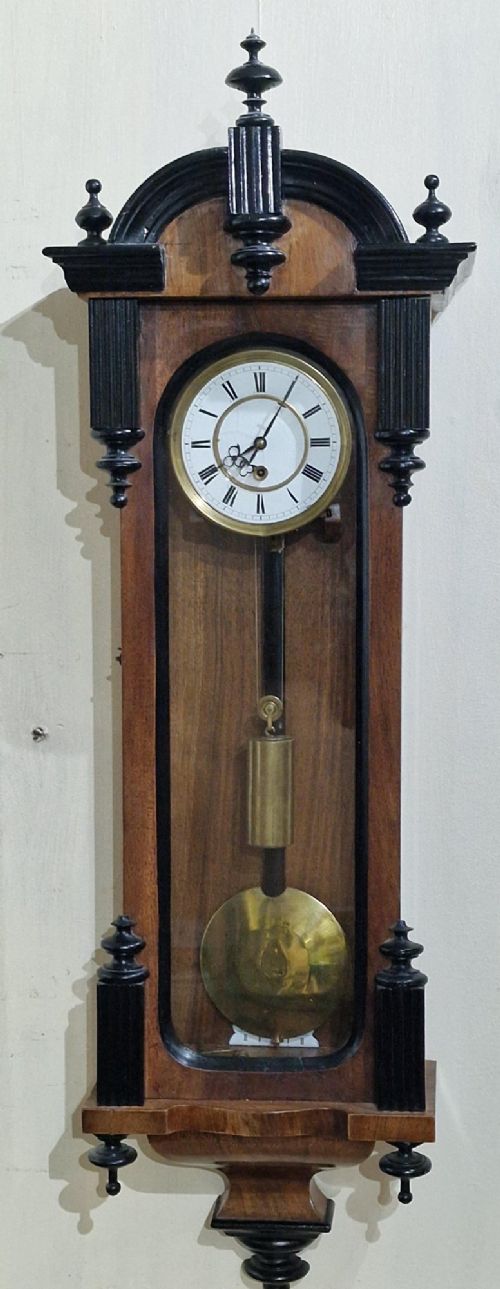
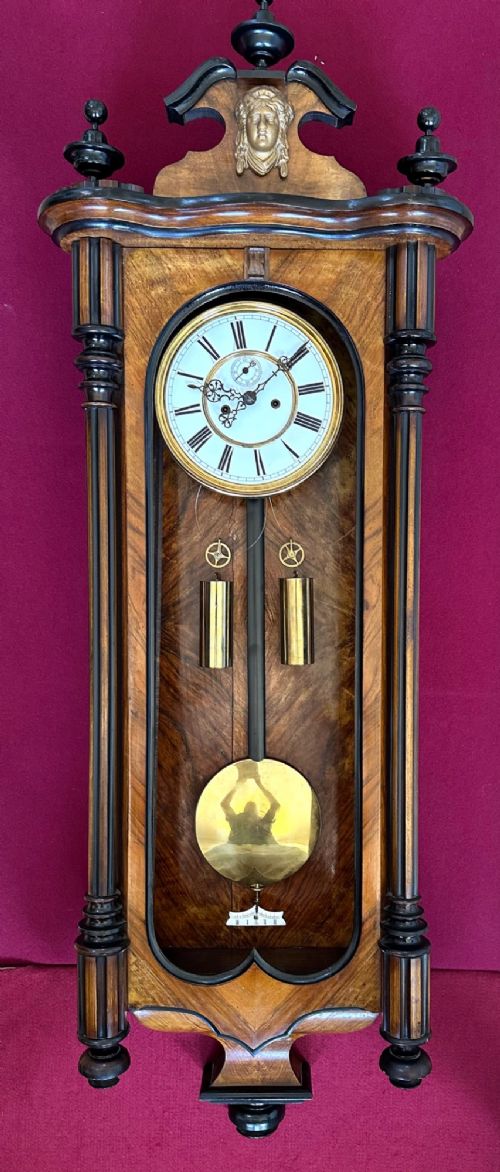


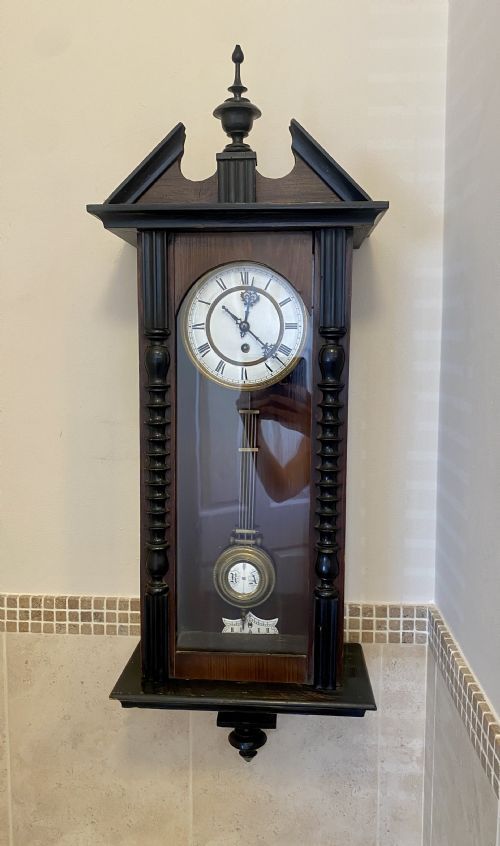
Ebonised Vienna Wall Clock
An ebonised vienna wall clock brings precision timekeeping and stately presence to a room, combining dark polished timber with a clear white dial.
Ebonised Vienna Wall Clock
When you search for an ebonised vienna wall clock, you are looking at regulated timepieces originating from the nineteenth century, specifically from Austrian and Victorian workshops. These instruments are designed to hang on a wall, often featuring long glass doors that display the swinging pendulum inside.
The versions you are most likely to meet on this page span the Victorian era, particularly dating from 1850 to 1880. They combine ebonised wood with contrasting walnut details, presenting either simple timepieces or complex striking movements.
These clocks take several forms, ranging from miniature wall clocks and eight-day strikers to month duration regulators and grande sonnerie models. Their origins are rooted in the Austrian Biedermeier style and the classic Vienna regulator tradition.
How they were made
Cases are constructed from timber, predominantly utilising walnut and ebonised wood to achieve a dark, uniform finish. Glass panels are fitted into the doors to protect the dial and allow a clear view of the pendulum.
The mechanical movements rely on brass components, while dials are frequently finished in enamel with distinct numerals. Spring or weight-driven mechanisms power these clocks, supporting either short eight-day runs or extended month durations.
Ebonised Vienna Wall Clock Retail Price Guide 2026
Typical asking prices for ebonised vienna wall clock among the pieces listed under this phrase on Sellingantiques today, from the lower quarter to the upper quarter. They describe what is for sale here now, not the wider market.
The object types recorded across these listings are exclusively wall clocks, including miniature versions and grande sonnerie models.
What varies in quality
The distinction between a standard wall clock and a top-tier example lies in the complexity of the movement and the precision of its assembly. Grande sonnerie strikes and month duration mechanisms represent a higher level of clockmaking skill than basic eight-day timepieces.
Cabinetwork also dictates quality, where crisp ebonising, well-figured walnut accents, and balanced proportions elevate the piece. The clarity of the enamel dial and the refinement of the brass fittings further separate ordinary clocks from exceptional ones.
Gustof Becker
The Ebonised Vienna Wall Clock Glossary
- Ebonised wood
- Timber treated to imitate ebony, providing a deep black finish common in Victorian clock cases.
- Vienna regulator
- A high-precision pendulum clock developed in Austria, known for accurate timekeeping and clear dial visibility.
- Grande sonnerie
- A striking mechanism that chimes the hours and quarters automatically, found in more complex clock movements.
- Eight-day
- A movement designed to run for eight days before requiring manual winding with a key.
- Biedermeier
- A Central European design style emphasising clean lines and utilitarian elegance during the nineteenth century.
Ebonised Vienna Wall Clock: Frequently Asked Questions
What is a vienna regulator?
A Vienna regulator is a high-precision wall clock developed in Austria during the nineteenth century, designed to measure time with exceptional accuracy.
These clocks feature long glass doors and prominent pendulums, making them both scientific instruments and decorative focal points in a home.
How do these clocks run?
These clocks operate using mechanical brass movements powered by springs or weights, requiring regular manual winding with a key.
Depending on the specific movement, a clock may run for eight days or extend up to a full month on a single wind.
Where should I hang a wall clock?
Hang these clocks on a sturdy interior wall away from direct sunlight, excessive moisture, and heavy vibrations to protect the mechanical movement.
Ensure the wall allows the clock to hang completely vertically so the pendulum swings evenly and keeps accurate time.
What is an ebonised finish?
An ebonised finish is a dark, chemical or painted treatment applied to cheaper woods to mimic the deep, lustrous appearance of solid ebony.
This technique was widely used in Victorian cabinetmaking to create high-contrast furniture and clock cases.