




Ebonised Burr Walnut Desk
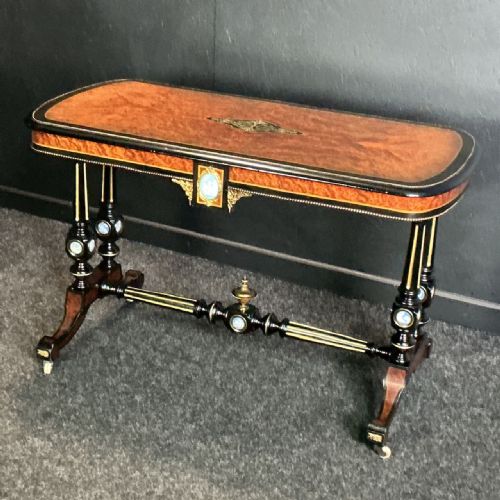
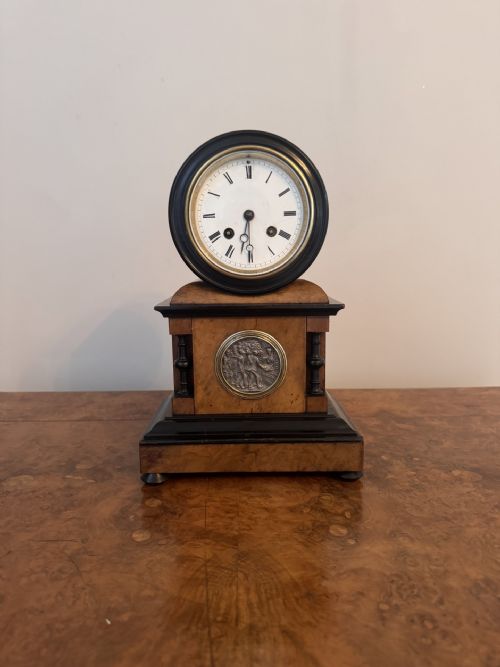
An ebonised burr walnut desk combines dark timber finishes with rich swirling grain figures, offering a striking centrepiece for a study.
Ebonised Burr Walnut Desk
An ebonised burr walnut desk unites the dark, uniform finish of ebonised wood with the highly figured patterns of burr walnut timber. These pieces typically emerge from the nineteenth century, spanning Victorian and continental European workshops.
Buyers will encounter various forms on this page, ranging from Davenport desks and pedestal writing tables to bureau bookcases and bonheur du jour designs. The combination of dark ebonised mouldings and warm walnut veneers creates a distinct visual contrast favoured during the Victorian period.
Originating across British, French, and German makers, these desks often incorporate secondary woods and decorative mounts. The survival of these pieces demonstrates the enduring appeal of contrasting timber treatments within period interiors.
Materials and construction
Makers constructed these desks by applying thin veneers of burr walnut onto stable carcase timbers, framing the swirling grain with solid ebonised wood. Ebonising involved treating timber, often fruitwood or pearwood, to imitate solid ebony through staining and polishing.
Metal mounts in brass and ormolu frequently accent the dark woodwork, alongside marquetry inlay and porcelain plaques. Secondary elements like leather writing surfaces and fitted interior drawers complete the construction of these refined nineteenth-century tables.
Ebonised Burr Walnut Desk Retail Price Guide 2026
Typical asking prices for ebonised burr walnut desk among the pieces listed under this phrase on Sellingantiques today, from the lower quarter to the upper quarter. They describe what is for sale here now, not the wider market.
Some nineteenth-century writing desks included concealed spring-loaded secret compartments designed to guard private correspondence from curious household staff.
Assessing quality and craftsmanship
The quality of an ebonised burr walnut desk rests upon the selection and matching of the walnut veneer figures across the writing surface and drawers. Superior examples display symmetrical grain patterns that flow evenly across the panels without disruption.
The crispness of the ebonised finish and the integration of brass or ormolu mounts indicate the skill of the original workshop. Finer pieces maintain tight joinery in the secondary drawers and retain their original hardware and fitted pigeonholes.
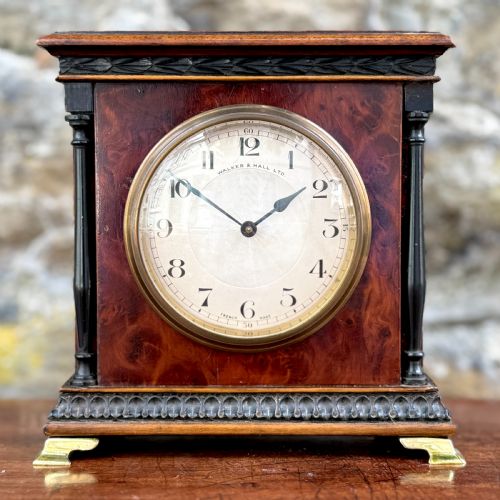
Walker and Hall·Baldwin of Loughborough
The Ebonised Burr Walnut Desk Glossary
- Ebonised
- Wood treated to resemble solid ebony through dark staining and polishing. This finish provides a sharp visual border for lighter walnut panels.
- Burr walnut
- Timber taken from the growth excrescence of a walnut tree, yielding intricate, swirling grain patterns. Cabinet makers prized this wood for decorative veneering.
- Ormolu
- Gilt bronze ornamentation applied to furniture mounts and clock cases. This technique involves coating cast bronze with a mercury and gold amalgam.
- Marquetry
- Decorative patterns formed by fitting together thin slices of various coloured woods. Artisans applied these pictorial designs directly to the furniture surfaces.
- Crossbanded
- A border technique where veneer strips are laid perpendicularly to the main grain direction. This frames panels of burr walnut on table tops and desk lids.
Ebonised Burr Walnut Desk: Frequently Asked Questions
Where were these desks typically used?
These desks served primarily as private writing tables in nineteenth-century drawing rooms, libraries, and studies. Wealthy homeowners utilised them for correspondence, record keeping, and reading.
Smaller formats like the Davenport or bonheur du jour suited tighter parlour spaces or ladies' boudoirs. Larger pedestal versions anchored grander administrative rooms and institutional studies.
How do I distinguish Victorian from earlier styles?
Nineteenth-century pieces often combine ebonised elements with burr walnut veneers, reflecting Victorian revivals of French and Aesthetic tastes. Examine the interior construction, secondary timbers, and lock mechanisms for period-specific manufacturing clues.
Earlier eighteenth-century examples rely less on ebonised borders and more on natural walnut tones and crossbanding. The integration of ormolu mounts and porcelain plaques frequently points towards mid-nineteenth-century French influence.
What is a Davenport desk?
A Davenport is a compact pedestal desk featuring a sloping, leather-lined writing lid that lifts to reveal a set of interior drawers. Side drawers often pull out to the side rather than the front, secured by a locking mechanism linked to the top lid.
This form gained popularity during the Victorian era for its space-saving efficiency in smaller rooms. Makers frequently incorporated burr walnut veneers and ebonised details to elevate their visual appeal.