
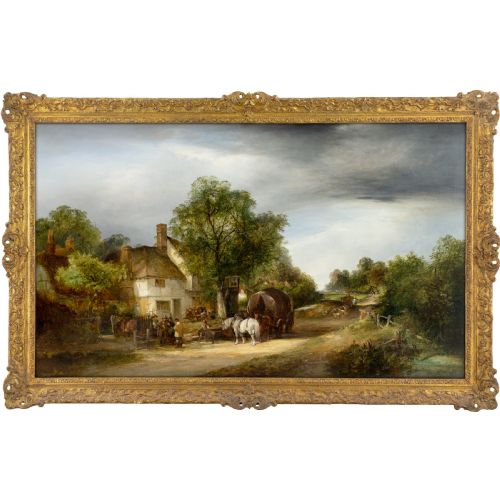


Earth Tone Pastoral Art
Earth tone pastoral art brings the quietude of nineteenth and early twentieth century rural life into a room through muted landscapes and farm scenes.
Earth Tone Pastoral Art
Earth tone pastoral art encompasses framed paintings and watercolours depicting rural scenes, farmsteads, livestock and agricultural labour. These works capture countryside views using natural palettes dominated by browns, greens, ochres and muted yellows.
Buyers encountering this selection will find Victorian and Edwardian pieces alongside early twentieth century works. Common subjects include cattle by streams, haymaking, ploughing teams and village views from locations across Britain.
The dominant formats on this page are original oil paintings on canvas and detailed watercolours on paper. Most examples arrive framed, preserving their period presentation and protecting the pigments.
Materials and construction
Painters utilised oil paint on canvas or wood panels, and transparent watercolours on paper, building scenes with layered pigments to achieve subtle earth tones. Artists mixed grounding earth pigments such as raw umber and yellow ochre to establish the muted atmospheric quality of these rural views.
Works on paper received protective glazing within wooden frames to shield the delicate washes from moisture and light. Canvases were stretched across wooden frames, often retaining their original period mouldings and gilt finishes.
Styles represented include Victorian genre, Edwardian pastoral, and British Impressionism, documenting changing approaches to rural scenery.
Distinctions in quality
Quality in these pastoral scenes rests upon the artist's handling of light, atmospheric depth and naturalistic proportions in figures and animals. Stronger works demonstrate confident brushwork or delicate watercolour washes that convey movement in skies, water and foliage without stiffness.
The integration of the palette separates accomplished compositions from more formulaic student or decorative pieces. A superior painting balances the earthy tones so that shadows hold transparency and highlights retain luminosity.
Oswald Garside·Ernest Higgins Rigg·Owen Bowen·James Orrock·James Hardy Junior·Frederick W Jackson·William Manners·Henry Charles Fox·Thomas Sidney Cooper·Thomas James Lloyd·Herbert Royle·Frederick J Knowles·John Percy Cooke·Jack R Mould·Frederick Tucker·William Greaves·James Kay·Sir Ernest Albert Waterlow·JE Hood·Peter de Wint
The Earth Tone Pastoral Art Glossary
- Pastoral
- Relating to the countryside, agriculture and farm life. These scenes focus on rural workers, livestock and quiet village settings.
- Watercolour
- A painting method where fine pigment is suspended in a water-soluble binder. Applied to paper, it creates translucent washes of colour.
- Canvas
- A heavy woven fabric stretched tightly over a wooden frame to serve as a sturdy surface for oil painting.
- Impressionism
- A style of painting emphasising immediate visual impressions through unblended brushstrokes and natural light. British variations adapted this to local skies and landscapes.
- Provenance
- The documented history and ownership trail of an artwork. This helps confirm authenticity and origin.
Earth Tone Pastoral Art: Frequently Asked Questions
What subjects appear in earth tone pastoral art?
These works feature rural landscapes, agricultural labour, farmsteads and livestock such as cattle and horses. Scenes often capture seasonal tasks like haymaking, ploughing and harvesting in British countryside settings.
Artists frequently painted rivers, moorlands, cottages and village views under overcast or gentle evening light, maintaining an atmosphere of quiet rural routine.
How do I care for antique watercolours?
Watercolours require protection from direct sunlight to prevent the pigments and paper from fading. Keep them away from damp environments to avoid foxing and paper deterioration.
Display these pieces under subdued interior lighting and ensure the framing maintains a seal against dust and insects.
What differentiates an oil painting from a watercolour?
Oil paintings utilise slow-drying pigments suspended in medium on canvas or wood panels, allowing for thick textures and rich, deep tones. Watercolours employ water-soluble pigments on paper, resulting in transparent washes and a lighter appearance.
Oils are generally more durable and do not require glass protection, whereas watercolours rely on glazing to shield the delicate paper surface.
How can I tell the period of a landscape painting?
Dating relies on stylistic clues, framing techniques, artists' signatures and materials. Victorian works often show detailed narrative elements, while Edwardian and later pieces may incorporate looser brushwork influenced by British Impressionism.
Examining the back of the canvas, stretcher frames, or paper backing often reveals inscriptions, gallery labels or stamps that narrow down the date.