
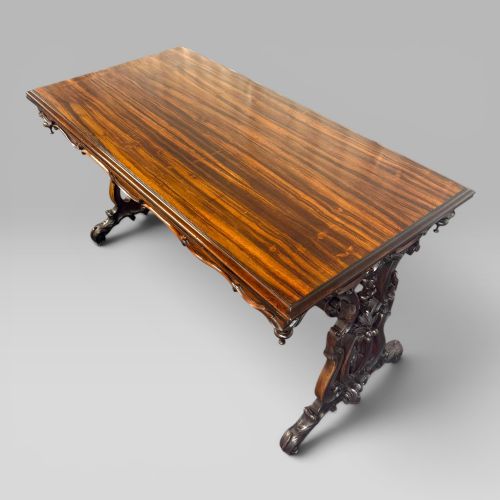
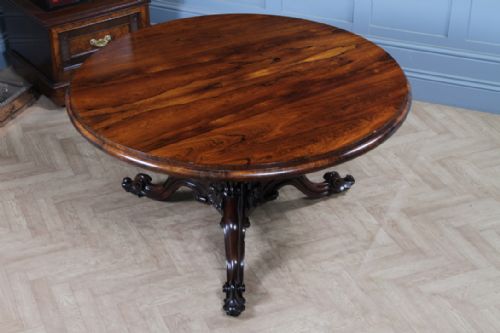


Early Victorian Rosewood Table
An early victorian rosewood table brings dense grain, warm colour and solid proportions to a room.
Early Victorian Rosewood Table
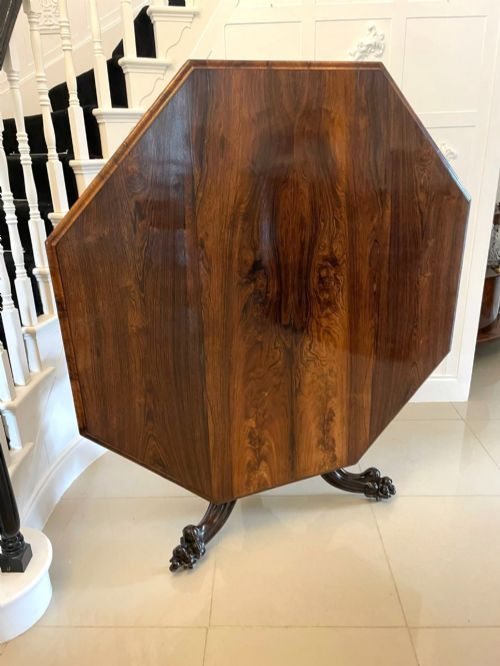
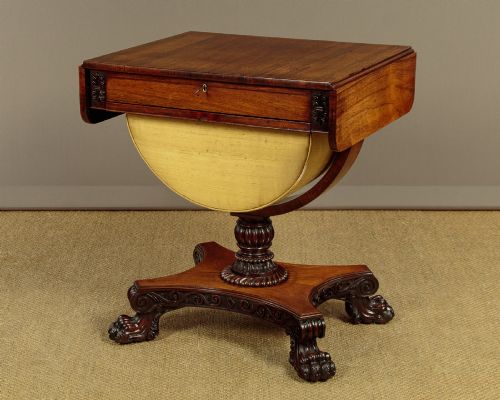
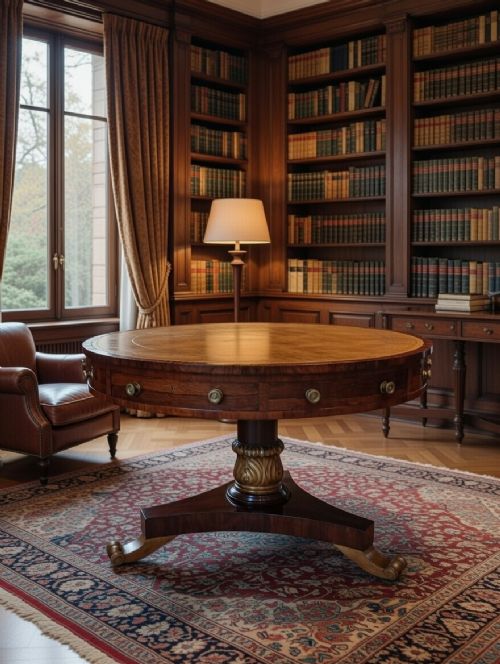
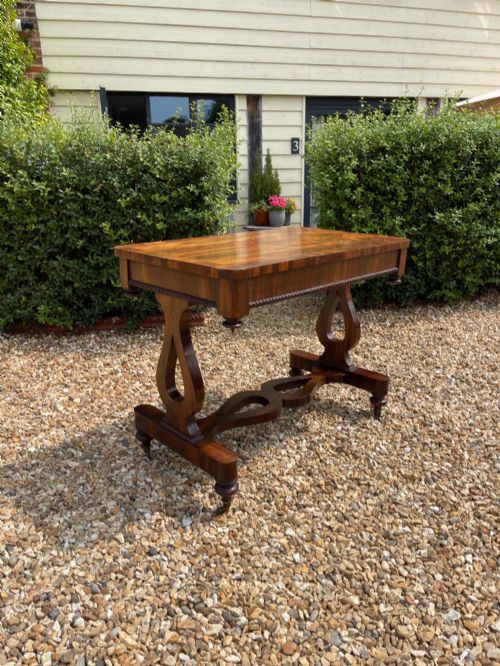
The early victorian rosewood table appears in multiple formats designed for domestic use during the nineteenth century, including centre tables, card tables, sofa tables, and library tables.
Makers of the period utilised rosewood alongside secondary timbers like mahogany, often incorporating tilt-top mechanisms, pedestals, and drawer spaces into forms ranging from breakfast tables to smaller work tables.
Examples on this page span the Victorian, William IV, and Regency periods, reflecting the transition of British cabinet making styles around 1840 to 1850.
Materials and Construction
Cabinet makers built these pieces using solid rosewood or applied dense rosewood veneers over firmer secondary woods, sometimes combining zebrawood, satinwood, or walnut for contrast.
Joinery methods relied on stable pedestal bases, turned pillars, and clever folding mechanisms for games and tea tables, supplemented by brass casters and leather inserts where appropriate.
Listings feature pieces spanning the 19th Century, 1800, Regency, and Victorian eras, predominantly constructed from rosewood with brass and mahogany accents.
Markers of Distinction
Distinctions in quality arise from the selection of timber figures, where rich grain patterns and matched veneers elevate a piece above standard stock.
The execution of carved details, stability of pedestal joints, and integrity of mechanical parts such as revolving tops or folding leaves separate standard workshop production from high-tier cabinet work.
Gillows·Thomas King
The Early Victorian Rosewood Table Glossary
- Rosewood
- A dense, dark timber with distinct dark brown or black figuring, prized in nineteenth century cabinet making for its rich polished finish.
- Centre Table
- A freestanding table designed to sit in the middle of a room rather than against a wall, finished with detail on all sides.
- Card Table
- A folding table with a hinged top that opens to reveal a baize or leather lined playing surface for games.
- Sofa Table
- A rectangular table traditionally placed in front of or beside a sofa, equipped with drop leaves and small drawers.
- Tilt Top
- A table mechanism allowing the circular top to pivot vertically on its pedestal for convenient storage.
Early Victorian Rosewood Table: Frequently Asked Questions
What rooms suit an early victorian rosewood table?
These tables adapt well to living spaces, studies, and entrance halls as centre pieces, desks, or display surfaces.
Their rich dark timber and compact footprints allow them to anchor traditional or eclectic modern room schemes.
How do I care for rosewood surfaces?
Protect the polished wood from direct sunlight and excessive heat to prevent fading or splitting.
Dust regularly with a dry cloth and apply occasional high quality furniture wax to maintain the sheen.
How can I tell an early victorian piece from later periods?
Examine the construction methods, timber thickness, and secondary woods used inside drawers or beneath table tops.
Early pieces rely on hand cut joints and heavy rosewood veneers rather than the machine milled pine found in later decades.
What is the purpose of a tilt top table?
Tilt top mechanisms allowed large circular breakfast or centre tables to be tipped vertical and pushed against a wall when not in use.
This saved valuable floor space in nineteenth century drawing rooms.