


Early Victorian Library Table
An early victorian library table is a substantial timber piece built for study and writing, prized for rich wood and enduring joinery.
Early Victorian Library Table
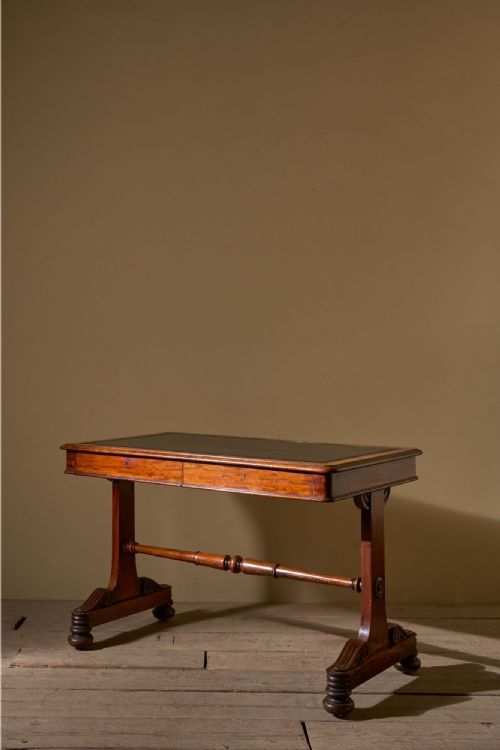
An early victorian library table is a substantial piece of furniture designed for reading, writing, and the organisation of books and papers. These tables emerge from the nineteenth century in various forms, including freestanding centre pieces and multi-drawer desks fitted with tooled leather writing surfaces.
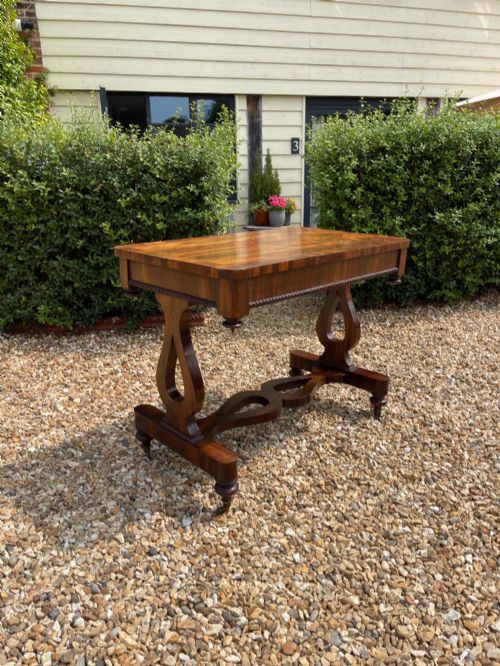
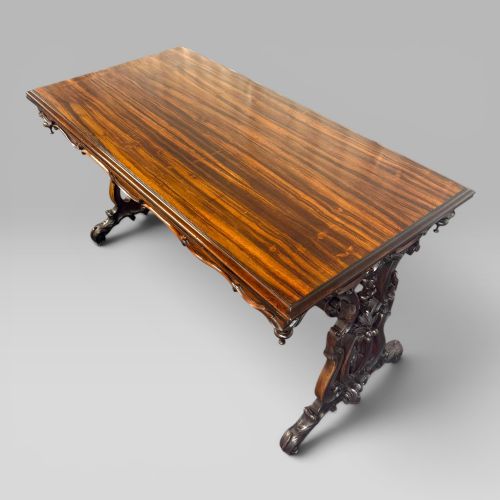
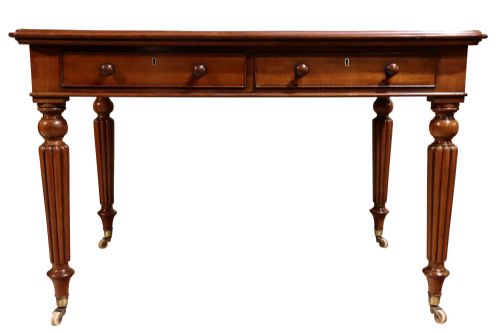
The versions most commonly met on this page are constructed from rich timbers like mahogany and rosewood, often featuring two or more drawers and turned or reeded legs. They served as functional work surfaces in private studies and libraries, built to stand in the middle of a room with finished backs.
Makers and makers' workshops of the period produced these writing tables in styles spanning late Regency through to early Victorian and Gothic Revival. They range from modest two-drawer formats to large partners desks designed for simultaneous use from both sides.
How They Were Made
Cabinet makers utilised dense hardwoods, predominantly mahogany and rosewood, alongside decorative veneers such as zebrawood, satinwood, and flame mahogany. These timbers were selected for grain pattern and strength, then polished to a deep lustre.
Writing surfaces were typically inset with panels of black or coloured leather, decorated with blind or gilt tooling around the perimeter. Drawers were constructed with dovetail joints and fitted with brass locks and pulls.
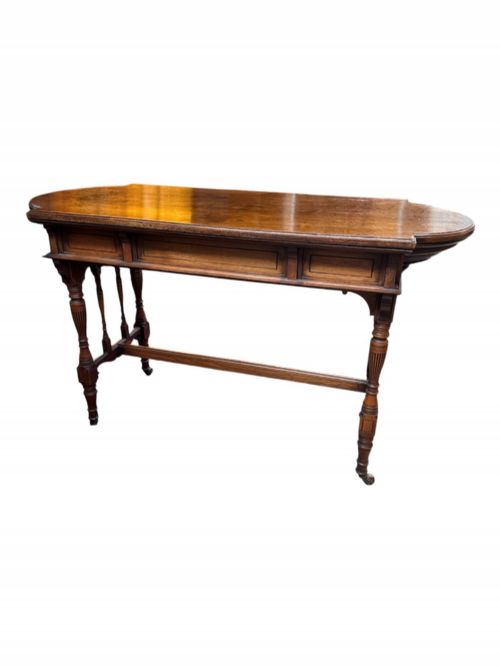
Structural support came from turned wooden legs, pedestal bases, or reeded columns, sometimes augmented with brass castors to allow the heavy tables to move across carpets.
The listings show diverse timbers including mahogany, rosewood, zebrawood, satinwood, and oak, alongside variants like pedestal desks and sofa tables.
What Varies in Quality
The standard of timber selection defines the upper tier of these tables, where cabinet makers deployed highly figured flame mahogany or choice rosewood veneers across the top boards and drawer fronts. Lesser examples rely on plain timber grains and simpler secondary woods for internal framing.
The crispness of hand-carved details, such as moulded edge profiles, reeded legs, and architectural brackets, separates standard workshop production from pieces attributed to notable makers. Drawer construction also reveals quality through tight hand-cut dovetails and solid mahogany linings.
Proportion and scale dictate the desirability of a piece, with well-balanced dimensions and original fitted leather writing surfaces holding greater distinction than altered or heavily restored examples.
Johnstone & Jeanes·J. Kerr & Co·Gillows Of Lancaster·Miles and Edwards
The Early Victorian Library Table Glossary
- Partners desk
- A large double-sided writing table fitted with drawers and cupboards accessible from both long sides, designed for two people to work opposite one another.
- Drum table
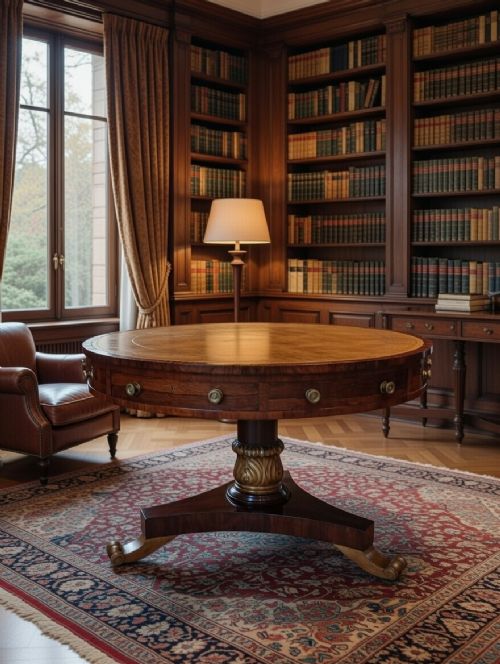
- A circular library table containing a rotating or stationary top with peripheral drawers, supported by a central pillar and tripod or plinth base.
- Sofa table
- A rectangular occasional table with drop leaves on either side, traditionally placed in front of a sofa and equipped with small frieze drawers.
- Tooled leather
- Animal hide inset into a desktop and decorated around the border with gold leaf or blind impressions using heated brass tools.
- Dovetail
- A traditional wood joint formed by interlocking wedge-shaped fingers, used primarily to construct strong drawer boxes without mechanical fasteners.
- Reeded
- A decorative moulding comprising a series of parallel convex semicircular ridges carved directly into timber legs or columns.
Early Victorian Library Table: Frequently Asked Questions
What is an early victorian library table?
An early victorian library table is a heavy wooden desk or freestanding table built between roughly eighteen thirty and eighteen sixty for domestic studies and libraries.
These pieces typically feature inset leather tops and frieze drawers, designed to be viewed from all sides rather than pushed against a wall.
How were these tables used originally?
They served as central workspaces for reading, correspondence, and storing manuscripts in large nineteenth-century homes.
Larger variants accommodated multiple readers or served as partners desks where two individuals could work facing each other.
How do I care for the leather top?
The leather writing surface benefits from gentle dusting and occasional applications of neutral leather balm to keep the material supple.
Avoid excessive moisture and harsh chemical cleaners which can strip the traditional gilt or blind tooling from the border.
How can I tell the period?
Dating relies on observing timber choices, construction methods, and stylistic cues such as transition from late Regency to early Victorian proportions.
Inspect the drawer linings, secondary woods, and hand-cut dovetails for consistency with nineteenth-century cabinet-making practices.