





Early Nineteenth Century Drawers
Early nineteenth century drawers bring solid construction and rich timber figure into a room, offering practical storage with enduring presence.
Early Nineteenth Century Drawers
Early nineteenth century drawers encompass a variety of storage forms originating from Georgian, Regency, and early Victorian periods. When searching for early nineteenth century drawers, buyers encounter substantial pieces designed to anchor a bedroom or living space.
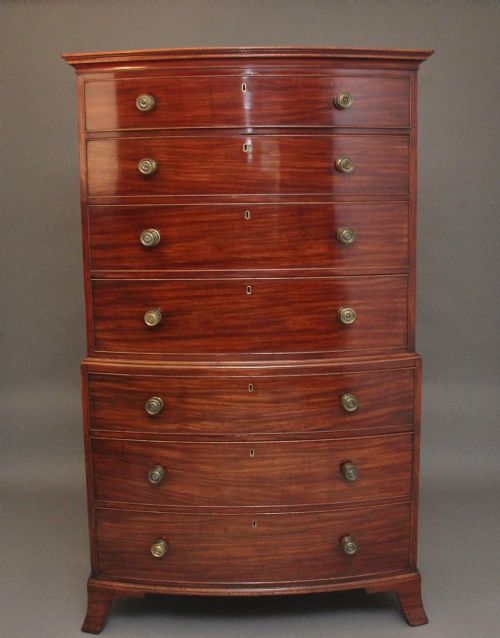
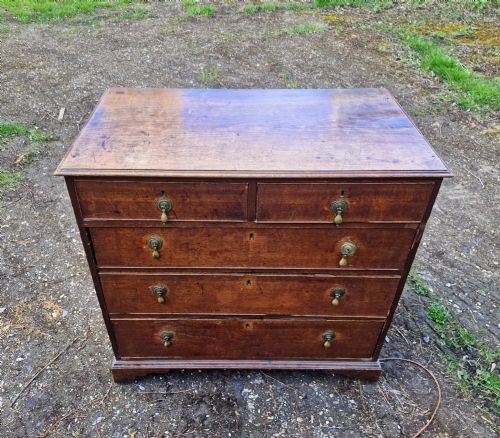
The selection on this page centres primarily on chests of drawers, spanning standard horizontal formats, bowfronts, and tallboys. Pieces arrive in woods such as mahogany, oak, pine, and burr walnut, reflecting workshop traditions across Britain, Scandinavia, and Germanic regions.
Alongside standard chests, the selection includes specialised forms like Wellington chests, commodes, and miniature furniture. Each piece demonstrates the heavy reliance on timber and brass hardware typical of the era's cabinet making.
Materials and construction methods
Cabinet makers relied heavily on solid hardwoods like mahogany and oak for structural integrity and visible surfaces. Secondary timbers such as pine frequently appear inside drawer construction and carcass backs.
Surface decoration involved careful selection of wood grain, including burr walnut and satin birch veneers, complemented by inlaid details. Brass handles, escutcheons, and occasional bone elements completed the hardware on these chests.
Early Nineteenth Century Drawers Retail Price Guide 2026
Typical asking prices for early nineteenth century drawers among the pieces listed under this phrase on Sellingantiques today, from the lower quarter to the upper quarter. They describe what is for sale here now, not the wider market.
One tiny chest decided to be a miniature, proving that great cabinet work simply scaled down its ambitions.
Judging the quality of these pieces
Quality rests on the selection of timber veneers and the precision of the cabinet work joining the carcass and drawer linings. Pieces exhibiting finely figured mahogany or burr walnut display a higher level of material selection by the maker.
The integrity of the original brass hardware and the smoothness of the drawer operation distinguish finer examples from standard utility pieces. Proportion and restraint in ornamentation separate refined workshop output from simpler provincial carpentry.
Gillows of Lancaster
The Early Nineteenth Century Drawers Glossary
- Bowfront
- A cabinet front that curves outward in a convex shape, common in Regency chests of drawers. This design softens the profile of the furniture.
- Tallboy
- A tall chest of drawers made in two sections, stacking one smaller chest upon a larger base. It maximises vertical storage space.
- Wellington chest
- A tall, narrow chest of drawers secured by a hinged vertical locking bar on one side. This design originated in the nineteenth century.
- Secretaire
- A desk disguised as a chest of drawers, featuring a drop-front writing surface. It combines storage with a pull-out writing compartment.
- Biedermeier
- A Central European style from the first half of the nineteenth century prioritising utilitarian comfort and clean lines over heavy ornamentation. It highlights natural wood grains.
Early Nineteenth Century Drawers: Frequently Asked Questions
What defines early nineteenth century drawers?
These pieces date from the Georgian, Regency, and early Victorian eras, spanning roughly from 1800 to 1850. They utilise timbers such as mahogany, oak, and burr walnut.
Construction typically involves hand-cut dovetails and solid timber carcases designed for domestic storage.
Where were these chests placed originally?
Bedrooms and dressing rooms served as the primary locations for chests of drawers and tallboys. They held linens, garments, and personal effects.
Drawing rooms and parlours accommodated smaller variants like commodes or miniature pieces.
How should I care for timber surfaces?
Maintain stable humidity levels in the room to prevent the solid woods and veneers from splitting. Avoid placing pieces in direct sunlight.
Apply natural beeswax periodically to nourish the mahogany, oak, or walnut grain without building up heavy residue.