



Early Georgian Tea Caddy
An early georgian tea caddy is a compact wooden container for storing dry tea leaves, prized for its fine timber and period joinery.
Early Georgian Tea Caddy
An early georgian tea caddy is a small lidded box designed to keep precious tea leaves secure under lock and key during the eighteenth and nineteenth centuries. These pieces appear in forms such as tea caddies, teapoys, caskets, and decorative boxes.
The versions most commonly met on this page range from red walnut examples dating to the eighteenth century through to mahogany, rosewood, and lacquer designs spanning the Georgian and Regency periods.
How they were made
Makers constructed these boxes using solid timbers such as red walnut and mahogany, often applying veneers of rosewood over a sturdy wood carcass. Surfaces frequently received detailed brass-inlaid decoration, gesso work, or penwork embellishment.
Fine joinery governs the construction, with hinged lids and internal compartments designed to protect delicate tea leaves from moisture and air. Lacquer finishes and carved wooden elements reflect the prevailing decorative tastes of the period.
Early Georgian Tea Caddy Retail Price Guide 2026
Typical asking prices for early georgian tea caddy among the pieces listed under this phrase on Sellingantiques today, from the lower quarter to the upper quarter. They describe what is for sale here now, not the wider market.
Listings feature pieces spanning the eighteenth and nineteenth centuries, constructed from mahogany, rosewood, red walnut, and brass-inlaid wood.
What varies in quality
The standard of timber selection and cabinetmaking determines the grade of a piece, with figured grains and precise jointing setting finer boxes apart. The complexity of surface ornamentation, from intricate brass inlay to penwork and gesso decoration, dictates the level of craftsmanship.
The integrity of the original hardware, including internal compartments and locks, distinguishes higher quality examples from those with extensive replacement parts or later alterations.
The Early Georgian Tea Caddy Glossary
- Tea caddy
- A small box or chest intended for the storage of loose tea leaves. These containers often featured internal compartments and a locking lid.
- Teapoy
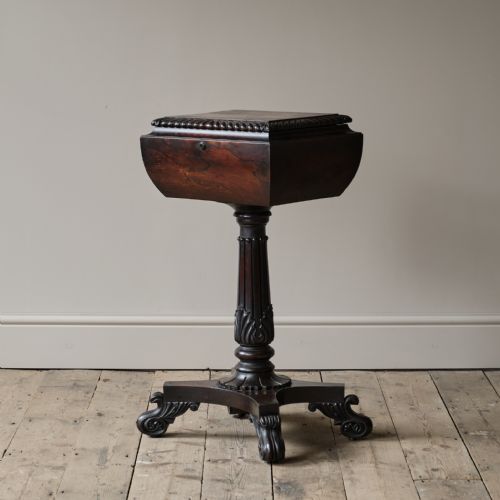
- A pedestal table or large box designed for holding tea caddies. They frequently incorporate internal canisters or mixing bowls.
- Penwork
- A decorative technique utilising India ink drawn on wood to create intricate motifs. This method appears on Regency period boxes.
- Gesso
- A plaster mixture applied to wood surfaces as a base for painting or gilding. It provides a smooth ground for decorative relief work.
Early Georgian Tea Caddy: Frequently Asked Questions
What is an early georgian tea caddy?
An early georgian tea caddy is a small wooden container made to store dry tea leaves securely under lock. These boxes date from the eighteenth and nineteenth centuries and reflect the high value placed on tea during the period.
They appear in various timbers including mahogany, walnut, and rosewood, often featuring internal divisions to separate different varieties of tea leaf.
How were tea caddies used?
These boxes sat in the parlour or dining room where the host prepared tea for guests. Because tea was an expensive commodity, the caddy remained locked between uses.
Servants or the master of the house kept the key to control access to the leaf supply, preserving the contents from damp and theft.
How do I date a tea caddy?
Dating relies on observing the timber species, construction methods, and decorative styles. Eighteenth-century examples often utilise red walnut, while later Regency pieces incorporate rosewood, brass inlay, and penwork.
Internal configurations and hardware details also help place a piece within its correct historical period.
What is the difference between a tea caddy and a teapoy?
A tea caddy is a portable box designed to sit on a table or sideboard. A teapoy typically refers to a larger container, sometimes mounted on a pillar and claw foot, or a stand incorporating multiple caddies.
Both served the same primary purpose of storing tea, but teapoys offered a more substantial furniture form for the room.