


Double Dog Clip Chain
A double dog clip chain is a sturdy utilitarian linkwork piece designed to secure a pocket watch, now worn flexibly as a necklace.
What a double dog clip chain is
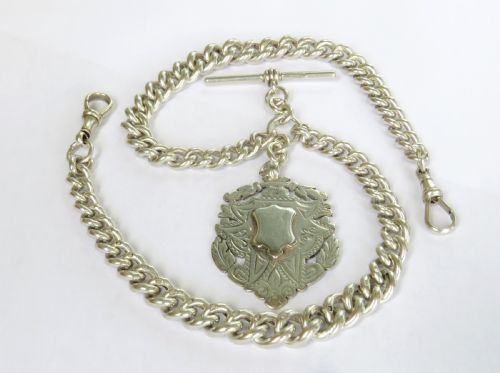
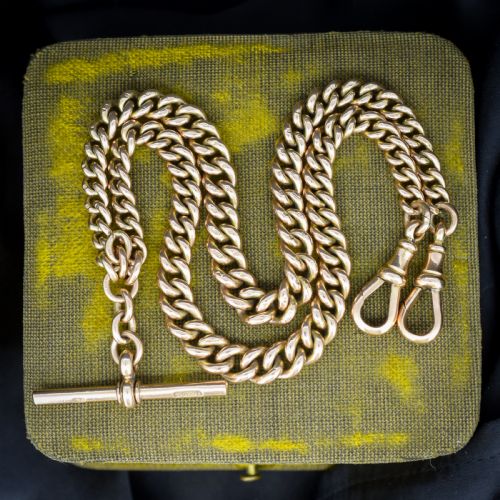
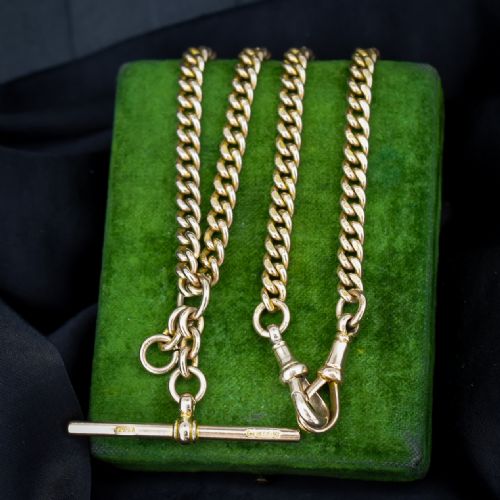
A double dog clip chain is a robust wearable linkwork piece created to secure a pocket watch, distinguished by spring-loaded swivel fasteners at both ends. You are most likely to meet Edwardian and early twentieth-century examples on this page, originating around nineteen ten to nineteen twenty-one.
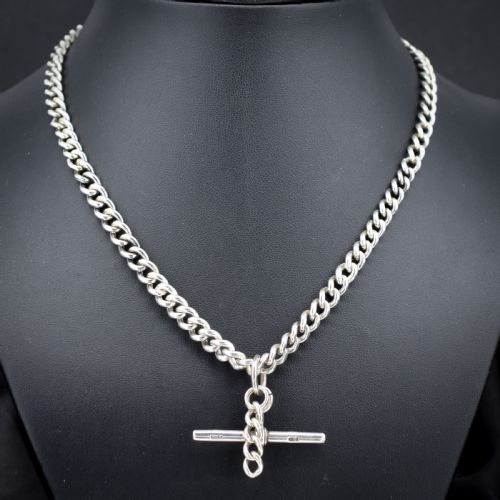
The evidence shows these pieces appearing primarily as watch chains, Albert chains, and necklaces. Makers originally fashioned them to anchor timepieces across a waistcoat using a T-bar centrepiece, though contemporary wearers frequently utilise them as shorter neck chains.
How they were made
Goldsmiths constructed these chains from nine-carat gold, including distinct variants of nine-carat rose gold, yellow gold, and rolled gold. Individual links were formed by hand or machine, then soldered and assembled into continuous strands.
The defining mechanical components are the swivel dog clips, which utilise internal springs to maintain a secure closure while allowing the fastening to rotate freely. Goldsmiths frequently incorporated graduated curb links, uniform curb links, figaro patterns, and paperclip links into the construction.
Retail Price Guide 2026
Typical UK retail prices for double dog clip chain, calculated from the Sellingantiques database of over a million retail prices indexed since 2003. This retail price guide relies exclusively on Sellingantiques data; no external sources or auction records are used, so the figures do not describe the wider market.
Listings show materials spanning nine-carat gold, nine-carat rose gold, yellow gold, and rolled gold across Edwardian and early twentieth-century periods.
What varies in quality
The distinction between ordinary and superior pieces rests on the weight of the gold and the structural integrity of the linkwork. Heavier specimens demonstrate substantial metal density across every individual link.
Another measure of quality involves the tension and responsiveness of the spring mechanisms inside the dog clips. Clips that retain a crisp snap and rotate smoothly without lateral looseness elevate the overall standard of the piece.
The Double Dog Clip Chain Glossary
- Dog clip
- A spring-loaded swivel fastening with a thumb lever, designed to hook securely onto a pocket watch loop or jump ring.
- Albert chain
- A traditional pocket watch chain named after Prince Albert, featuring one or more central attachment points.
- T-bar
- A short transverse bar attached to the centre of a watch chain, designed to slide through a waistcoat buttonhole.
- Graduated curb link
- A sequence of interlocking links that increase progressively in size from the ends toward the middle of the chain.
- Paperclip chain
- A style of linkwork featuring elongated, flattened rectangular links that resemble joined stationery.
Frequently Asked Questions
How do I wear a double dog clip chain?
You can wear a double dog clip chain around the neck by clipping the two swivel fasteners together or attaching them to a central jump ring. This allows the links to drape neatly as a short necklace.
Alternatively, some wearers incorporate a pendant or leave the clips exposed at the front as a decorative feature. The sturdy construction accommodates daily wear without difficulty.
What is the difference between curb and paperclip links?
Curb links are uniformly twisted, interlocking flat links that lie close against the skin or clothing. They provide a dense, classic appearance common in traditional watch chains.
Paperclip links consist of elongated rectangular loops separated by smaller connecting links, creating an open, airy visual rhythm. Both styles appear frequently in Edwardian gold chains.
How can I tell if my chain is solid gold?
You can identify solid nine-carat gold by locating official hallmarks stamped onto the metal, such as crown or purity marks. Chester assay office markings frequently appear on pieces from this era.
Rolled gold examples consist of a thin gold layer bonded to a base metal core rather than solid precious metal throughout. Examining the links closely under magnification helps reveal the underlying construction.
Were these chains made for men or women?
Albert chains were originally designed for nineteenth and early twentieth-century men to secure pocket watches across waistcoats. The substantial weight and length served a purely practical function in daily attire.
Today, contemporary collectors of all genders wear these versatile chains as necklaces. The historical context has shifted entirely toward decorative neckwear.