

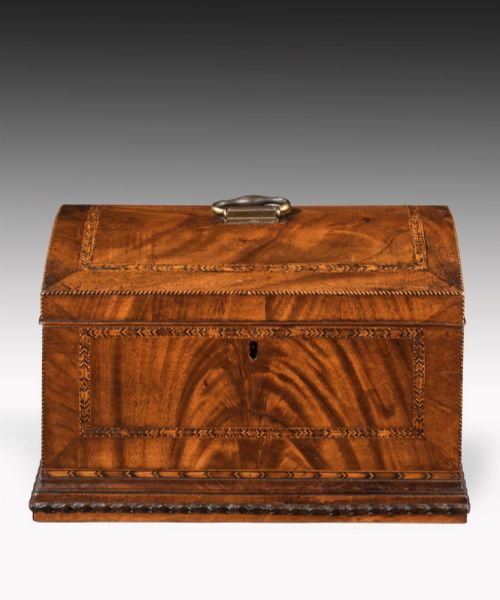


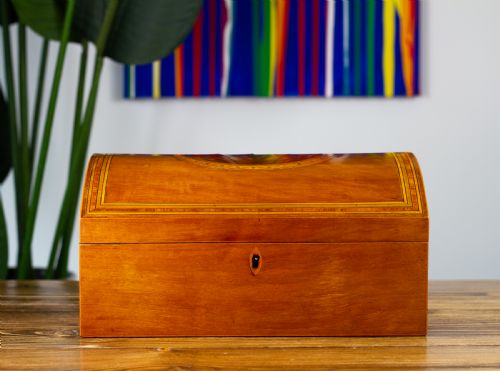


Domed Top Wooden Casket
A domed top wooden casket offers a curved silhouette and secure storage, combining period craftsmanship with practical utility.
Domed Top Wooden Casket
A domed top wooden casket provides a distinctive arched lid designed to shed dust and allow extra interior clearance for contents like jewellery, stationery, or gloves. These pieces emerge predominantly from the Victorian and Georgian eras, spanning the nineteenth century into the early twentieth century.
The forms vary from small table boxes to larger stationery and jewellery repositories. You are most likely to encounter Victorian walnut examples, often featuring brass bindings or elaborate burr wood veneers, alongside occasional Georgian mahogany pieces and folk art variations.
How domed top wooden caskets were made
Carpenters constructed these caskets using native and exotic timbers such as walnut, mahogany, satinwood, and pine, frequently applying decorative burr veneers to the curved surfaces. Boxwood and brass inlays or bindings provided structural reinforcement and geometric contrast.
Makers shaped the lids into distinct arches by steaming or segmenting the timber, then fitted interior trays and silk or velvet linings. Iron hardware and brass locks secured the contents, while painted finishes appeared on Scandinavian folk art and colonial pieces.
Domed Top Wooden Casket Retail Price Guide 2026
Typical asking prices for domed top wooden casket among the pieces listed under this phrase on Sellingantiques today, from the lower quarter to the upper quarter. They describe what is for sale here now, not the wider market.
One surviving box travelled from the Black Forest via Dutch trade routes before finding a home on a nineteenth-century table.
What varies in quality
The calibre of a domed top wooden casket rests upon the selection of timber veneers and the precision of the joinery shaping the curved lid. Uniform grain alignment across the arch indicates superior cabinet work.
Hardware integration further separates standard utility boxes from finer examples, seen in flush brass banding, intact escutcheons, and well-fitted interior partitions that survive centuries of use.
Trussell Brighton
The Domed Top Wooden Casket Glossary
- Burr walnut
- A highly figured timber harvested from the burl growths of walnut trees, prized for its swirling patterns on box lids.
- Stationery box
- A specialised cabinet form with stepped interior compartments designed to hold writing paper and envelopes upright.
- Escutcheon
- A protective brass plate surrounding a keyhole, often intricately pierced or engraved on nineteenth-century caskets.
- Black Forest style
- Carved wooden decoration originating from Central Europe, featuring naturalistic motifs and rustic textures.
Domed Top Wooden Casket: Frequently Asked Questions
What were domed top wooden caskets used for?
These caskets served to secure valuable personal possessions, correspondence, and accessories in domestic settings.
Their elevated lids provided the necessary vertical clearance to accommodate bulky items like stacked stationery, bottled scents, or boxed gloves.
How do I care for a wooden casket?
Keep wooden caskets away from direct sunlight and fluctuating heat sources to prevent timber warping and veneer splitting.
Apply occasional traditional wax polish to nourish the grain and maintain the natural lustre of the polished surface.
How do I date a domed top casket?
Examine the construction methods, locking mechanisms, and secondary timbers visible on the interior base and partitions.
Victorian pieces often display brass banding and burr walnut veneers, whereas Georgian examples favour solid mahogany or satinwood.
Are all domed caskets lined inside?
Many fine jewellery and stationery caskets retain their original silk, velvet, or paper linings fitted into removable internal trays.
Simpler utility boxes and folk art pieces frequently left the interior bare polished wood or painted surfaces.