


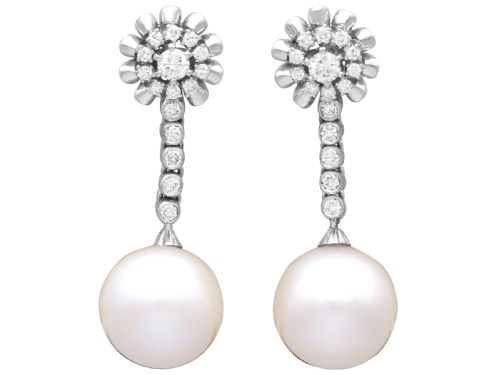


Diamond Pearl Drop Earrings
Diamond pearl drop earrings combine bright faceted stones with luminous organic gems in swinging forms found across multiple historic eras.
Diamond Pearl Drop Earrings
When you search for diamond pearl drop earrings, you encounter items designed to suspend from the earlobe, capturing movement and light through the pairing of gems. The examples span Georgian, Victorian, Edwardian, Art Deco, and mid-century periods, showing how goldsmiths adapted the form across decades.
The most common versions met on this page trace back to the Victorian and Edwardian eras, alongside Art Deco pieces and mid-century designs. These creations utilise drops, dangles, and cluster configurations that place pearls at the focal point below diamonds.
Materials and Construction
Makers set diamonds and pearls in metals including yellow gold, white gold, rose gold, silver, and platinum. Silver mounts appear frequently on earlier pieces, often combined with gold backs, while later periods rely on platinum and white gold to support the stones.
Gems are shaped using old cut, rose cut, and Swiss cut techniques for the diamonds, paired with natural pearls, seed pearls, and baroque pearls. Foliate motifs, enamel, and specific settings secure these materials into cohesive drop structures.
Diamond Pearl Drop Earrings Retail Price Guide 2026
Typical asking prices for diamond pearl drop earrings among the pieces listed under this phrase on Sellingantiques today, from the lower quarter to the upper quarter. They describe what is for sale here now, not the wider market.
Listings feature diamond and pearl drop earrings utilising silver, platinum, yellow, white, and rose gold across eight distinct historic periods.
Quality and Distinction
The standard of execution rests on the harmony between the metalwork and the specific gems selected. Finer pieces demonstrate careful proportioning where the mount complements the natural lustre of the pearl and the cut of the diamond without overpowering the design.
The integration of the drop mechanism and the selection of matching pearls or natural variations dictate the overall execution. Evidence shows that whether utilising yellow gold, platinum, or silver foliate mounts, the best examples maintain structural integrity alongside delicate detail.
The Diamond Pearl Drop Earrings Glossary
- Drop earring
- An earring style where an ornament hangs below the main body of the setting rather than sitting directly against the lobe.
- Old cut
- A historic diamond cutting style with a small table and a high crown, designed to catch candlelight.
- Rose cut
- A gemstone cut featuring a flat base and a domed crown faceted with triangles.
- Baroque pearl
- An irregularly shaped pearl valued for its organic and asymmetric form.
- Seed pearl
- Very small natural pearls often used in clusters or strung closely together in historic jewellery.
Diamond Pearl Drop Earrings: Frequently Asked Questions
What periods do these earrings come from?
The pieces span Georgian, Victorian, Edwardian, Art Deco, and mid-century periods. Each era brings distinct metal choices and mounting styles.
Craftsmanship shifts from early silver and gold combinations to platinum settings in later twentieth-century designs.
Are natural pearls common in these pieces?
Natural pearls appear across Victorian and Edwardian examples in the inventory. They are often paired with old cut or rose cut diamonds.
Testing and documentation help identify natural origins within these historic drops.
How should historic drop earrings be worn?
These items are suited for evening wear or special occasions due to their length and movement. Care should be taken with the drop mechanisms and delicate pearl surfaces.
Storing them in individual compartments prevents the stones from scratching against other items.
What metals support these diamond and pearl drops?
Makers utilised yellow gold, rose gold, white gold, silver, and platinum across the different decades. Early Victorian and Georgian pieces frequently combine gold and silver.
Platinum becomes prominent during the Art Deco period, offering strong support for intricate metalwork.