


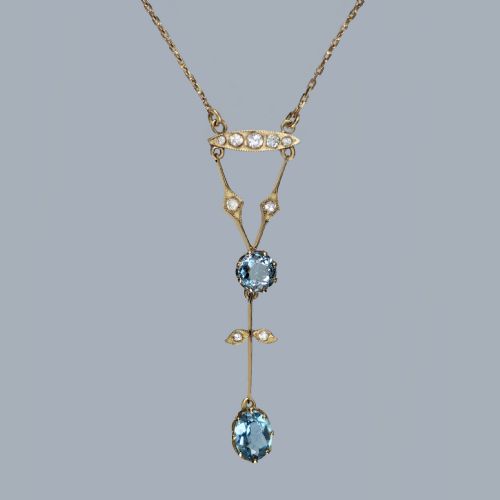


Diamond Aquamarine Drops
Diamond aquamarine drops combine pale blue beryl with brilliant stones in pendant necklaces and earrings crafted during the Edwardian, Art Deco, and mid-century periods.
Diamond Aquamarine Drops
Diamond aquamarine drops encompass pendant necklaces and earrings featuring suspended blue beryl accompanied by diamonds. These items appear in Edwardian, Art Deco, 1920, 1930, 1950, 1960, and later periods.
The earrings and necklaces take various drop and cluster configurations. Most frequently, a buyer meets pendant necklaces and drop earrings set in white metals like platinum and white gold, alongside yellow gold mountings.
How they were made
Maker's workshops mounted aquamarines and diamonds in platinum, 18ct gold, 14ct gold, 9ct gold, and 11ct yellow gold. Pearls and demantoid garnets occasionally supplement the primary stones.
Techniques evolved from delicate Edwardian wirework and platinum settings to geometric Art Deco arrangements and mid-century modern styling utilising baguette-cut diamonds.
Current listings feature items from the Edwardian period, 1910, 1920, 1930, 1950, 1960, and later than 1960, utilising platinum and various gold purities.
What varies in quality
Quality separates through the saturation and clarity of the aquamarine crystal alongside the carat weight and cut of the accompanying diamonds. Heavier carat stones and finer platinum or gold work distinguish the top tier of pieces.
The sophistication of the period design, such as intricate Edwardian filigree or precise Art Deco geometry, dictates the overall execution and balance of the jewellery.
The Diamond Aquamarine Drops Glossary
- Aquamarine
- A transparent, pale blue to light green variety of beryl utilised as the primary drop stone in these necklaces and earrings. Its name derives from seawater.
- Cluster
- An arrangement of smaller gemstones clustered closely around a central focal stone, often seen in vintage drop earrings.
- Platinum
- A dense, ductile, malleable silver-white precious metal favoured for secure stone settings during the Edwardian and Art Deco eras.
Diamond Aquamarine Drops: Frequently Asked Questions
What periods do these pieces span?
These items date from the Edwardian era and 1910 through the 1920, 1930 Art Deco period, 1950 and 1960 mid-century years, up to later than 1960.
Different decades brought distinct metal choices and geometric or flowing designs.
How do I wear drop earrings?
Drop earrings suspend below the earlobe, moving slightly with the wearer. They suit evening attire and formal occasions.
Matching the metal colour to other jewellery helps coordinate the look.
What metals are used?
Makers utilised platinum, 18ct gold, 14ct gold, 11ct yellow gold, and 9ct gold. White gold and platinum dominate the Art Deco examples.
Yellow gold frequently appears in Edwardian and vintage pieces.
Are pearls combined with aquamarines?
Certain Edwardian and early pieces incorporate pearls alongside aquamarines, demantoid garnets, and diamonds. These materials reflect the decorative preferences of the 1910 period.
Such combinations offer a softer, multi-textured appearance.