

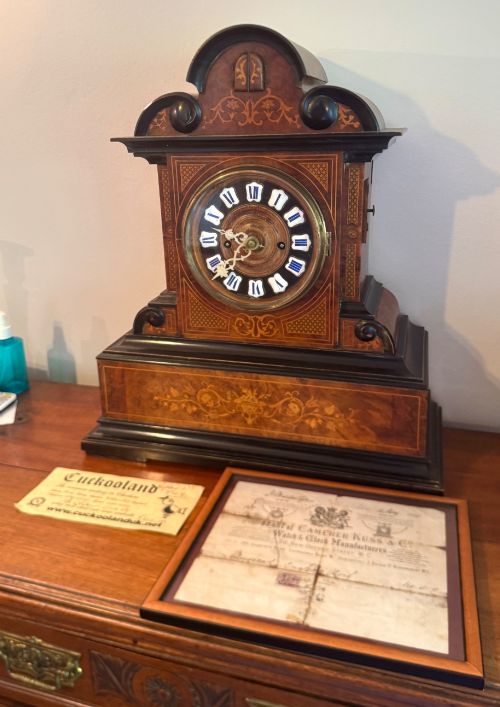


Decorative Wooden Clock
A decorative wooden clock brings warmth and character to a room, offering both practical timekeeping and historic craftsmanship.
Decorative Wooden Clock
A decorative wooden clock represents a diverse group of timepieces spanning the eighteenth, nineteenth, and twentieth centuries, encompassing styles from the Victorian era to Arts and Crafts. These objects take various forms, including mantel clocks, bracket clocks, wall clocks, and desktop boxes fitted with timepieces.
Buyers frequently encounter mahogany, walnut, and oak examples, often enhanced with brass, enamel, or ebonised wood details. The selection ranges from French Empire and Louis XIV Revival pieces to simpler nineteenth-century wall clocks and early twentieth-century painted displays.
Makers and origins vary across the inventory, with pieces originating from British and continental workshops. Whether seeking a large nineteenth-century cuckoo mantel clock or a small mahogany wall clock, collectors find distinct regional characteristics and period-specific designs.
Materials and construction
Craftsmen utilised timber such as mahogany, walnut, oak, and burr yew to build the foundational cases and wall mounts. These woods were often ebonised or finished with intricate marquetry and hand carving, particularly in Arts and Crafts and Louis XIV Revival examples.
Metal and glass components complemented the wooden structures, incorporating brass bezels, ormolu mounts, and enamel dials. Fusee movements and twin fusee mechanisms provided the mechanical precision housed within these timber cases.
Decorative Wooden Clock Retail Price Guide 2026
Typical asking prices for decorative wooden clock among the pieces listed under this phrase on Sellingantiques today, from the lower quarter to the upper quarter. They describe what is for sale here now, not the wider market.
A desktop box successfully moonlights as a clock, proving that nineteenth-century desk accessories knew how to multitask.
Distinctions in quality
Quality differentiates through the refinement of the woodwork, such as the precision of marquetry, the depth of hand carving in oak, and the selection of figured veneers like burr yew. Superior pieces display harmonious proportions and careful integration of brass and ormolu mounts.
The sophistication of the internal movement and dial presentation also separates examples. Twin fusee mechanisms and finely painted or enamelled clock faces indicate a higher standard of horological craftsmanship compared to simpler utilitarian designs.
John Leroux·Christie of Perth
The Decorative Wooden Clock Glossary
- Bracket clock
- A portable timepiece traditionally designed to sit on a bracket or shelf, often featuring a fine wood case with a carrying handle.
- Fusee movement
- A conical pulley mechanism used in older clocks to maintain even tension on the mainspring as it unwinds, ensuring accurate timekeeping.
- Marquetry
- The art of applying pieces of veneer to a structural object to form decorative patterns, frequently seen on walnut and mahogany clock cases.
- Ormolu
- Gilded bronze ornamentation applied to furniture and clock cases, characteristic of French Empire and revival styles.
- Ebonised wood
- Timber treated to resemble ebony, providing a dark, contrasting finish popular in nineteenth-century decorative pieces.
Decorative Wooden Clock: Frequently Asked Questions
What periods do these clocks cover?
The available selection spans from the eighteenth century through the Victorian era and into the early twentieth century, including pieces from the 1920s and 1960s.
These dates reflect a broad range of stylistic revivals and traditional manufacturing periods represented in the current inventory.
Where should a bracket clock be placed?
Bracket clocks are traditionally designed for mantelpieces, desks, or dedicated wall brackets where their detailed wood cases and dial work remain visible.
Their portable nature allows them to sit securely on flat surfaces in living spaces or studies.
How do I identify an Arts and Crafts clock?
Arts and Crafts timepieces typically feature hand-carved oak construction with an emphasis on visible craftsmanship and natural materials.
They often date around 1900 and display simpler, more robust forms compared to ornate French revival styles.
What materials are most common?
Mahogany, walnut, and oak form the primary wooden structures, often paired with brass, glass, and enamel dials.
Some pieces incorporate specialised finishes like ebonised wood, burr yew veneer, or ormolu mounts.