
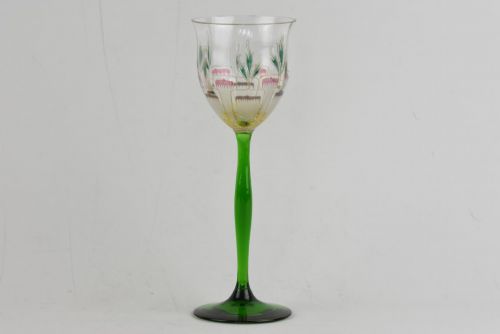


Decorative Wine Glasses
These decorative wine glasses bring colour and form to the table, offering substance and style through Victorian, Edwardian, and Continental craft.
Decorative Wine Glasses
When you search for decorative wine glasses, you encounter a range of glassware that extends from single enameled goblets to matched pairs mounted in silver plate and ormolu. The examples on this page encompass Victorian, Edwardian, and early twentieth-century origins, drawing on British, French, and German workshops.
Most items you meet here take the form of wine glasses, rummers, and chalices, alongside related serving vessels such as claret jugs, liqueur ewers, and decanters. Alongside standard glassware, the selection includes pieces featuring acid-cut cameo work, floral enamelling, and opalescent finishes.
The styles span from Victorian Rococo Revival and French nineteenth-century designs to the flowing lines of Art Nouveau and Jugendstil. Buyers select these pieces to add period character to a dining setting or to collect specific decorative techniques from the turn of the twentieth century.
How they were made
Makers shaped the vessels using clear crystal and opalescent glass, often applying cut glass techniques to create faceted surfaces that catch the light. Workshops also utilised gold leaf and intricate enamel decoration to adorn the exterior of the bowls and bodies.
Many items incorporate metal elements, combining glass bodies with silver plate, silver mounts, or cast ormolu frames and handles. Acid-cut cameo methods allowed artisans to carve away outer layers of glass to reveal contrasting coloured backgrounds beneath.
Carboys occasionally sneak in among the wine glasses, proving that some nineteenth-century drinkers took their provisions on a much larger scale.
What varies in quality
The distinction between standard items and superior examples lies in the crispness of the glass cutting and the precision of the enamel or gold leaf application. Pieces with substantial metal mounts in ormolu or silver plate tend to show finer hand-chasing and heavier gauge construction.
The artistry of the glasshouse dictates desirability, particularly where skilled hands executed acid-cut cameo work or complex Jugendstil forms. Maker attribution, visible in specific enamelling styles or recorded workshop origins, elevates certain vessels above anonymous production.
Thereisenthal·Stevens & Williams·Adelbert Niemeyer
The Decorative Wine Glasses Glossary
- Rummer
- A large, heavy drinking glass with a short stem and a capacious bowl, popular for wine or ale during the nineteenth century. These vessels often feature thick bases and cut glass decoration.
- Ormolu
- Gilded bronze used for decorative mounts, handles, and collars on nineteenth-century glassware and ewers. This material adds weight and decorative polish to the finished piece.
- Jugendstil
- The German manifestation of Art Nouveau, characterised by organic plant motifs and fluid lines. This style appears on Continental glassware from around nineteen hundred.
- Enameled glass
- Glassware decorated with fused glass powders or paints fired onto the surface to create coloured floral or geometric patterns. It demands steady brushwork and careful kiln control.
Decorative Wine Glasses: Frequently Asked Questions
Are these glasses meant for drinking?
Many of these vessels function well for serving wine or liqueurs, though older pieces with delicate enamel or gold leaf merit careful handling.
Collectors often balance practical use with the preservation of fragile nineteenth-century surfaces.
How do I date an antique glass?
Dating relies on stylistic clues such as the flowing curves of Art Nouveau or the heavier ornamentation of Victorian Rococo Revival.
Material combinations, including silver plate mounts and opalescent glass finishes, also point to specific manufacturing decades.
What is acid-cut cameo glass?
This technique involves layering different coloured glasses and using acid to eat away the top layer, leaving a raised design.
It requires considerable skill to control the depth of the acid and achieve a clean, detailed motif.
How do I care for enameled glassware?
Enamel decoration requires gentle hand washing in lukewarm water to protect the fused surface colours from abrasion.
Harsh detergents and dishwashers should be avoided to prevent damage to the glass and any accompanying metal mounts.