


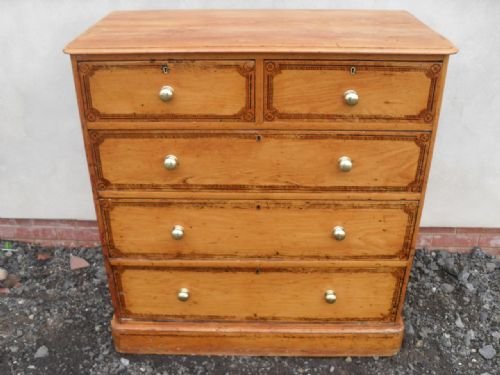
Decorative Bedroom Chest Drawers
These decorative bedroom chest drawers bring painted charm, figured walnut, and period character to a room.
Decorative Bedroom Chest Drawers
A decorative bedroom chest drawers is a storage piece designed to hold garments while serving as a focal point in a domestic interior. These items appear in formats ranging from tallboys and commodes to standard chest of drawers forms.
Buyers meet pieces originating from various periods, including the eighteenth century, nineteenth century, Victorian era, and the early decades of the twentieth century. Regional styles span French provincial, Chinoiserie, Art Deco, and Welsh country.
The most common examples on this page utilise pine, painted wood, and walnut, often ornamented with painted surfaces, lacquer, or inlay. They offer practical surface space alongside deep drawer storage.
How they were made
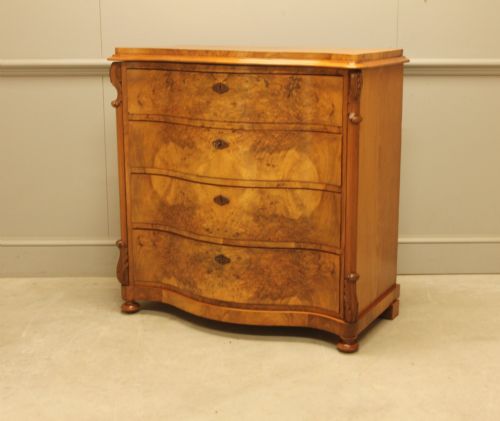
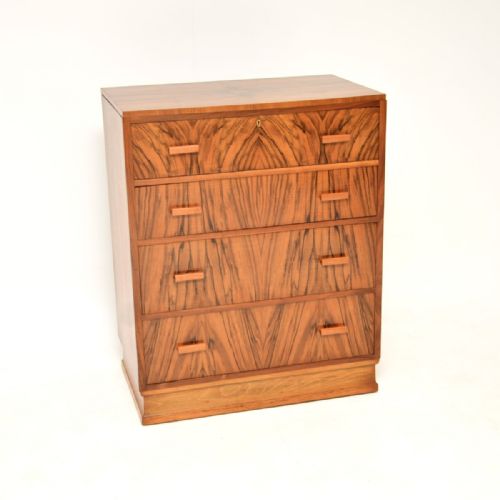
Cabinetmakers constructed these chests using timbers such as pine, mahogany, and walnut, frequently applying burr or figured walnut veneers to create striking grain patterns. Selected pieces feature intricate inlay work set into the primary wood.
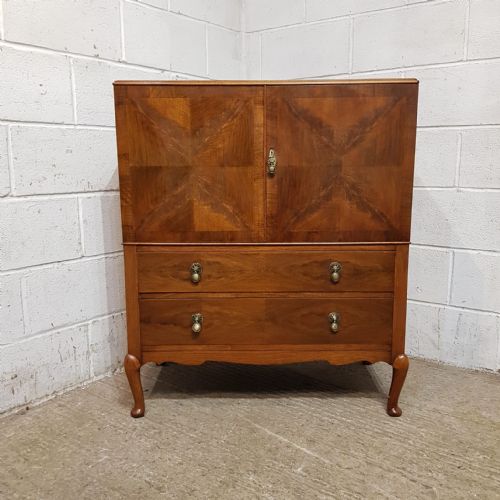
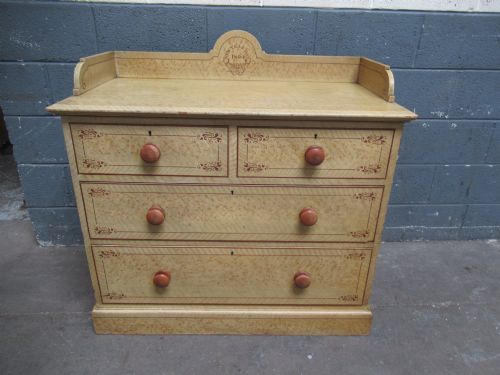
Surfaces receive decorative treatments including hand painting, Japanning, and pale cream colour finishes. Brass hardware such as handles and escutcheons complete the construction, fastened securely to the drawer fronts.
Form variations include standard chests, tallboys, and commodes executed in Chinoiserie and Art Deco styles.
What varies in quality
Quality separates pieces through the crispness of their cabinetwork and the execution of surface decoration. Hand-painted or Japanned finishes show varying levels of artistic skill, from simple vernacular work to refined, detailed motifs.
The choice of primary timber and veneer selection dictates the visual depth of a piece. Figured walnut and flame mahogany exhibit superior grain movement compared to standard domestic woods.
The Decorative Bedroom Chest Drawers Glossary
- Commode
- A low chest of drawers or cabinet originating from French furniture design. They frequently serve decorative functions in bedrooms.
- Tallboy
- A tall chest of drawers consisting of one chest stacked atop another. This vertical format maximises storage while occupying a smaller floor footprint.
- Japanning
- A European technique for finishing furniture in imitation of East Asian lacquerwork. It involves layered varnishes and decorative motifs.
- Bowfront
- A convex, curved front profile found on certain chests of drawers. This shape softens the geometric lines of the cabinet.
- Inlay
- A decorative technique where contrasting materials are inserted into recesses in the wood surface. It creates ornamental patterns across drawer fronts and tops.
Decorative Bedroom Chest Drawers: Frequently Asked Questions
What periods do these chests cover?
The listings encompass examples spanning the eighteenth, nineteenth, and early twentieth centuries. This includes Victorian items alongside Art Deco and earlier periods.
Specific regional styles such as French provincial and Welsh country also appear among the selections.
What materials are used?
Construction relies primarily on wood, with pine, mahogany, and walnut frequently utilised by makers. Burr walnut and figured walnut veneers add decorative surface texture.
Additional materials include brass for hardware and specialised paint or lacquer for decorated finishes.
How were they used historically?
These chests functioned as primary storage furniture in bedrooms for clothing and personal linens. Their decorative surfaces also provided a display area for tabletop items.
Tallboy and commode variations offered different capacities and spatial arrangements within domestic chambers.
How do I identify different styles?
Styles are recognised through distinct decorative treatments and silhouettes, such as the curved lines of French commodes or the geometric form of Art Deco pieces. Painted Japanning indicates specific decorative traditions.
Timber choices and hardware details further distinguish periods like the Victorian era from earlier centuries.