
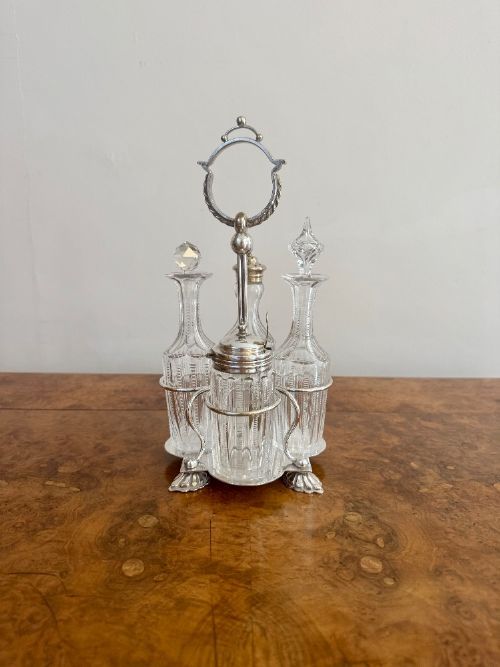
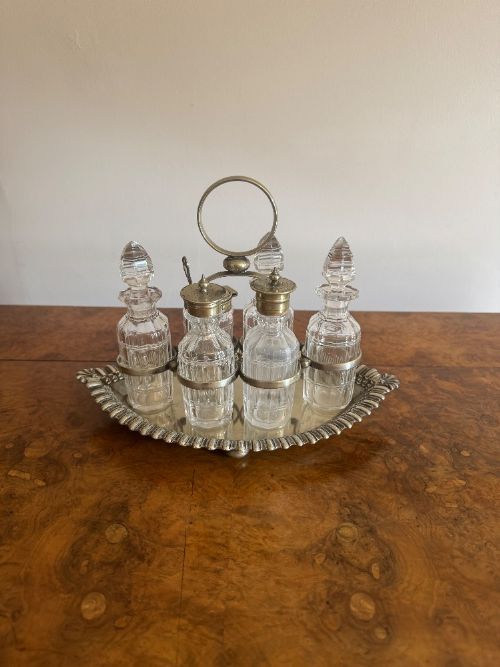


Cut Glass Oil Vinegar
Cut glass oil vinegar bottles and stands bring sparkle and precision to the table, combining heavy glass vessels with polished metal.
Cut Glass Oil Vinegar
When you search for cut glass oil vinegar, you encounter table accessories designed to hold condiments and dressings for dining. These pieces range from individual oil and vinegar bottles mounted in silver to larger cruet sets and stands.
The most common examples on this page are Edwardian silver plated cruet sets and Victorian silver mounted bottles, alongside Georgian and Art Deco examples.
Materials span cut glass, lead crystal, sterling silver, and silver plate, frequently supported by mahogany or ebonised wood stands.
Materials and construction
The glass elements are hand cut, shaping heavy lead crystal and clear glass to catch the light and provide durable service on the dining table.
Metal mounts, handles, and frames utilise sterling silver and silver plate, often paired with wooden bases in mahogany or ebonised wood.
Silversmiths and glass cutters combined their trades to fit metal collars and stoppers securely to glass bodies.
Some Victorian novelty cruet stands take charming figural shapes, bringing miniature theatre to the dining table.
Evaluating quality and craftsmanship
Quality rests in the crispness of the glass cutting and the weight of the metal components, distinguishing heavy lead crystal from simpler pressed glass.
Maker attribution and full silver hallmarks elevate a piece, alongside the completeness of matching bottles and original stoppers within a stand.
Mappin Brothers·Walker & Hall·Charles Thomas Fox·Elkington & Co·Hester Bateman·William Hutton & Sons·Wade Wingfield Wilkins
The Cut Glass Oil Vinegar Glossary
- Cruet set
- A fitted stand holding multiple bottles or casters for condiments, oil, vinegar, and sauces at the dining table. These frames often include a central carrying handle.
- Lead crystal
- A heavy glass variety containing lead oxide that increases brilliance and allows deep, sharp cutting. It forms the body of many fine condiment bottles.
- Silver plate
- A layer of silver fused to a base metal core, commonly used for Victorian and Edwardian cruet frames. It provided the look of solid silver at a lower cost.
- Sterling silver
- An alloy containing a high proportion of pure silver, used for hallmarked bottle mounts and stands. It carries official assay office marks denoting its standard.
Cut Glass Oil Vinegar: Frequently Asked Questions
What is a cruet set?
A cruet set is a tabletop stand holding bottles for oil, vinegar, and sauces, alongside casters for salt, pepper, and mustard. They kept condiments organised during formal meals.
These sets were usually placed in the centre of the dining table or on a sideboard for easy access by diners or servants.
How do I date an antique cruet stand?
Dating relies on silver hallmarks, maker marks, and stylistic clues such as the form of the handle or the cut of the glass. Georgian pieces often feature simpler frames, while Victorian and Edwardian examples show heavier ornamentation.
Checking any stamped registration numbers or assay office marks provides specific years of manufacture.
Are the stoppers original?
Finding original matching glass stoppers in cut glass bottles is an important detail for collectors. Replacement stoppers often differ slightly in cutting pattern or fit.
Examining the ground glass neck and the base of the stopper helps determine if they belong together from the period.
How do I clean antique silver plate?
Cleaning requires a gentle silver polish and a soft cloth to remove tarnish without wearing through the thin silver layer on plated frames. Harsh chemical dips should be avoided on antique plated items.
Glass bottles can be washed separately in warm soapy water using a bottle brush to clear old residue.