

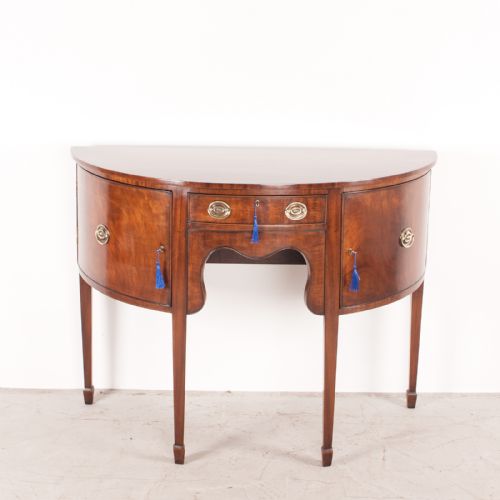
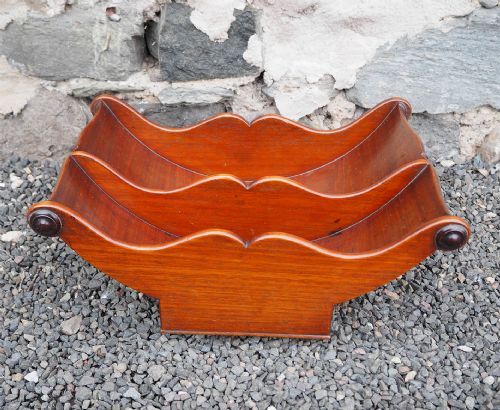


Curved Mahogany Server
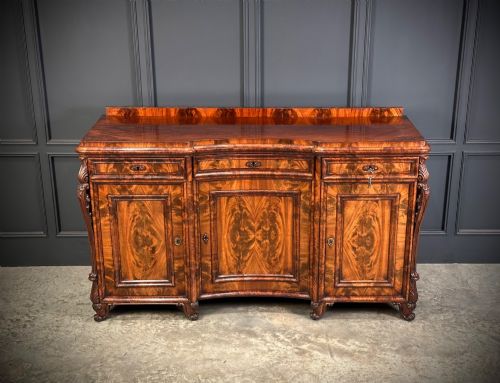
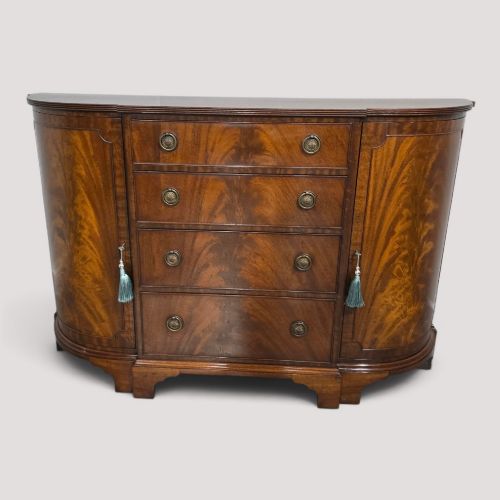
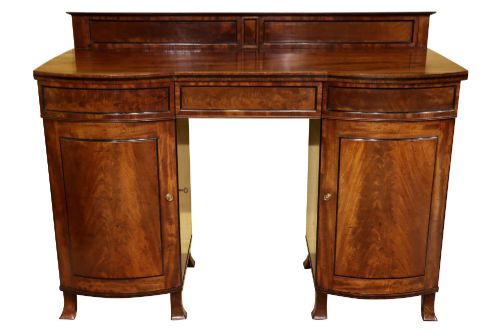
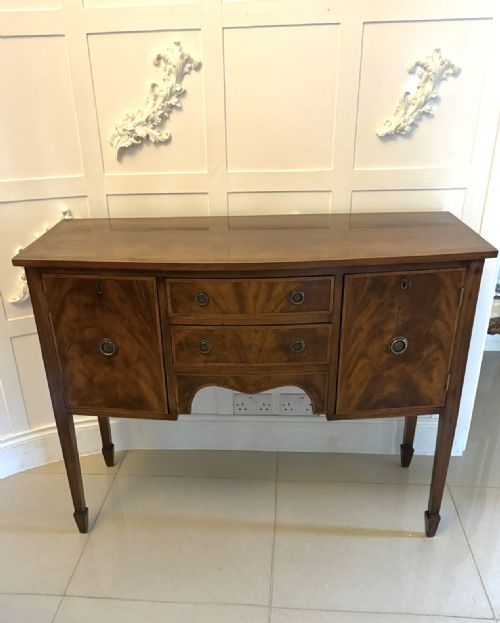
These curved mahogany servers combine fluid frontal sweeps with rich timber grains, offering both practical dining storage and a commanding presence in a room.
Curved Mahogany Server
When you search for a curved mahogany server, you are looking at substantial dining furniture designed to hold glassware, silver, and wine. The pieces appearing here span the Georgian, Regency, and Edwardian eras, taking forms such as bow fronts, serpentine shapes, and demi-lune designs.
How they were made
Cabinet makers utilised solid mahogany alongside flame mahogany veneer to create deep, figured surfaces on the sweeping fronts. Timbers were selected for their natural grain patterns and laid carefully over structural carcases.
Details were enhanced through contrasting stringing and banding, incorporating boxwood inlay and satinwood inlay to frame drawer fronts and tabletops. Brass hardware and fittings provided functional handles and mounts across the periods.
The selection includes mahogany sideboards spanning the Georgian, Regency, and Edwardian periods, incorporating boxwood and satinwood inlay.
What varies in quality
The standard of a curved mahogany server rests on the selection of the timber and the precision of the curved joinery. Finer pieces display continuous flame mahogany veneers that follow the sweep of the bow or serpentine front without interruption.
Attention to detail in the secondary woods and the sharpness of boxwood or satinwood inlay set superior examples apart. The execution of the curved drawers and the integrity of the structural carcase determine the standing of the piece within its period.
The Curved Mahogany Server Glossary
- Bow front
- A cabinet or sideboard front that curves outward in a convex arc. This shape softens the linear geometry of a dining room.
- Serpentine
- A front contour characterised by a central convex curve flanked by concave sweeps. It requires advanced carpentry to achieve smoothly.
- Demi-lune
- A half-moon shape used for side tables and serving surfaces. These pieces fit flat against a wall while projecting a curved profile.
- Flame mahogany
- Timber veneer cut from the fork of the mahogany tree where branches join the trunk. It produces a distinctive flickering flame-like pattern.
- Stringing
- Thin lines of contrasting wood inlaid into the surface of furniture. It is often seen in boxwood or satinwood outlining drawers and edges.
Curved Mahogany Server: Frequently Asked Questions
What is the difference between a sideboard and a server?
Sideboards and servers both provide surface space and storage for dining rooms, though servers often lean towards serving food and drinks.
In practice, historical terminology overlaps considerably, and many items catalogued as servers share the exact proportions and drawers of traditional sideboards.
How do I identify a Georgian mahogany sideboard?
Georgian pieces typically display hand-cut dovetails, dense solid mahogany timbers, and restrained inlay work without mass-produced uniformity.
Look for period-appropriate timber shrinkage, original brass hardware, and traditional construction methods beneath the drawers and inside the carcase.
Where should I place a curved sideboard?
These pieces suit dining rooms, hallways, or large living spaces where their curved fronts can be viewed without obstruction.
Ensure there is enough clearance around the convex or serpentine sweep so the piece commands attention rather than crowding a tight walkway.
What maintenance does antique mahogany need?
Keep mahogany furniture away from direct heat sources and sudden temperature changes to prevent the timber and veneer from splitting.
Apply a traditional beeswax polish occasionally and buff gently with a soft cloth to maintain the natural lustre of the wood.