

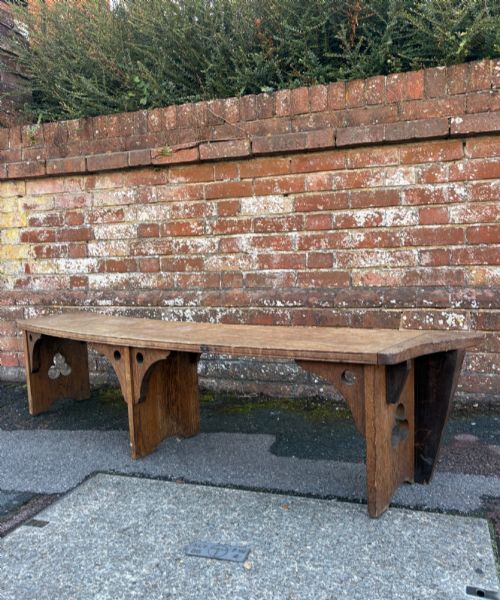


Curved Hall Bench
These curved hall bench pieces shape themselves to a narrow space and bring timber grain right to your front door.
Curved Hall Bench
A curved hall bench gathers people in an entranceway using a distinct sweep that hugs the wall. These seats take the form of settles, loveseats, and barrel-backed chairs designed to fit awkward or narrow passages without blocking the flow of movement.
The pieces appearing on this page span several centuries, reaching from the mid-eighteenth century through the Victorian and Edwardian eras up to the nineteen-thirties. Makers shaped them in regional styles ranging from Georgian country and Arts and Crafts Gothic Revival to Traditional Chinese and Viennese bentwood.
Among these variations, the wooden barrel-backed settle stands out as a frequent form, offering high sides to keep out draughts in cold hallways. Other examples adopt the open frame of a bentwood settee or the carved panels of an early oak design.
How they were made
Carpenters built these frames using sturdy native timbers such as oak, pine, and mahogany, often pairing woods within a single piece to balance strength and weight. Pine and oak provide the solid structure for heavy panelled settles, while beech lends itself to the steaming and bending required for bentwood frames.
Joinery methods reflect the period of origin, from pegged oak panels in eighteenth-century workshops to steam-bent components in later factory production. Makers finished surfaces with wax, paint, or polish to protect the timber, and occasionally added upholstered fabric to seats for comfort.
Curved Hall Bench Retail Price Guide 2026
Typical asking prices for curved hall bench among the pieces listed under this phrase on Sellingantiques today, from the lower quarter to the upper quarter. They describe what is for sale here now, not the wider market.
The documented periods stretch from seventeen-fifty to nineteen-thirty across eight stylistic categories.
What varies in quality
The standard of a curved hall bench depends upon the integrity of its timber and the skill required to achieve its curved form. Pieces shaped from solid hardwoods like oak demand precise woodworking to maintain structural strength along the bend without splitting.
Design complexity also separates standard seating from finer examples, particularly where workshops incorporated hand-carved supports, trefoil details, or complex steam-bent framing. The preservation of original painted surfaces or waxed finishes adds to the integrity of the piece.
Thonet
The Curved Hall Bench Glossary
- Settle
- A wooden bench with high back and arms, often featuring a solid panelled construction designed to block draughts in hallways.
- Barrel back
- A seating form characterised by a curved, enclosing backrest that wraps around the occupant in a continuous sweep.
- Bentwood
- Wood softened by steam and bent into curved structural components, commonly utilised in nineteenth-century production.
- Trefoil
- A decorative three-lobed shape resembling a clover leaf, frequently carved into wooden supports during the Gothic Revival style.
- Aesthetic movement
- A late nineteenth-century design approach focused on artistic expression and visual refinement rather than narrative subjects.
Curved Hall Bench: Frequently Asked Questions
Where should I place a curved hall bench?
These seats suit entrance halls and narrow passages where a straight bench leaves awkward gaps. Their curved profiles allow them to hug corners or line curved walls effectively.
They also function well in large landings or reception rooms where an open-backed settee or barrel settle creates a defined seating area.
How do I care for wooden bench surfaces?
Maintain waxed pine or oak by applying a suitable beeswax periodically to nourish the grain and prevent the timber from drying out. Avoid placing wooden seating near direct heat sources that might cause the wood to warp.
Dust carved details and panel joints regularly with a soft cloth to prevent dirt accumulation in recessed areas.
How do I identify a Georgian bench?
Georgian seating relies on dense timbers like mahogany and pine, often displaying classic proportions and restrained decorative carving. Look for structural characteristics typical of eighteenth-century cabinet making.
Barrel-backed settles from this period feature joined staves and enclosed sides designed for practical use in hallways.