



Curved Front Hall Table
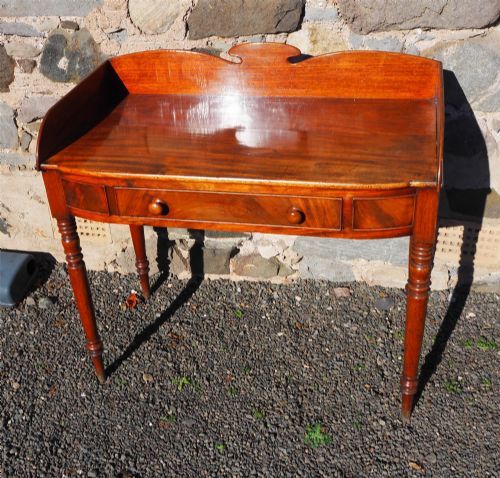
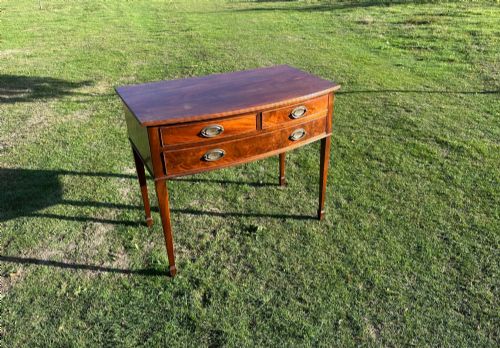
These curved front hall table pieces provide a graceful profile for narrow entrance spaces, combining rich timbers with distinctive front lines.
Curved Front Hall Table
A curved front hall table brings subtle movement and soft lines to an entrance space, avoiding the harsh geometry of straight edges. The pieces found here span multiple eras, including Georgian, Regency, and Victorian periods.
Most examples take the form of side tables, console tables, or compact sideboards, frequently featuring mahogany or walnut construction. These items range from simple 19th-century lamp tables to grand George III serving tables.
Makers often employed a bow front or serpentine curve to give the furniture depth and visual interest without claiming too much floor space. The selection encompasses revival styles such as Queen Anne, Chippendale, and Rococo alongside authentic older pieces.
Materials and construction methods
Cabinetmakers relied heavily on solid mahogany and burr walnut, selecting timber with pronounced grain patterns to accentuate the sweeping curves of the facade. Selected items incorporate contrasting brass hardware or marble tops to enhance the surface texture.
Shaping the timber required skilled joinery to bend or cut the wood accurately while maintaining structural integrity across the front apron and legs. Drawer boxes utilised traditional hand-cut joints to accommodate the curved configuration.
Curved Front Hall Table Retail Price Guide 2026
Typical asking prices for curved front hall table among the pieces listed under this phrase on Sellingantiques today, from the lower quarter to the upper quarter. They describe what is for sale here now, not the wider market.
Mahogany and walnut predominate among the woods, occasionally accompanied by marble surfaces and brass fittings.
Assessing quality in curved front furniture
Quality rests upon the fluency of the curve and the selection of timber veneers, where highly figured burr walnut or rich mahogany elevates the visual weight of the piece. Finer examples display harmonious proportions between the depth of the bow and the slenderness of the legs.
The integrity of the structural joints and the crispness of any applied carving dictate the standard of execution. Superior workshops maintained tighter tolerances around the curved drawer fronts and internal framing.
The Curved Front Hall Table Glossary
- Bowfront
- A convex curved front that projects outward in a smooth arc. This shape softens the profile of case pieces and tables.
- Serpentine
- A concave-convex-concave undulating front line. It adds considerable complexity to the joinery compared to a simple bow.
- Console table
- A table designed to stand against a wall, frequently supported by brackets or legs at the front. These pieces serve narrow circulation spaces effectively.
- Serving table
- A large side table used in dining rooms for food placement. They often date to the Georgian period and feature robust proportions.
- Burr walnut
- Wood taken from a tree growth or burl containing swirling grain patterns. It provides a highly decorative surface layer on finer tables.
Curved Front Hall Table: Frequently Asked Questions
How do I style a curved front hall table?
Position the piece flat against the hallway wall to let the curved projection draw the eye inward without obstructing movement. Keep the top surface uncluttered so the timber grain and form remain prominent.
Pair the table with a simple mirror or a single lamp to balance the visual weight of the front curve. Avoid overcrowding the edges to maintain the clean silhouette characteristic of these tables.
Were these tables used only in halls?
Historical room use was flexible, and tables with curved fronts served multiple functions across the home. Many operated as side tables in reception rooms, dressing tables in bedrooms, or serving tables in dining spaces.
Compact proportions made them adaptable for circulation areas where standard rectangular furniture protruded too far. Their current role as hall furniture reflects their enduring utility in narrow spaces.
How do I date a mahogany hall table?
Examine the colour, patina, and construction methods to establish an approximate period. Earlier Georgian examples display deep, warm patination and hand-finished timber surfaces.
Later Victorian and revival pieces often utilise machine-sawn components and denser finishes. Comparing the secondary timbers inside the drawers provides further clues regarding origin and age.