




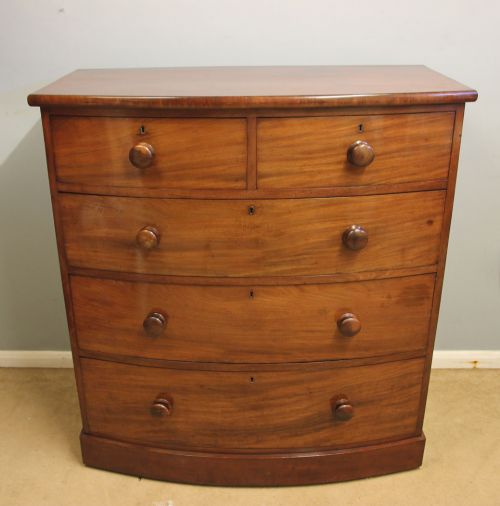


Curved Front Bureau
These curved front bureau and chest pieces combine sweeping timber profiles with deep storage, offering a practical centrepiece for any traditional room.
Curved Front Bureau
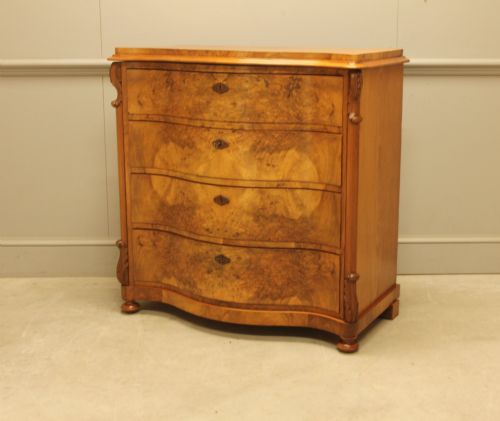
When searching for a curved front bureau, buyers encounter various forms of serpentine and bow front chests of drawers, desks, and bureau bookcases. These pieces originate across the eighteenth, nineteenth, and early twentieth centuries, spanning periods such as Georgian, Victorian, Regency, and Edwardian. Regional styles also appear, including French provincial and Swedish interpretations alongside standard English cabinetmaking.
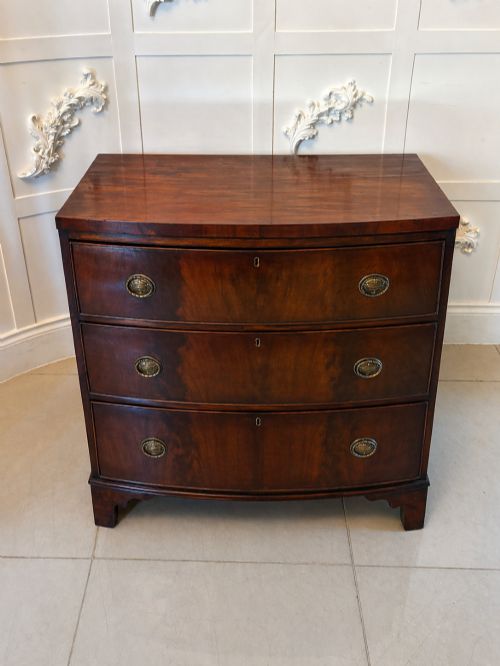
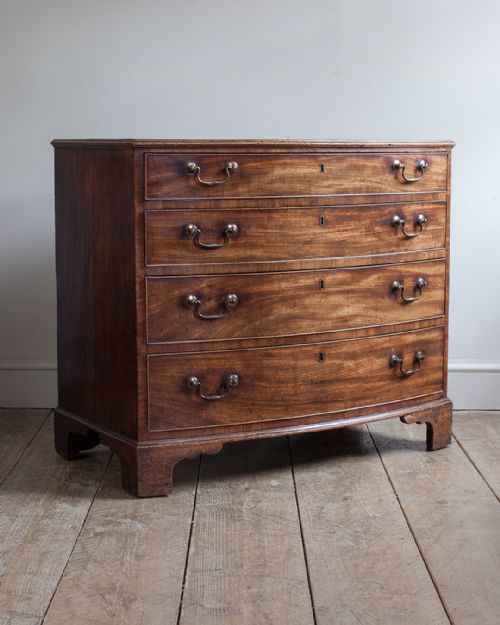
The primary forms on this page include mahogany and burr walnut bow front chests alongside serpentine chests of drawers and fitted desks. Cabinetmakers utilised graceful convex and concave curves to soften the mass of timber storage furniture. Such designs allowed these pieces to function effectively in bedrooms, studies, and drawing rooms alike.
How they were made
Cabinetmakers constructed these pieces primarily using solid timbers and figured veneers such as mahogany, walnut, burr walnut, satinwood, and oak. Mahogany and walnut provided stable framing, while flame and burr veneers created striking decorative grain patterns across drawer fronts and fall fronts. Secondary woods were selected for drawer linings and internal divisions.
Surface ornamentation involved brass handles, inlaid stringing, marquetry, and leather writing inserts. Skilled joiners shaped solid timber and curved veneers to follow the tight radiuses of bow and serpentine profiles. Hand-cut dovetails secured the drawer construction, while traditional polish finishes brought out the natural depth of the grain.
Curved Front Bureau Retail Price Guide 2026
Typical asking prices for curved front bureau among the pieces listed under this phrase on Sellingantiques today, from the lower quarter to the upper quarter. They describe what is for sale here now, not the wider market.
Listings feature mahogany, oak, walnut, burr walnut veneer, satinwood, brass, and leather across Georgian, Victorian, and Edwardian periods.
What varies in quality
The quality of a curved front piece rests upon the selection of timber and the precision of its curved joinery. Superior examples feature book-matched veneers and carefully figured mahogany or burr walnut that wrap harmoniously around the sweeping facade. Lesser pieces employ plain secondary timbers with less disciplined grain alignment across the drawer tiers.
Construction detail further separates standard production from finer cabinetwork. High-grade items display tightly fitted cockbeading, hand-cut dovetailing, and substantial original brass hardware. The fluidity of the serpentine or bow shape itself demonstrates the maker's mastery over timber distortion and tension.
The Curved Front Bureau Glossary
- Bow front
- A convex curved furniture front that projects outward in a smooth arc. This shape gained widespread popularity during the Georgian and Regency periods.
- Serpentine
- A furniture front characterised by a central convex curve flanked by two concave curves. It requires advanced woodworking skill to execute properly.
- Bureau bookcase
- A writing cabinet featuring a sloping fall-front desk compartment combined with upper shelving enclosed by doors. It provides both workspace and display storage.
- Escritoire
- A fine writing desk or cabinet designed for correspondence and paper storage. Many examples incorporate internal pigeonholes and small drawers.
- Cockbeading
- A small, rounded moulding applied to the edges of drawer openings. It conceals the joints and adds a refined decorative border.
Curved Front Bureau: Frequently Asked Questions
How do I clean a mahogany bureau?
Dust regularly with a soft, dry cloth to prevent particulate buildup on the timber surface.
Apply traditional beeswax periodically to nourish the polish and maintain a soft lustre without using silicone sprays.
Where should I place a bow front chest?
Position the piece against a flat wall where the projecting curve can be appreciated without blocking foot traffic.
Keep wooden furniture away from direct heat sources and strong sunlight to prevent the timber veneers from drying or splitting.
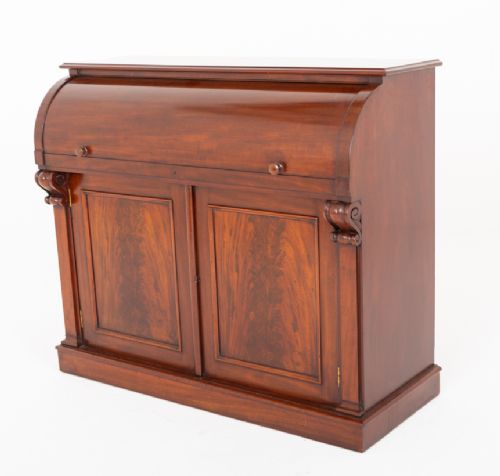
Can I use a cylinder desk for daily writing?
The curved rolling cylinder mechanism retracts to reveal a pull-out writing surface fitted with small drawers and pigeonholes.
Close the cylinder when writing tasks conclude to keep papers concealed and protect the leather insert from dust.