
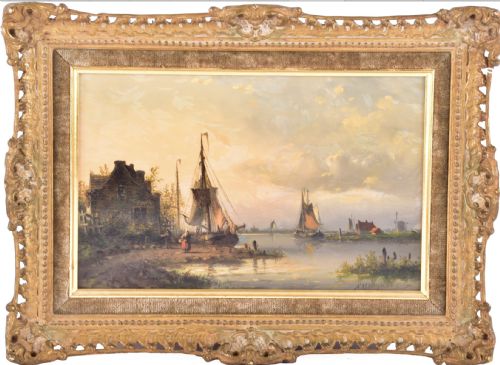


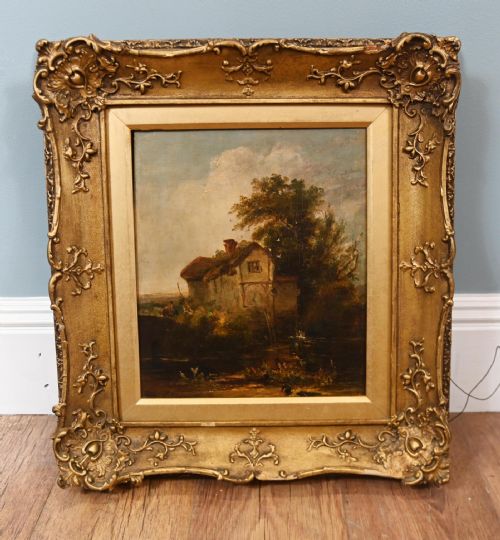


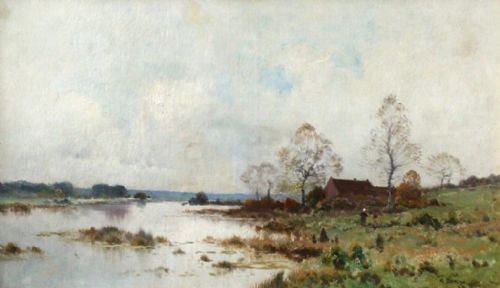


Cottage River Oil Painting
A cottage river oil painting captures rural tranquility along the water, offering a glimpse into pastoral domestic life from past centuries.
Cottage River Oil Painting
A cottage river oil painting depicts water landscapes alongside rural dwellings, ranging from quiet country streams to active riverbanks with boats. Buyers seeking a cottage river oil painting typically encounter nineteenth century Victorian works alongside early twentieth century interpretations and mid century impressionist pieces.
The subjects span British, Flemish, French, and Scandinavian schools, often recording specific regions like Surrey, Derbyshire, or the River Nidd. These framed artworks frequently include figures such as fishermen, boatmen, or families gathering firewood near thatched or rustic homes.
Materials and technique
Artists painted primarily with oil on canvas or wood panel, applying pigment to build texture and depth within the landscape. Canvases are frequently housed within period wooden frames, sometimes accented with gesso and gilt details.
Brushwork varies from the tight detail seen in Victorian landscapes to looser strokes characteristic of the Barbizon style and French impressionism. Pigments capture natural light at dusk, sunset, or midday across water and sky.
Fishermen, firewood collectors, and boatmen populate these riverbanks, eternally pausing by their cottages.
Quality and handling
Quality rests upon the artist's ability to render light, atmosphere, and spatial depth across the river and surrounding foliage. Finer examples display confident brushwork and balanced composition that anchor the cottage securely within the rural setting.
The preservation of the original oil paint surface and the suitability of the period frame influence the standing of a piece. Signed works by recognised painters carry distinct provenance compared to unsigned or school attributed canvases.
John Horace Hooper·Mario Pinetti·Abraham Hulk Junior·Pierre Emmanuel Eugene Damoye·Harry Pennell·Robert Gallon·Thomas Thomas·Stuart Lloyd·Walter Meegan·Henry Bright·Edward Charles Williams·Alfred Augustus Glendening·John Falconar Slater·Henry Cooper·Charles W Oswald·Victor Forssell·S Holt·Charles Greville Morris·Henry Maidment
The Cottage River Oil Painting Glossary
- Oil on Canvas
- Pigment mixed with drying oil applied to stretched fabric. This was the primary medium for landscape artists throughout the nineteenth and twentieth centuries.
- Giltwood
- Wood carved and covered with a thin layer of gold leaf or gilt. These frames often accompany Victorian and Edwardian paintings.
- Barbizon School
- A French movement focusing on realism in landscape painting, emphasising atmospheric effects and rural life. Artists in this tradition painted direct observations of nature.
- Gesso
- A paint mixture consisting of a binder mixed with chalk or gypsum. It was used to prepare wooden panels and build up ornate relief on picture frames.
- Impressionism
- A style characterised by relatively small, thin yet visible brush strokes and open composition. Mid century practitioners applied these principles to traditional river scenes.
Cottage River Oil Painting: Frequently Asked Questions
What periods do these paintings date from?
The works span from the eighteenth century through the nineteenth and twentieth centuries, encompassing Victorian, Edwardian, and mid-century eras.
Most surviving pieces originate in the Victorian period and the early decades of the twentieth century.
Where were these landscape scenes painted?
Artists painted scenes across Britain, France, Flanders, Denmark, and Sweden, recording local waterways and rural architecture.
Many canvases document specific named rivers and countryside locations in England and Scotland.
Who are the artists behind these works?
Pieces are created by named professional painters, regional artists, and wider European schools operating without individual attribution.
Signed works provide direct links to known nineteenth and twentieth century landscape painters.
How should I frame and display them?
These paintings are commonly displayed in their original wood, giltwood, or gesso frames which complement the period aesthetic.
Placement away from direct sunlight protects the oil paint surface and canvas integrity over time.