

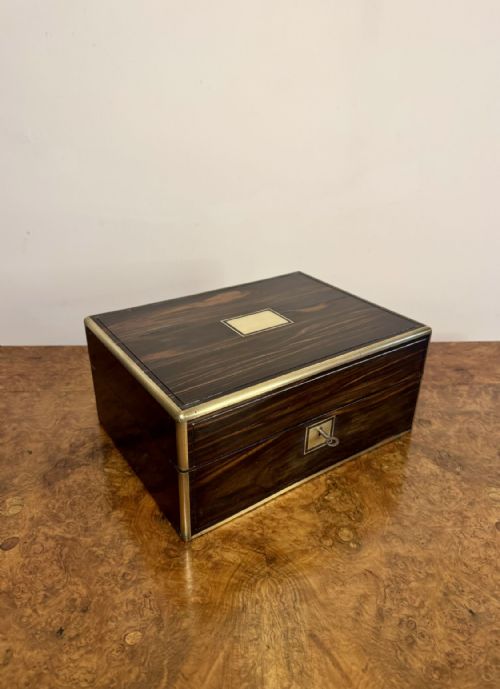


Coromandel Wood Chest
These coromandel wood chest examples are finely figured storage pieces that bring rich grain and polished brass to any table.
Coromandel Wood Chest
A coromandel wood chest on this page usually takes the form of a tea caddy, decanter box, or jewellery box designed for domestic storage. These items date predominantly from the Regency and Victorian periods, spanning the nineteenth century.
Makers shaped these boxes to hold tea, drinks, stationery, or trinkets, employing compact forms that suited the elegant interiors of their day. The selection ranges from plain rectangular caddies to dome top boxes and travelling vanity cases.
Victorian and Regency pieces dominate the current listings, often reflecting the revival styles popular in English craftsmanship during the eighteen-eighties and surrounding decades.
Materials and construction
The primary material is coromandel wood, chosen for its dense texture and dark, striated grain patterns. Cabinet makers paired this exotic timber with contrasting brass mounts and inlay.
Interiors often feature fitted compartments lined in velvet or glass, accompanied by cut crystal components in the decanter and drinks boxes. Mother-of-pearl details occasionally appear as decorative accents on the lids and escutcheons.
Coromandel Wood Chest Retail Price Guide 2026
Typical asking prices for coromandel wood chest among the pieces listed under this phrase on Sellingantiques today, from the lower quarter to the upper quarter. They describe what is for sale here now, not the wider market.
Some Victorian boxes include secret drawers that require pressing a hidden wooden spring to release.
Assessing quality
Quality rests on the depth of the timber's figuring and the precision of the brass binding fitted to the edges and corners. Superior examples display seamless integration between the dark wood and the metal mounts.
The sophistication of the internal layout distinguishes finer pieces, particularly where compartments remain intact and retain their original velvet or cut crystal fitments.
The Coromandel Wood Chest Glossary
- Coromandel
- A dense and heavily figured tropical hardwood prized for its dark brown colour and contrasting light streaks. It served as a luxury veneer throughout the nineteenth century.
- Tea Caddy
- A small box constructed to store loose tea leaves securely under lock and key. Victorian and Regency examples often feature internal foil-lined canisters.
- Decanter Box
- A specialised portable case built to house glass bottles or decanters safely during transit. They frequently include cut crystal vessels and velvet-lined partitions.
- Escutcheon
- A protective plate surrounding a keyhole, usually fashioned from brass to complement the exterior wood of the box.
Coromandel Wood Chest: Frequently Asked Questions
What were these boxes used for?
These boxes served practical domestic purposes such as storing expensive tea leaves, safeguarding jewellery, or transporting glass decanters. Their secure locks reflected the high value placed on these household goods.
Over time, they transitioned from utilitarian objects to decorative mantel and tabletop display pieces in period homes.
How do I date a coromandel box?
Dating relies on combining the stylistic clues of the period, such as Regency lines or Victorian Gothic Revival elements, with the construction techniques used inside. Brass mounts and lock mechanisms also offer reliable chronological markers.
Examining the secondary timbers and lining materials helps narrow the decade of manufacture between eighteen hundred and nineteen hundred.
How do I care for coromandel wood?
Keep the wood away from direct sunlight and sudden temperature shifts to prevent the dense grain from drying out or splitting. Gentle dusting with a dry microfibre cloth preserves the polished surface.
Avoid using heavy silicone polishes, as they build up on the vintage finish and dull the natural figure of the timber.
What is the difference between a tea caddy and a jewellery box?
Tea caddies generally feature internal lidded compartments designed to keep loose leaves separate and dry, sometimes with a central mixing bowl space. Jewellery boxes and vanity cases prioritize multi-tiered trays and velvet-lined sections for small trinkets.
Both forms utilise coromandel wood and brass hardware, but their internal architecture reflects their original contents.