

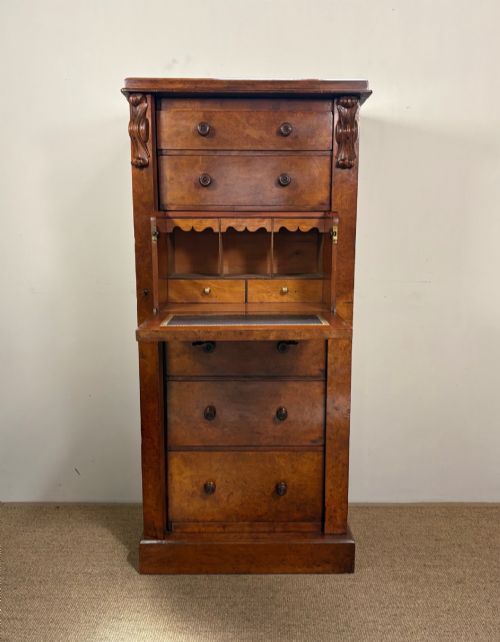


Compact Walnut Chest Drawers
These compact walnut chest drawers offer generous storage in a reduced footprint, combining rich timber figure with practical proportions for modern rooms.
Compact Walnut Chest Drawers
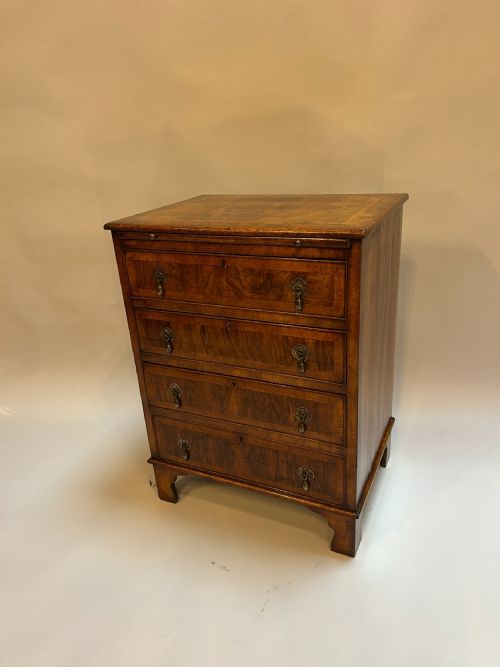
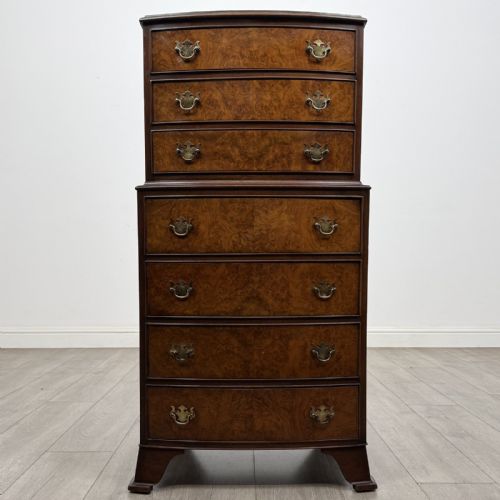
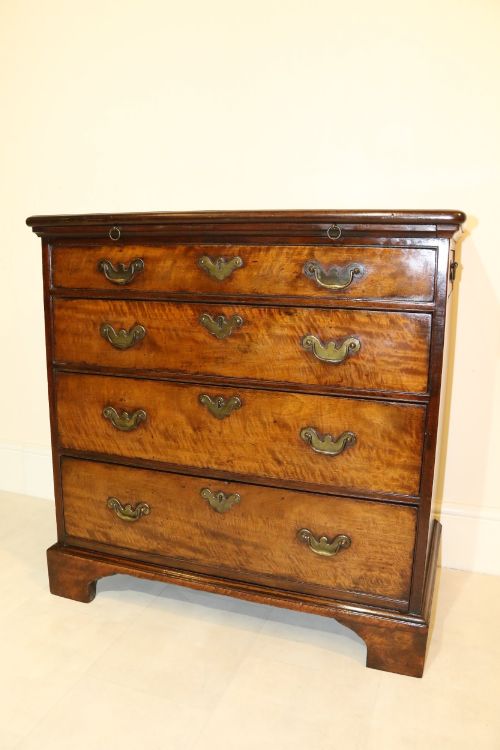
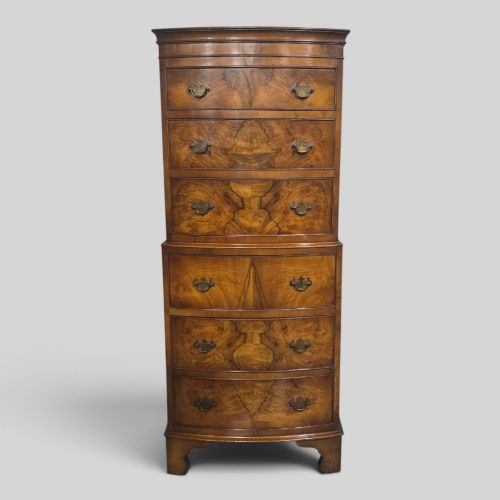
A compact walnut chest drawers provides efficient storage through scaled-down proportions, making it ideal for tight spaces without sacrificing surface area or character. These pieces range from early eighteenth-century bachelor desks and nineteenth-century Wellington chests to Edwardian and Art Deco small chests, bedside lockers, and tallboys.
The materials and styles seen on this page span solid walnut, burr walnut, oak, and brass hardware, styled across Georgian, Victorian, Queen Anne, and Art Deco periods. Buyers frequently encounter small serpentine chests, bow-fronted designs, and block-front forms that prioritise neat utility.
Each piece reflects the prevailing domestic requirements of its era, from eighteenth-century writing chests with folding tops to twentieth-century compactum wardrobes and tallboys designed for vertical storage.
Assessing quality in walnut furniture
Quality rests primarily in the selection and matching of the walnut veneer, where master cabinetmakers chose highly figured burr timber to create symmetrical patterns across the drawer fronts. The crispness of the mouldings, the dovetail construction of the drawers, and the retention of original brass hardware further distinguish superior examples.
Proportion and scale dictate the desirability of these pieces, with finer examples maintaining taut architectural lines and unwarped surfaces across serpentine, bow-front, or block-front configurations.
Compact Walnut Chest Drawers Retail Price Guide 2026
Typical asking prices for compact walnut chest drawers among the pieces listed under this phrase on Sellingantiques today, from the lower quarter to the upper quarter. They describe what is for sale here now, not the wider market.
Materials represented across these listings include solid walnut, burr walnut, oak, brass, and leather.
Gillows of Lancaster
The Compact Walnut Chest Drawers Glossary
- Burr walnut
- A veneer sliced from the knotty growth of a walnut tree, prized for its swirling, highly decorative grain patterns. It frequently appears on the drawer fronts of Edwardian and Art Deco pieces.
- Wellington chest
- A tall, narrow chest of drawers secured by a hinged locking side pilaster that fastens over the drawer edges. This form originates in the nineteenth century.
- Serpentine
- A curved front shape with a convex centre flanked by concave sides, or vice versa, requiring precise woodworking skill. It adds fluid movement to small chests of drawers.
- Block-front
- A rigid, three-section cabinet front where the outer sections project forward and the central section recedes. This style appears on Georgian and revival pieces.
- Compactum
- A large wardrobe or tallboy combining drawers, hanging space, and shelves within a single enclosed unit. Art Deco examples often pair walnut with coromandel.
- Bachelor chest
- A small chest of drawers featuring a fold-over top that creates a writing surface. These eighteenth-century pieces serve dual functions in compact spaces.
Compact Walnut Chest Drawers: Frequently Asked Questions
What is a compact walnut chest drawers?
A compact walnut chest drawers is a scaled-down storage unit made from walnut timber, designed to fit into smaller rooms while retaining traditional drawer storage.
These pieces include Edwardian small chests, Georgian style block-fronts, and Art Deco tallboys, all selected for their neat proportions and rich wood grain.
Where should I place a small chest?
These small chests function effectively as bedside tables, hallway storage, or secondary drawer units in bedrooms and studies where floor space is limited.
Their reduced depth allows them to sit comfortably in narrow passageways or beside low seating without obstructing movement through the room.
How do I care for walnut furniture?
Walnut furniture requires protection from direct sunlight and extreme humidity fluctuations to prevent the wood veneers from drying out or splitting.
Regular dusting with a dry, soft cloth preserves the polished surface, while occasional waxing maintains the moisture and lustre of the burr walnut grain.
How can I tell the period?
Dating relies on observing construction methods, hardware styles, and timber treatments that align with specific eras from the eighteenth century to the 1930s.
Early pieces show hand-cut dovetails and solid timber carcases, whereas Edwardian and Art Deco examples utilise specific veneer slicing techniques and distinct decorative hardware.