



Collectible Flintlock Gun
A collectible flintlock gun delivers the tactile weight of mechanised history, offering collectors a tangible connection to early modern firepower and craftsmanship.
Collectible Flintlock Gun
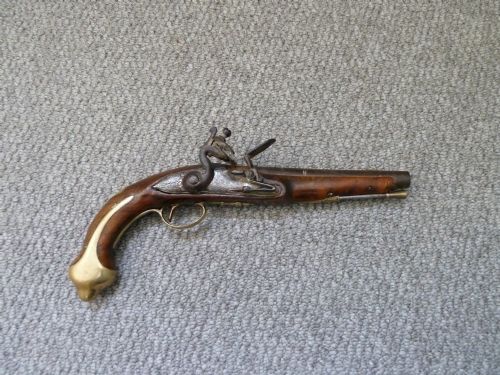
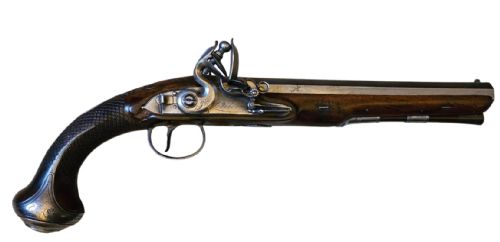
A collectible flintlock gun encompasses pocket pistols, military sidearms, blunderbusses, and long arms spanning the eighteenth and nineteenth centuries. These pieces represent a pivotal era in firearms evolution where the flintlock mechanism dominated personal defence and military combat.
The most common examples on this page are eighteenth-century pocket pistols and regulation military arms, often bearing the signatures of British and European makers. Pieces range from Georgian military issues to refined Queen Anne style arms featuring cannon barrels and silver wire inlay.
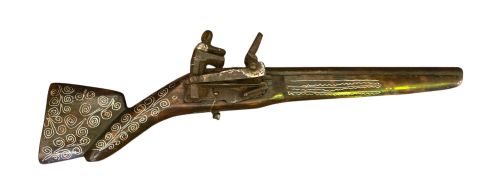
Regional variations appear across British, Belgian, Irish, and Ottoman origins, showcasing diverse mechanical adaptations like the snaphaunce mechanism. Collectors encounter both utilitarian service weapons and highly decorative civilian duelling pieces.
Materials and Construction
Construction relies upon traditional forging and woodworking techniques, pairing forged steel, iron, and brass mechanisms with dense stocks of walnut and other woods. Metal components underwent hand-filing and hardening, while wooden stocks were shaped to house the lockwork and barrel securely.
Finishing touches often included intricate silver wire inlay, engraved brass mounts, and cast silver furniture executed by skilled regional gunsmiths. Barrels range from smoothbore iron tubes to cannon-moulded brass forms, each fitted with a flintlock frizzen and cock.
Collectible Flintlock Gun Retail Price Guide 2026
Typical asking prices for collectible flintlock gun among the pieces listed under this phrase on Sellingantiques today, from the lower quarter to the upper quarter. They describe what is for sale here now, not the wider market.
Some pocket pistols feature turn-off barrels that unscrew entirely like the lid of a jar for loading.
Assessing Quality and Merit
Quality rests upon the crispness of the lock mechanism, the integrity of the wooden stock, and the presence of maker signatures or hallmarks. Superior examples retain original matching components and sharp, legible engraving on the lockplate.
The refinement of domestic civilian pistols diverges sharply from standard military issue pieces, with finer arms displaying meticulous silver wire work, figured walnut stocks, and superior overall balance.
Henry Nock·James Barber·Timothy Hughes·Meyer And Mortimer·Barber Of Newark
The Collectible Flintlock Gun Glossary
- Flintlock
- The ignition mechanism that uses a piece of flint held in a cock to strike a steel frizzen, creating sparks to ignite the priming powder.
- Frizzen
- The vertical steel plate struck by the flint to produce sparks and cover the priming pan.
- Canon barrel
- A barrel turned with mouldings resembling a cannon, frequently seen on eighteenth-century pocket pistols.
- Snaphaunce
- An early type of flintlock ignition using a separately moving steel and pan cover.
- Bore
- The interior hollow of the barrel, measured in historical gauge standards.
Collectible Flintlock Gun: Frequently Asked Questions
How do I identify an 18th-century flintlock?
Examination of the lockplate shape, barrel form, and maker signatures usually reveals the period of manufacture. Eighteenth-century pieces typically feature rounded lockplates and distinct brass or silver furniture styles.
Matching the proof marks and regional design traits against known maker records confirms the approximate date of production.
What is a Queen Anne pistol?
A Queen Anne pistol is a type of pocket firearm characterised by a breech formed in one piece with the trigger plate and a drop-in barrel. This design gained popularity during the early eighteenth century.
These pieces often feature cannon barrels and concealed trigger mechanisms housed within a distinct bag-shaped grip.
How were pocket flintlocks used?
Pocket flintlocks served as personal protection devices for civilians navigating unsafe roads or urban areas during the Georgian period. Their compact size allowed them to be easily carried in pockets or muffiers.
Owners relied on them for close-range self-defence before the advent of percussion cap systems.
How should I display a flintlock gun?
Displaying antique firearms requires a stable environment away from excess moisture and direct sunlight to protect the wooden stocks and steel surfaces. Wall-mounted racks or glass-fronted cabinets work well for secure presentation.
Maintaining a consistent indoor climate prevents the walnut wood from drying out and preserves the integrity of the metal components.